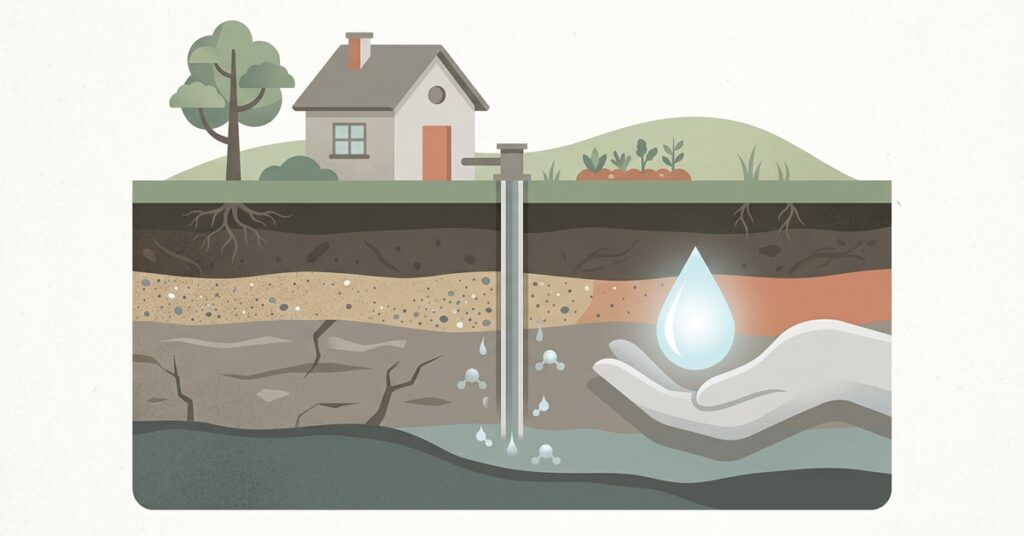
A homeowner outside Harlem got a notice from a neighbor’s community group about PFAS testing at a nearby public water system and wanted to know what her own results looked like. She does not have any. Her house is on a private well, which means no utility tests it, no annual report gets mailed to her, and no federal limit applies to what comes out of her tap. That gap is the most important thing to understand about PFAS in the CSRA, and it has nothing to do with how contaminated any particular water source is.
PFAS regulation has moved quickly and unevenly over the past two years. Some of what you may have read about it is already out of date. Here is where things actually stand, and what it means depending on where your water comes from.
What PFAS Are
PFAS stands for per- and polyfluoroalkyl substances, a family of thousands of synthetic chemicals used since the 1940s in products that need to resist water, grease, heat, or stains. Nonstick cookware, waterproof fabrics, food packaging, and firefighting foam are the common examples.
They are often called “forever chemicals” because the carbon-fluorine bond that makes them useful also makes them extremely slow to break down, both in the environment and in the human body. The EPA’s overview of PFAS covers the chemistry and the exposure pathways in more detail.
The concentrations involved are very small, which is part of why this topic is confusing. PFAS limits are written in parts per trillion (ppt), a unit that describes one part of a substance per trillion parts of water. For scale, most other drinking water contaminants are regulated in parts per billion or parts per million, which are a thousand and a million times larger.
Where the Federal Rule Stands Right Now
In April 2024, the EPA finalized the first national drinking water standards for PFAS. That rule set enforceable limits, called maximum contaminant levels or MCLs, for six PFAS categories:
- PFOA at 4.0 ppt
- PFOS at 4.0 ppt
- PFHxS at 10 ppt
- PFNA at 10 ppt
- HFPO-DA, commonly known as GenX, at 10 ppt
- A Hazard Index of 1 for mixtures containing two or more of PFHxS, PFNA, HFPO-DA, and PFBS
That was the picture in 2024. It has since changed. According to the EPA’s PFAS drinking water page, last updated May 18, 2026, the agency has proposed to rescind the drinking water regulations for PFHxS, PFNA, HFPO-DA, and the Hazard Index mixture, while keeping the PFOA and PFOS limits at 4.0 ppt. The same action would let water systems request two additional years, moving their compliance deadline from 2029 to 2031.
Two things are worth being precise about here.
First, a proposal is not a final rule. As of that May 2026 update the 2024 standards remained in effect unless and until the rescission is finalized. If you are reading this some months later, the status may have moved again, and the EPA page above is the authoritative place to check rather than a news summary.
Second, none of this changes the underlying science about the compounds themselves. A rescinded drinking water limit means the federal government is not requiring utilities to treat for that compound. It does not mean the compound was reclassified as harmless.
The Compliance Timeline, and Why 2027 Matters to You
Under the 2024 rule, public water systems have until 2027 to complete initial monitoring, and until 2029 to install treatment where results exceed the limits. That second date is the one that may extend to 2031.
The practical consequence is that a lot of PFAS data does not exist yet. If you looked up your utility’s report a year ago and saw nothing about PFAS, that may have meant the system had not yet monitored, not that it monitored and found nothing. Those are very different conclusions, and it is worth going back to look again as monitoring results come in.
Your utility publishes an annual Consumer Confidence Report, or CCR, that summarizes what it tested for and what it found. Water systems serving Augusta, Evans, Grovetown, North Augusta, and Aiken all produce one, and it is the correct starting point if you are on public water.
If You Are on a Private Well, None of This Applies to You
This is the part that gets missed, and in the CSRA it affects a lot of households.
The EPA is direct about it: the quality and safety of drinking water from private domestic wells are not regulated by the federal government under the Safe Drinking Water Act, and private well owners are responsible for delivering safe drinking water to their own households. Around 15 percent of the U.S. population, more than 43 million people, rely on private wells.
Every part of the framework above assumes a utility. The monitoring deadlines, the enforceable limits, the treatment requirements, and the annual report all attach to public water systems. A private well has no monitoring deadline, no enforceable limit, and no report. Nobody is going to tell you what is in it.
Rural and semi-rural properties across Columbia, McDuffie, Burke, and Aiken counties run on private wells in large numbers. Those are exactly the properties where a PFAS question has no institutional answer.
What Makes a Well Worth Testing
PFAS do not occur naturally. They come from somewhere, which means proximity to a source matters more than general worry:
Firefighting foam use. Aqueous film-forming foam, used historically at airports, military installations, and fire training facilities, is one of the most significant documented sources of groundwater PFAS.
Industrial and manufacturing operations. Textile finishing, metal plating, paper coating, and chemical manufacturing have all used PFAS in processes.
Landfills and land application sites. PFAS in consumer products end up in landfills, and leachate can reach groundwater. Land application of treated sewage sludge, called biosolids, is another documented pathway.
Wastewater treatment plant discharge upstream of a shallow well. Conventional treatment does not remove PFAS.
A well in a subdivision several miles from anything on that list is a lower priority than a well downgradient of an active or former industrial site. Testing is not free, and matching it to actual site conditions is a more useful approach than testing on a hunch.
What Testing Involves
PFAS analysis is not part of a standard well water panel. A typical homeowner well test covers bacteria, nitrates, pH, hardness, and sometimes metals. PFAS require a separate method, run by a laboratory accredited for it, and the sampling is unusually demanding.
Because the target concentrations are so low, cross-contamination during collection can invalidate a sample. Many common items are themselves PFAS sources: some sample containers, certain tapes and sealants, waterproof field notebooks, and even some personal care products worn by the person collecting the sample. Proper collection means following the laboratory’s protocol on containers, gloves, and handling precisely rather than approximately.
If results come back elevated, the treatment options with the best evidence behind them at the household scale are granular activated carbon, ion exchange resin, and reverse osmosis. Each has different performance across different PFAS compounds and different maintenance requirements, so the specific results should drive the choice.
What to Do
-
If you are on public water, pull your utility’s most recent Consumer Confidence Report and look specifically for PFAS results. If the report predates the system’s monitoring, check again rather than assuming the absence of data means the absence of a problem.
-
If you are on a private well, understand that testing is your responsibility and nobody else’s. Start with the standard panel if you have not tested recently. Add PFAS analysis if your property sits near any of the source categories above.
-
Do not buy treatment equipment before you have results. PFAS filters are marketed aggressively, and the right technology depends on which compounds are present and at what concentration. Testing first is cheaper than guessing.
If you are on a well and want to talk through whether PFAS testing makes sense for your property, or you want a standard water panel run first, the EnviroPro 360 team is glad to help you think it through. Reach out here any time.