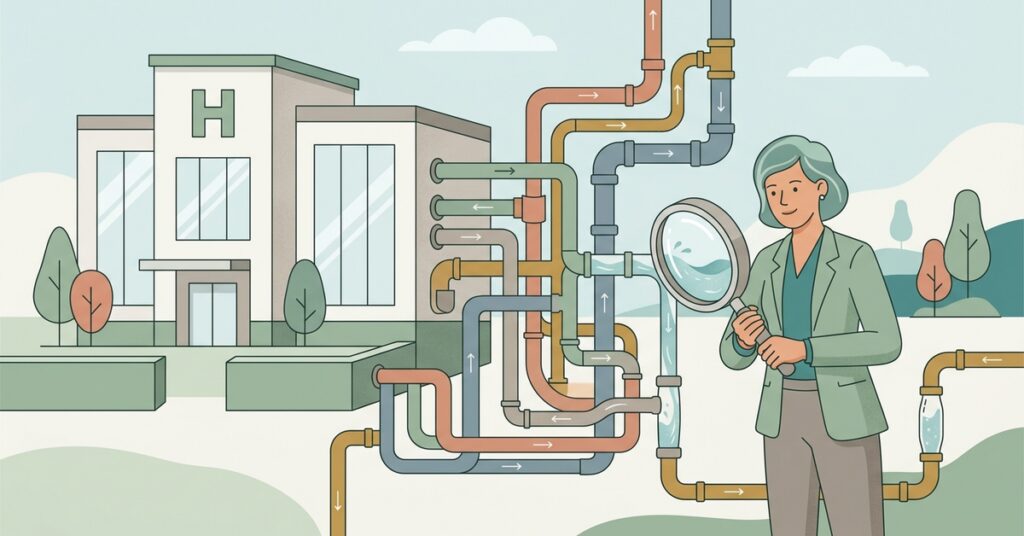
A family in North Augusta finished a guest suite over their garage so a grandmother with COPD (chronic obstructive pulmonary disease, a long-term lung condition) could move in. The suite had its own bathroom at the far end of a long hot water run, and for the eight months of construction and furnishing, that shower was used maybe twice. The water heater was set to 120 degrees, which is the standard recommendation for preventing scald injuries. Every individual decision in that sequence was reasonable. Together they described a nearly ideal set of conditions for Legionella growth, in a house nobody would think to test.
Legionella gets discussed almost entirely as a hospital and cooling tower problem, and there are good reasons for that. The consequences concentrate in facilities full of vulnerable people. But Legionella is fundamentally a plumbing bacteria, and houses have plumbing.
What Legionella Actually Is
Legionella is a genus of bacteria found naturally in fresh water, usually at concentrations too low to make anyone sick. It becomes a problem when it enters a building water system and finds conditions that let it multiply.
Inhaling it in aerosolized form, meaning water broken into a fine mist small enough to breathe, can cause two illnesses. Legionnaires’ disease is a serious form of pneumonia. Pontiac fever is a milder flu-like illness. Neither spreads from person to person, and drinking contaminated water is not the usual route of exposure. Breathing it in is.
Georgia’s Department of Public Health notes that legionellosis case reports have increased in Georgia over the past several years, that between 8,000 and 18,000 people are hospitalized with Legionnaires’ disease in the United States annually, and that actual illness numbers are likely higher because the disease is underdiagnosed. It is a reportable condition in Georgia, with cases required to be reported to DPH within seven days. The same page names hot water tanks and plumbing systems directly alongside the more familiar cooling towers and whirlpool spas.
That underdiagnosis point matters more than it sounds. Legionnaires’ disease presents as pneumonia, and pneumonia in an older adult usually gets treated as pneumonia without anyone asking where it came from. The specific urine antigen or culture testing that identifies Legionella has to be ordered deliberately.
The Four Conditions That Create Risk
Legionella needs a specific combination of circumstances. Any one of them alone is not a problem. Together they are.
Water in the Growth Temperature Range
OSHA identifies the ideal temperature range for Legionella growth as 68 to 122 degrees Fahrenheit. That range is wide, and it covers a lot of ordinary residential plumbing.
It covers a water heater set conservatively. It covers hot water that has cooled while sitting in a long pipe run. It also covers cold water lines in an Augusta summer, where supply water arriving at 75 or 80 degrees and sitting in an uninsulated attic or crawl space line is squarely inside the growth window. The CSRA’s long humid summers keep unconditioned spaces warm for months at a stretch, and the pipes running through them are not exempt.
Stagnation
Moving water is significantly less hospitable than standing water. OSHA specifically flags “dead legs,” meaning sections of pipe that were capped or altered so water no longer flows through them, and non-recirculated hot water lines where water sits between uses.
In a house, stagnation looks like a guest bathroom used four times a year, a basement utility sink nobody touches, an outdoor shower in the off season, a whole-house filtration system with low throughput, or an entire home closed up while its owners spend two months elsewhere.
Biofilm and Scale
Biofilm is a thin bacterial layer that forms on the inside surfaces of pipes, tanks, and fixtures. It shelters Legionella from disinfectant residual and gives it organic material to feed on. Sediment and scale in the bottom of a water heater do the same thing. An older water heater that has never been drained is a more favorable environment than a new one, independent of temperature.
Something That Makes Mist
Legionella in a pipe is not an exposure. Legionella aerosolized into breathable droplets is. In a home, the aerosol generators are showers first and foremost, then faucet aerators, humidifiers, hot tubs, decorative fountains, and misting systems.
The Temperature Tradeoff Nobody Explains Well
Here is where residential guidance gets genuinely contradictory, and it is worth understanding rather than guessing at.
The standard consumer recommendation is to set a water heater to 120 degrees Fahrenheit. That number exists to prevent scald injuries, particularly to young children and older adults with slower reaction times, and it saves energy as a secondary benefit. It is good advice on its own terms.
The Legionella control guidance points the other direction. OSHA’s control and prevention guidance describes storing domestic hot water at a minimum of 140 degrees Fahrenheit and delivering it at a minimum of 122 degrees Fahrenheit to all outlets. For remediating a system, it describes raising the heater to at least 158 degrees for 24 hours and then flushing each outlet for 20 minutes.
Those two recommendations are in direct conflict at the water heater, and 120 degrees is inside the growth range OSHA identifies.
The resolution is not to pick one. It is a thermostatic mixing valve, a device installed at the water heater that lets the tank store water hot enough to suppress bacterial growth while tempering the water delivered to fixtures down to a safe temperature. It addresses both problems instead of trading one for the other. Any licensed plumber can install one, and it is a routine job.
When Residential Testing Actually Makes Sense
Most homes do not need Legionella testing, and there is no value in testing every house. The situations where it earns its cost are specific:
- An immunocompromised or high-risk person is moving in. Georgia DPH identifies the most vulnerable as people 50 or older, current or former smokers, those with chronic lung disease, and those with compromised immune systems. Someone on immunosuppressive therapy or in active cancer treatment moving into a household is a reasonable trigger.
- The house sat vacant or barely used. An extended vacancy, a renovation, a seasonal property, or a home that sat unsold for months all mean months of stagnation.
- A household member was diagnosed with Legionnaires’ disease. Public health will investigate probable sources, and the home water system is one of them.
- There is a hot tub, spa, or decorative water feature. These combine warm water with aggressive aerosolization, which is the highest-risk pairing in a residential setting.
- The system was recently modified. Abandoned pipe runs left in place during a remodel are exactly the dead legs OSHA describes.
What Testing Involves
Sampling matters as much as the lab work. A first-draw sample, collected before any water is run, captures what has been sitting in the pipe and at the fixture. A flushed sample, collected after running the line, reflects what is coming from the larger system. The two answer different questions, and collecting only one can miss a localized fixture problem or a system-wide one.
Samples are typically pulled from the water heater outlet, the fixtures farthest from the heater, and any aerosol-generating equipment. Results come back in CFU per liter (colony-forming units per liter, a count of viable bacteria in a water volume). Culture methods take a week or more but distinguish live bacteria and identify the species. PCR methods return results faster but detect genetic material from bacteria whether living or dead, which makes them useful for screening and less useful for confirming an active problem.
What to Do
-
If anyone in your household is in a higher-risk group, find out what temperature your water heater is actually set to. Not what you assume, and not what the installer left it at years ago. If it is at or near 120 degrees, ask a plumber about adding a thermostatic mixing valve so the tank can run hotter safely.
-
Flush the fixtures nobody uses. Run every seldom-used shower and faucet, hot and cold, for several minutes on a regular schedule. This costs nothing and directly addresses stagnation, which is the condition you have the most control over. Clean or replace showerheads and faucet aerators while you are at it.
-
Test when there is a specific reason to, not on a schedule. A vacancy, a diagnosis, a high-risk household member, or a spa installation are reasons. General worry is not, and a negative result on a healthy household changes nothing about how you should be maintaining the system.
If you have a high-risk family member, a home that sat empty, or a water feature you are unsure about, the EnviroPro 360 team can talk through whether testing makes sense for your situation and what it would involve. Reach out here any time.