Here’s an example scenario: in 2023, a hospital in the southeastern United States identified Legionella pneumophila in its domestic hot water system during routine testing. The facility had a water management program in place, detected the contamination early, implemented corrective actions, and avoided a single patient case. Two years earlier, a different facility without a water management program discovered its Legionella problem only after three patients developed Legionnaires’ disease, a severe form of pneumonia caused by inhaling water droplets contaminated with Legionella bacteria. One patient died.
The difference between those two outcomes was a water management program. Since 2017, the Centers for Medicare & Medicaid Services (CMS) has required healthcare facilities to have one. If you administer a hospital, long-term care facility, or any healthcare operation that participates in Medicare or Medicaid, this applies to you.
What Legionella Is and Why Healthcare Facilities Are Vulnerable
Legionella is a genus of bacteria that occurs naturally in freshwater environments. It becomes a health concern when it colonizes building water systems and multiplies to dangerous concentrations. People become infected by inhaling small droplets of water (aerosols) that contain the bacteria. Legionnaires’ disease is not contagious and cannot spread from person to person.
Healthcare facilities face elevated risk for several reasons:
Vulnerable populations. Hospital patients, nursing home residents, and long-term care populations often have weakened immune systems, chronic lung disease, or other conditions that make them significantly more susceptible to Legionella infection. The CDC reports that one in four Legionnaires’ disease cases are healthcare-associated, and the case fatality rate in healthcare settings can reach 25%.
Complex water systems. Hospitals and large care facilities have extensive plumbing networks with long pipe runs, multiple temperature zones, dead legs (sections of pipe with little or no flow), storage tanks, and specialized equipment like hydrotherapy pools, decorative fountains, and humidifiers. Each of these creates conditions where Legionella can grow.
Warm water temperatures. Legionella thrives between 77°F and 113°F (25°C to 45°C). Building water systems that maintain temperatures in this range, particularly domestic hot water systems with insufficient temperature at the point of use, provide ideal growth conditions.
The CMS Requirement
In June 2017, CMS issued a Survey & Certification memorandum (S&C 17-30) requiring all Medicare-certified healthcare facilities to have a water management program that reduces the risk of Legionella and other waterborne pathogens.
This is not a recommendation. It is a condition of participation. During CMS surveys, inspectors evaluate whether your facility has a compliant program, whether it is being actively implemented, and whether documentation supports that implementation. Facilities found out of compliance receive deficiency citations, which can escalate to conditions of immediate jeopardy, monetary penalties, or loss of Medicare certification.
The CMS requirement references two key guidance documents:
ASHRAE Standard 188 (Legionellosis: Risk Management for Building Water Systems), published by the American Society of Heating, Refrigerating and Air-Conditioning Engineers. This standard provides the framework for developing a water management program.
The CDC’s toolkit, Developing a Water Management Program to Reduce Legionella Growth and Spread in Buildings, which provides a practical, step-by-step guide to implementing ASHRAE 188.
What a Compliant Program Includes
A water management program is not a binder on a shelf. It is an active, ongoing system with the following components:
Water Management Team
A designated multidisciplinary team responsible for the program. This typically includes facilities management, infection prevention, administration, and any outside consultants. The team must have defined roles and authority to make decisions about water system management.
Building Water System Assessment
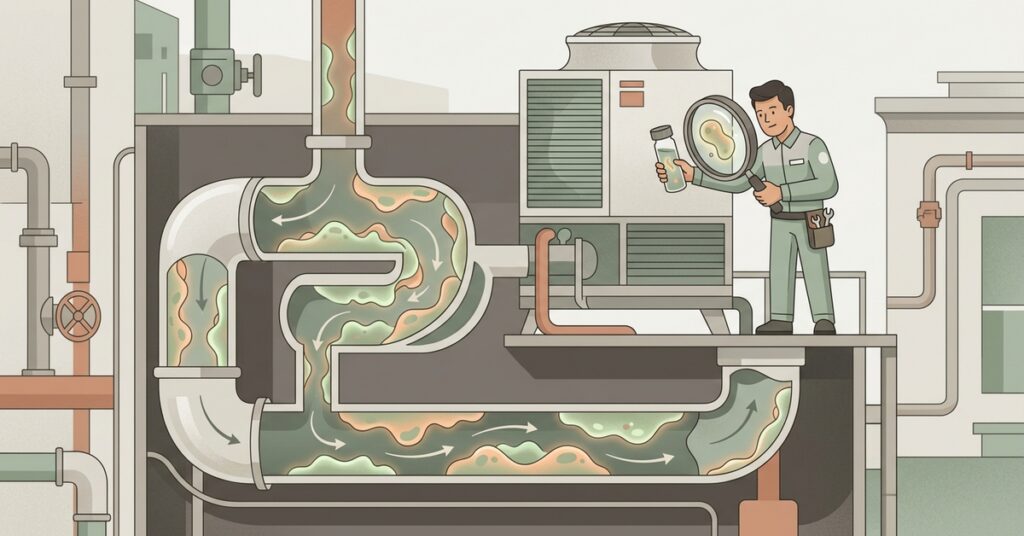
A comprehensive survey of your facility’s water systems, identifying all points where Legionella growth or transmission could occur. This includes domestic hot and cold water systems, cooling towers, decorative water features, ice machines, hydrotherapy equipment, and any other devices that generate aerosols from building water.
Control Measures
Specific actions to limit Legionella growth at each identified risk point. Common control measures include:
- Maintaining hot water storage above 140°F (60°C) and delivery above 122°F (50°C) at the point of use
- Maintaining cold water below 68°F (20°C)
- Flushing low-use outlets on a defined schedule to prevent water stagnation
- Treating cooling tower water with biocides and maintaining proper chemistry
- Managing dead legs by removing abandoned pipe sections or implementing flushing protocols
Monitoring
Regular measurement and documentation of control parameters. This includes temperature monitoring at representative points throughout the system, residual disinfectant levels, cooling tower chemistry, and visual inspections for biofilm (the slimy bacterial layer that forms inside pipes and fixtures where Legionella colonizes).
Environmental Testing
Periodic water sampling and laboratory analysis for Legionella. Testing frequency depends on your facility’s risk profile, but many programs include baseline testing, routine monitoring, and triggered testing in response to system changes or patient cases.
Samples are typically analyzed using culture methods that report results in colony-forming units per liter (CFU/L). Your water management program should define action levels: the Legionella concentration that triggers corrective action such as thermal disinfection (superheating the system), hyperchlorination, or point-of-use filtration.
Corrective Actions and Response Plan
Documented procedures for what happens when monitoring reveals a problem. This includes both routine corrective actions (a temperature out of range at a specific tap) and emergency response procedures (a positive Legionella culture at elevated concentrations or a suspected healthcare-associated case).
Documentation
Everything must be documented. Meeting minutes, monitoring results, corrective actions, system modifications, and test results all form the record that CMS surveyors will review. Good documentation demonstrates active management. Gaps in documentation suggest gaps in implementation.
Common Mistakes
Writing a program but not implementing it. CMS surveyors look for evidence of active implementation: recent monitoring records, completed corrective actions, meeting notes. A program document without supporting evidence of implementation will not satisfy surveyors.
Monitoring only cooling towers. While cooling towers are a significant risk, domestic hot water systems are the most common source of healthcare-associated Legionnaires’ disease. Your program must address all building water systems.
Relying solely on temperature monitoring. Temperature control is important but not sufficient. Legionella can survive in biofilm even when water temperatures are outside the growth range. Environmental testing provides direct evidence of whether Legionella is present.
What to Do Now
-
If you don’t have a water management program, this is urgent. CMS expects one in place at every Medicare-certified facility. Start with the CDC toolkit, assemble your team, and begin the building assessment.
-
If you have a program on paper, verify it’s being actively implemented. Check that monitoring is current, corrective actions are being completed, and documentation is up to date. A surveyor could walk in at any time.
-
If you haven’t done environmental testing, baseline Legionella testing of your water systems tells you what you’re working with and establishes whether your control measures are effective.
If your facility needs help with Legionella testing, water system assessment, or getting a water management program started, the EnviroPro 360 team works with healthcare facilities across the CSRA. Reach out here and we’ll help you get your program on solid ground.