A Martinez homeowner began scraping the popcorn ceiling in a 1974 ranch house — a straightforward weekend project. The dust settled across every surface in the room before anyone stopped to consider whether the material might contain asbestos. It did. What should have been a two-day job turned into a professional decontamination project that cost more than the original renovation budget.
That scenario is common in the CSRA, where a large share of the housing stock dates from the 1950s through the late 1970s. You cannot confirm whether a material contains asbestos just by looking at it — only laboratory analysis can do that. But you can make a meaningful visual assessment of your home before calling an inspector: identifying which areas are higher priority, recognising condition warning signs that require urgent attention, and reading the renovation history clues that tell you whether prior work may have already disturbed something.
This post covers that assessment process. For a detailed reference guide to which materials contain asbestos and where to find them, see our post on identifying common asbestos sources in homes. For the homeowner’s guide to testing and what to do with results, see our post on how to safely test for asbestos at home.
The key date is 1980, not 1990
Post titles and general advice often use 1980 or 1990 interchangeably as the cutoff for asbestos concern. The accurate picture is more specific:
- The EPA banned spray-applied asbestos surfacing materials in 1973 and most other spray applications by 1978
- The Consumer Product Safety Commission banned asbestos in patching compounds in 1977
- New pipe insulation installations using asbestos were effectively restricted by the mid-1970s
- Most asbestos-containing building products were phased out of production by 1980, though manufacturers could use existing inventory into the early 1980s
The practical guidance: homes built before 1980 carry the highest likelihood of asbestos-containing materials. Homes built between 1980 and 1986 should be assessed on a material-by-material basis — some products from this period came from pre-restriction stock. Homes built after 1986 face much lower risk, and homes built after 1990 carry minimal risk for most standard building materials.
The renovation history of the home matters as much as the original construction date. A 1960s home that was substantially renovated in 1995 using modern materials may have less asbestos exposure risk in renovated areas than its construction date suggests. Conversely, a 1985 home where original materials were never touched may still have asbestos-containing products installed from late-production stock.
Assessing risk by condition, not just by age
Age tells you whether asbestos-containing materials might be present. Condition tells you how urgently they need attention. The two most important condition factors are friability and disturbance history.
Friability: the difference between low-risk and urgent
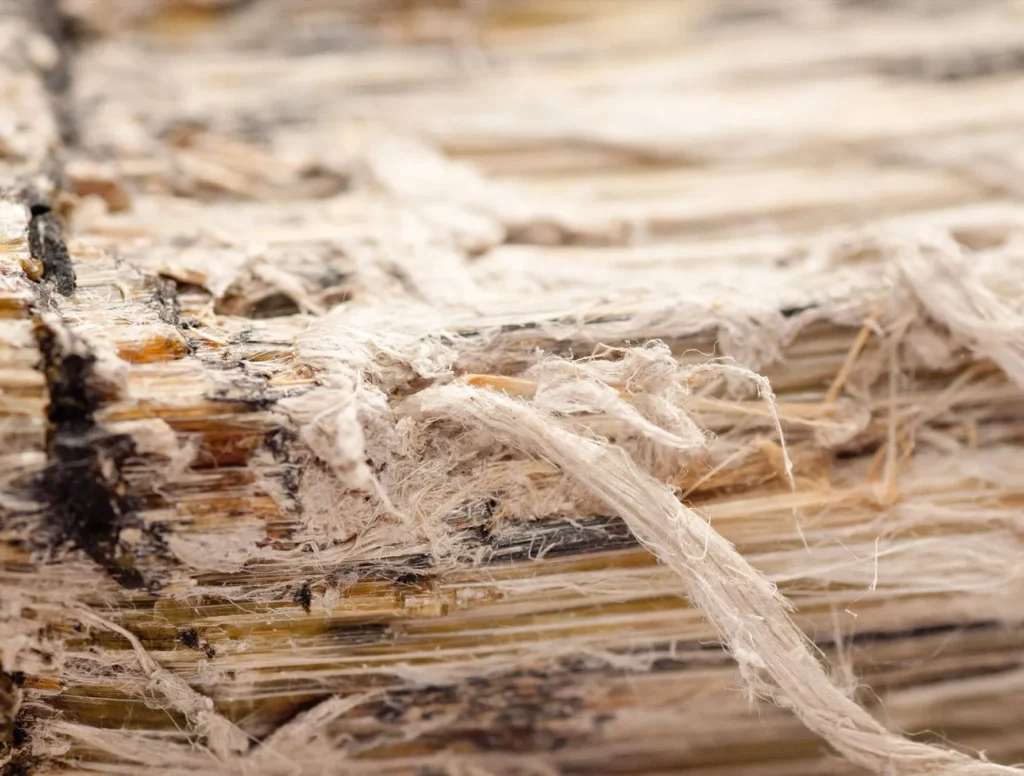
Friable materials are those that can be crumbled, pulverized, or reduced to powder by hand pressure. Friable asbestos-containing materials release fibers when disturbed even lightly — including by normal maintenance activities, foot traffic, or HVAC airflow across deteriorating surfaces. Non-friable materials, by contrast, require significant mechanical force — cutting, grinding, sawing — to release fibers.
When assessing your home, note any materials that appear to be:
- Soft, chalky, or powder-like on the surface
- Crumbling at edges or corners without being touched
- Flaking or shedding visible particles
- Visibly damaged with exposed inner layers or fibrous material showing
- Wet or water-damaged — moisture accelerates deterioration and increases friability
These are the priority materials for testing and management regardless of what they are. A deteriorating pipe wrap in a crawl space is a higher-priority concern than an intact popcorn ceiling in an unused bedroom, even if both may contain asbestos.
Access and disturbance risk
Even intact asbestos-containing materials become higher-risk when they are in locations where they are routinely disturbed. Assess each suspected material in the context of how it is used:
- A popcorn ceiling in a room used daily, where furniture is regularly moved against the walls, faces more incidental disturbance than a ceiling in a sealed utility room
- Floor tile under heavy furniture that has never moved is lower-risk than tile in a high-traffic hallway that has been repeatedly cleaned and scoured
- Pipe insulation in a finished basement that is accessed only for annual maintenance differs from insulation in an actively used workshop where vibration and physical contact occur regularly
A room-by-room visual assessment checklist
Work through your home systematically before scheduling an inspection. The goal is not to confirm asbestos — only a lab can do that — but to document what you observe, prioritise which areas need testing first, and give the inspector a complete picture of your home’s condition when they arrive.
Attic
Look for loose fill insulation that appears as small silver-gray or tan pebbles — this is the profile of vermiculite, which carries a high probability of asbestos contamination from the Libby, Montana mine. Do not enter or disturb the attic if vermiculite is present. Also check for pipe penetrations through the attic floor with any fibrous or chalky wrap material around them.
Urgency level: Vermiculite present = high priority for testing before any attic work. Fiberglass batts or blown cellulose = lower risk, standard pre-renovation check.
Ceilings
Examine all textured ceiling surfaces. Popcorn or cottage-cheese texture installed before 1980 has a meaningful probability of containing asbestos. Run your eye across the surface looking for areas where texture is flaking, crumbling at light fixtures or ceiling fans, or where prior repairs created inconsistent texture patches. Any areas showing active deterioration are higher priority than intact sections.
Also check drop ceiling tiles in basements and finished lower levels. Glue-up 12-inch square tiles from this era — particularly those with a mineral wool or fibrous appearance — are a sampling candidate.
Urgency level: Deteriorating texture or damaged tiles = test before any overhead work. Intact, undisturbed texture = test before any renovation affecting that ceiling.
Floors
Identify any 9-inch by 9-inch floor tiles — this size is the strongest visual indicator of potential asbestos content, as it was the dominant residential tile size from the 1950s through the late 1960s. Also assess 12-inch tiles from the same era. Look for:
- Tiles that are cracked, crumbling, or have sections that have lifted or broken off
- Black adhesive residue visible at tile edges or where tiles have already been removed
- Sheet vinyl with visible backing material at cut edges or lifted seams — the backing layer is a separate sampling candidate from the surface material
If any tiles have already been removed by prior owners and you can see the black mastic layer beneath, do not attempt to scrape or sand it before it is tested.
Urgency level: Cracked or crumbling tiles with exposed edges = test promptly. Intact tiles not being disturbed = test before any flooring work.
Basement and crawl space
This is often the highest-priority area in pre-1980 homes. Look for:
- Any insulating material wrapped around pipes — white or gray corrugated wrap, cloth-wrapped sections, or chalky molded sections around pipe elbows. These are high-probability asbestos-containing materials, and any that are deteriorating, crumbling, or showing exposed fibrous material need attention before any work in that area.
- Duct wrap on older HVAC distribution ductwork — gray or white fibrous blanket material
- Boiler or furnace insulation — gray or white blanket or board material around the unit body or combustion components
Urgency level: Deteriorating pipe wrap or duct insulation showing exposed fibrous material = high priority, test before any mechanical work regardless of renovation plans. Intact wrap = test before any plumbing or HVAC work.
Walls
Joint compound and drywall tape mud are harder to assess visually because they are hidden under paint. However, look for:
- Any drywall seams where prior patching repairs have created a different surface texture — this may indicate joint compound work done before mid-1980s restrictions
- Wall surfaces that have a slightly gritty or sandy texture under paint — this may indicate textured wall coating applied before restrictions
- Exterior cement siding panels (flat or corrugated sheet material, often gray) — pre-1980 cement board siding has a different appearance from modern fiber cement and is a sampling candidate
Urgency level: Intact wall surfaces not being disturbed = low urgency. Any wall demolition or patching in a pre-1980 home = test joint compound before sanding.
Mechanical room and utility areas
Check furnace and boiler units for any insulating material on or around the unit body, especially on older oil or coal-burning systems. Look at the connections between the unit and ductwork or piping for any tape, wrap, or mudded fittings that appear fibrous or chalky.
Urgency level: Any deteriorating insulation on or around the furnace/boiler = test before heating season maintenance. Intact insulation = test before any mechanical replacement or repair work.
Reading renovation history red flags
A home’s renovation history can tell you as much about asbestos risk as its construction date. Look for evidence of prior work that may have disturbed asbestos-containing materials without testing:
- Patched or inconsistent ceiling texture. Sections of popcorn ceiling that look different from the rest — smoother, differently coloured, or with a clear boundary — indicate that prior scraping or patching occurred. The patched areas may have been repaired with non-asbestos compound over an asbestos base layer, but the surrounding original texture remains a testing candidate.
- Missing or replacement floor tile sections. If some tiles in a room are newer than others, a prior owner removed original tiles — potentially without testing. The remaining original tiles and any remaining mastic adhesive should be tested.
- Exposed black adhesive on concrete floors. If tiles were removed and only the mastic remains, that mastic is likely the highest-risk surface in the room and should be tested before any grinding or additional removal work.
- Pipe insulation that has been cut, taped, or partially replaced. Sections of new fibreglass insulation spliced into older pipe wrap indicate that prior repair work disturbed the original insulation. The remaining original material should be sampled.
- Evidence of water damage near suspect materials. Water staining on or near asbestos-candidate materials — around pipe insulation, below textured ceilings, at floor tile edges — indicates prior moisture exposure that may have accelerated deterioration and increased friability.
- DIY renovation records with no asbestos documentation. If the prior owner did substantial renovation work and has no asbestos testing records, assume those areas may have had materials disturbed without assessment.
How to document your assessment for the inspector
A well-documented assessment before the inspector arrives makes the site visit faster and more thorough. Before scheduling, spend 30 to 45 minutes walking through your home with your phone camera and a notepad:
- Photograph each suspect material. Take photos from a normal viewing distance — do not get close enough to disturb anything. Capture the full surface and any areas of visible damage or deterioration. Note the room and location for each photo.
- Note approximate area or length. For each material type, record an approximate size — square footage of ceiling texture, linear feet of pipe insulation, number of floor tiles. This helps the inspector determine how many samples are needed and whether any regulatory notification thresholds apply to your planned renovation.
- Record condition observations. For each material, note whether it appears intact and undamaged, shows minor surface wear, or shows active deterioration. Be specific: “corrugated pipe wrap on basement hot water line, chalky white surface, crumbling at elbow fitting” is more useful than “old pipe wrap.”
- Gather any existing documentation. Prior inspection reports, renovation permits, and any records from the seller’s disclosure are all useful context for the inspector.
Sharing this documentation when you schedule your inspection — or bringing it on-site when the inspector arrives — means they can focus their time on sampling rather than discovery, and you are less likely to have a material missed.
When to call immediately vs. when you have time to schedule
Not every asbestos concern in a pre-1980 home requires urgent action. Here is a practical framework:
Call promptly — within days:
- You have already disturbed a suspect material and there is visible dust or debris
- Pipe insulation in a living or sleeping area is visibly crumbling or flaking
- Ceiling texture is actively flaking or falling in an occupied room
- You have vermiculite in an attic with an active air leak into living spaces below
- You or a contractor disturbed a suspect material and you want to understand the exposure situation
Schedule in advance of renovation:
- All planned renovation work in pre-1980 areas — schedule testing 2 to 3 weeks before the contractor start date to allow for standard lab turnaround and any needed abatement
No immediate urgency:
- Suspect materials in good condition with no renovation planned — document their location and condition, note them for future contractors, and revisit when a project is scheduled
FAQ
My home was built in 1983. Should I still assess it for asbestos?
Yes, but with lower baseline concern than a 1970s home. Homes built between 1980 and 1986 may contain materials manufactured from pre-restriction inventory. If you find 9-inch square floor tiles, textured ceiling surfaces, or corrugated pipe insulation in a home from this era, they are worth sampling before renovation even though the probability of a positive result is lower than in a pre-1980 home.
I can see fibrous white material around a pipe in my basement. Is that definitely asbestos?
Not definitely — fibrous pipe wrap could be asbestos-containing material or it could be fibreglass or mineral wool installed more recently. Visual inspection cannot distinguish them. If the material is in good condition and you are not planning any work near it, document its location and have it sampled before any plumbing or HVAC work in that area. If it appears to be actively deteriorating, treat it as higher priority.
How do I know if prior owners removed asbestos-containing materials correctly?
Ask the seller for any asbestos testing or abatement records as part of your due diligence. If none exist and there is evidence of prior renovation work, treat areas where work occurred as having unknown asbestos status. An inspector can assess what remains and advise on whether the work appears to have been done safely based on what they observe.
The popcorn ceiling looks fine — smooth and painted over. Is it still a concern?
Yes. Paint applied over an asbestos-containing popcorn ceiling does not neutralise the asbestos — it may actually help hold the material together, which is one reason painted popcorn ceilings in good condition are relatively low-risk in an undisturbed state. But if you plan to scrape or remove the ceiling, the underlying texture is still a testing candidate regardless of how many layers of paint are over it.
What should I tell my contractor about asbestos before they start work?
Tell them the construction date of the home and what testing has or has not been done. If testing has been completed, give them the lab report. If testing has not been done, ask them to build pre-renovation testing into the project plan before any demolition or material removal begins. A contractor who is unwilling to wait for test results before disturbing suspect materials in a pre-1980 home is taking a risk that could become your problem as well as theirs.
EnviroPro 360: Residential asbestos inspections for CSRA homeowners
EnviroPro 360 provides certified residential asbestos inspections for homeowners across Augusta, GA and the Central Savannah River Area. Our state-licensed inspectors conduct thorough site visits, sample suspect materials safely, and provide written reports with clear findings and recommendations — giving you the accurate information you need before any renovation project begins.
- Pre-renovation asbestos inspections for single-family homes
- Priority assessments for deteriorating or high-concern materials
- Accredited laboratory bulk sampling with 3–7 day standard turnaround; rush available
- Written reports formatted for contractor use and real estate transactions
- Georgia EPD and South Carolina DHEC accredited inspectors
- Add-on testing: mold, radon, lead paint, and Legionella
If you have a pre-1980 home in the CSRA and are planning renovation work or have found materials that concern you, contact EnviroPro 360 to schedule an inspection before any work begins.