A hard rain hits overnight. In the morning, the basement floor drain has backed up. There’s dark water across the floor, and the smell is awful. A cleanup crew spends three days pulling carpet, cutting drywall and spraying disinfectant. Now the floor looks clean and smells like bleach.
Your kids’ playroom is down there. Is it safe to use again?
Looking clean and being clean are not the same thing after sewage. This guide explains what a sewage backup leaves behind. It covers why a visual check isn’t enough. It also shows how testing gives you real proof before you move back in.
What does a sewage backup carry?
Sewage is wastewater from toilets, sinks, tubs and drains. It is full of germs from human waste.
The Virginia Department of Health says sewage contains bacteria, viruses and other germs that can cause disease. The CDC warns that water with sewage in it can cause diarrheal illness, including E. coli and Salmonella infections. It also lists wound infections, skin rash and tetanus as risks.
Here is what that means in plain terms:
- Bacteria. E. coli and Salmonella are two well-known examples. They can cause stomach illness.
- Viruses. Some spread through waste and can make people sick if they get on hands or food.
- Parasites. These are tiny living things that can live in the gut.
- Mold. Sewage leaves wet materials behind. If they don’t dry fast, mold can grow.
Children, older adults and people with weak immune systems face the most risk. So do people with open cuts.
What is Category 3 water?
Water damage pros sort water by how dirty it is. They use a standard called IICRC S500. The IICRC (Institute of Inspection, Cleaning and Restoration Certification) writes standards for cleanup and restoration work.
S500 sorts water into three categories:
- Category 1 is clean water, like a burst supply line.
- Category 2 has some contamination, like a washing machine overflow.
- Category 3 is grossly contaminated water. It can carry germs, toxins and other harmful substances.
Sewage is Category 3. So is water that backs up from beyond the toilet trap. Clean water that sits too long can also become Category 3.
Category 3 water changes how cleanup is done. Workers need protective gear. Most porous materials that got wet must be removed. Porous means the material soaks up water, like carpet, padding, drywall and insulation. The CDC advises throwing out porous items that can’t be cleaned and dried.
Can you clean up a sewage backup yourself?
A small spill on a tile floor, like a toilet overflow, may be something you can handle. Wear gloves, boots and eye protection. Wash your hands well when you’re done.
A larger backup is different. If sewage soaked carpet, drywall or a crawl space, it needs a trained crew. The EPA notes that when water is known or suspected to hold sewage, workers need protective gear and containment. Containment means sealing off the work area so dust and germs don’t spread.
EnviroPro 360 does not do sewage cleanup or remediation. We test and report. That keeps our results independent of the cleanup bill.
Why doesn’t a clean-looking floor prove it’s safe?
You can’t see bacteria. A floor can look spotless and still carry germs. Here’s why a visual check falls short:
- Sewage soaks in. It wicks into the bottom of walls, under baseboards and into cracks in concrete.
- Hidden spots get missed. Corners, behind appliances and inside wall cavities are hard to reach.
- Bleach smell is not a test. A strong cleaner smell tells you something was sprayed. It doesn’t tell you it worked.
- Wet materials linger. Wall framing or subfloor that stays damp can grow mold weeks later.
- Air ducts can spread it. If sewage reached a return vent or air handler, the HVAC system may carry contamination to other rooms.
The cleanup crew may do excellent work. Testing is how you, your family or your tenants know for sure.
What does sewage backup testing check?
Sewage backup testing is sometimes called a sewage screen. It checks surfaces for signs that sewage is still there. The exact plan depends on the building and what happened.
Surface swab and wipe samples
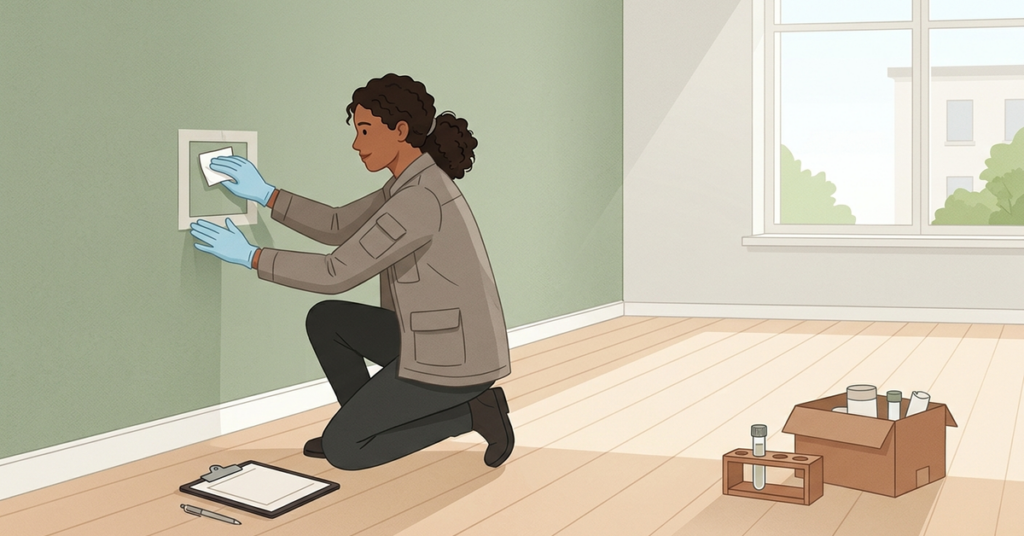
The inspector wipes a measured area with a sterile swab. They sample floors, lower walls, baseboards and other surfaces the water touched. The samples go to an accredited lab.
Indicator bacteria
The lab looks for indicator bacteria. These are germs that point to sewage. Testing for every possible germ isn’t practical. So labs look for the common ones that travel with human waste. These often include E. coli, coliform bacteria and sometimes Enterococcus. Coliform bacteria are a large group of germs often used to flag contamination. E. coli is one kind that comes from the gut, so it is a stronger sign of sewage.
A comparison sample
A good inspector also samples an area the water never reached. That gives a baseline for your building. Some bacteria live in normal soil and dust. A comparison sample helps show what is normal and what is left over from the backup.
Moisture readings
Testing should also check for leftover moisture. A moisture meter shows whether framing and subfloor are dry. Damp materials are a mold risk. If they stay wet, mold testing may be needed too. Read more in After the Flood: When Water Damage Turns Into a Mold Problem.
The report
You get a written report with the lab results and sample locations. It shows which areas passed and which need more cleaning. If an area fails, the cleanup crew goes back, and that area is tested again.
When should you test after a sewage backup?
Timing matters. Here are the most common times to test.
After cleanup, before you move back in
This is the main one. Test after the crew finishes and before anyone uses the space again. This is often called clearance testing. It answers the question, “Is it clean now?”
Before walls and floors go back in
If drywall and flooring were removed, test before the new materials go up. Once new walls close in the framing, any leftover contamination is sealed inside. Fixing it later means tearing out new work.
For insurance documentation
Insurance claims go more smoothly with records. Lab results show what was found and that the area passed after cleanup. Keep the report with your photos and invoices. See why documentation matters for insurance.
For landlords and tenants
A backup in a rental raises a hard question. Is the unit fit to live in again? Test results give both sides facts instead of guesses. Landlords get proof the unit was cleaned. Tenants get proof it’s safe to return.
When buying or selling
If a home had a past sewage backup, ask for records. If there are none, testing can show whether the problem was handled.
Sewage backups in commercial buildings
Sewage backups don’t only happen in homes. Offices, restaurants, schools, churches, medical offices and apartment buildings all have floor drains and older lines.
In a business, more people are exposed. Staff, customers and students may all use the space. A restaurant or clinic has extra reasons to be sure. Testing before you reopen gives you a record that you checked. It also helps you answer questions from staff, tenants or inspectors.
For multi-unit buildings, a backup in one unit can affect others. Water moves through shared walls and floors. Testing the units next to the backup can show if the problem spread.
Why backups happen in Georgia and South Carolina homes
Our area has a few common causes.
- Heavy storms. Summer storms and hurricane season can overload city sewer systems. Water then pushes back up through the lowest drain in the house.
- Tree roots. Our big oaks and pines send roots into older clay sewer lines. Roots catch waste and cause clogs.
- Older pipes. Many older homes still have cast iron or clay lines that crack and sag with age.
- Septic systems. Rural homes on septic can back up when the tank is full or the drain field fails.
If backups keep happening, the cause may be a broken line under the slab. Learn more in The Leak That Isn’t Under Pressure: Finding Drain and Sewer Line Failures Under Your Slab.
Why independent testing matters
The company that cleaned up should not be the one that tells you it’s clean. That’s a conflict of interest. An independent tester has no stake in the cleanup bill. They only report what the lab finds.
EnviroPro 360 does not clean, remove or rebuild. We take samples, send them to an accredited lab and explain the results. You can share our report with your contractor, your insurance company or your tenants.
Your next steps
- Stay out of the area until it’s cleaned. Keep children and pets away, and let a trained crew handle large backups.
- Schedule testing after cleanup and before rebuilding. Ask for surface sampling and moisture readings in every area the water touched.
- Keep the report. Store it with your photos and invoices for your insurance company, buyers or tenants.
EnviroPro 360 provides sewage screen testing and other environmental testing for homes and businesses in Augusta and nearby towns in Georgia and South Carolina. If you have questions about a sewage backup or want to talk through your situation, the EnviroPro 360 team is happy to help. Reach out any time for a quote.