Radon cannot be seen, smelled, or detected by any of the usual senses. In homes across Augusta, Aiken, Evans, and the surrounding CSRA region, it can be present at concentrations high enough to represent a genuine lung cancer risk without any visible sign that anything is wrong. That combination of invisibility and health consequence makes radon one of the most consistently underestimated indoor hazards in the region.
This post explains what radon is, how it enters homes, what the health research shows, and what homeowners in the CSRA need to know about testing.
What Radon Is and Where It Comes From
Radon is a naturally occurring radioactive gas produced by the decay of uranium in soil and rock. Uranium is a trace element present throughout the Earth’s crust, including in the soils beneath homes throughout Georgia and South Carolina. As uranium breaks down, it produces radium, which in turn produces radon gas. Radon is chemically inert — it does not bind to surfaces or react with other materials. It disperses through the soil and, when it reaches a structure, seeps through any opening that connects the building’s interior to the ground.
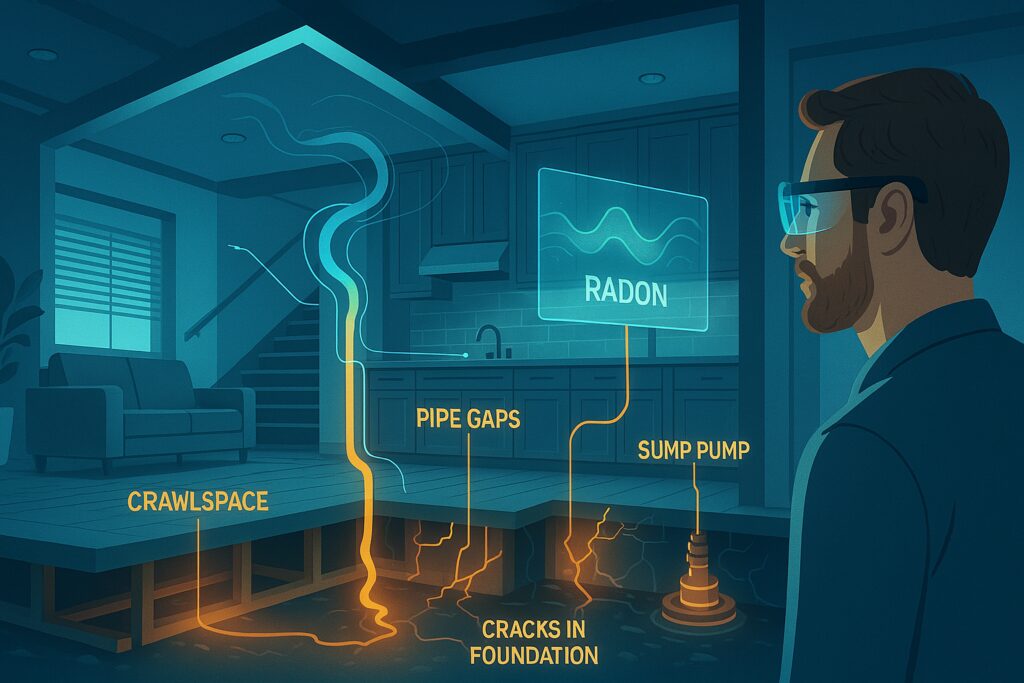
Common radon entry points include:
- Cracks in poured concrete slabs and foundation walls
- Gaps around plumbing and utility penetrations
- Sump pit openings
- Crawl space soil-to-air interfaces
- Construction joints between foundation components
Once inside, radon accumulates in the air. Without active ventilation or a mitigation system to direct it away from the home, it builds up over time — particularly in basements, crawl spaces, and ground-floor rooms where entry points are closest and air exchange with the outside is lowest.
The Health Risk from Radon Exposure
The Environmental Protection Agency identifies radon as the second leading cause of lung cancer in the United States. The EPA estimates that radon causes approximately 21,000 lung cancer deaths annually. Among non-smokers, radon is the leading cause of lung cancer.
The Centers for Disease Control and Prevention similarly flags radon as a significant public health concern, noting that exposure risk can be substantially reduced by testing and taking action when levels are elevated. The CDC guidance is consistent with the EPA’s: test every home below the third floor, and act if the result is at or above the action level.
The key characteristic of radon’s health risk is its delayed nature. Radon exposure does not produce immediate symptoms. Lung cancer associated with radon typically develops 15 to 25 years after the exposure that contributed to it. This long feedback loop is what makes radon genuinely dangerous: people can breathe elevated levels for years without any indication that damage is accumulating. By the time symptoms appear, the contributing exposure is long past.
The EPA Action Level and What It Means
Radon is measured in picocuries per liter (pCi/L). The EPA action level for indoor radon is 4.0 pCi/L. At or above this concentration, the EPA recommends installing a mitigation system to reduce indoor levels. The EPA also recommends that homeowners consider action at levels between 2.0 and 4.0 pCi/L if they plan to remain in the home long term.
For context, typical outdoor radon concentrations average approximately 0.4 pCi/L — about ten times lower than the indoor action level. Indoor air in a home without elevated radon will generally fall somewhere between outdoor levels and the action threshold. Indoor air in a home with elevated radon can reach concentrations many times the 4.0 pCi/L threshold, particularly in homes with significant foundation openings and poor natural ventilation.
Radon in the CSRA: What Augusta-Area Homeowners Should Know
The CSRA includes Augusta, Richmond County, Columbia County, and the South Carolina communities of Aiken County, including North Augusta and the city of Aiken. Radon levels in this region are not uniform. Soil geology, foundation type, and home construction all influence how much radon a specific property generates and accumulates.
A neighbor’s radon test result does not predict your own. Two homes on the same street, with similar foundation types, can have meaningfully different radon concentrations depending on how their individual foundations interact with the soil beneath them. Regional radon zone maps provide a general indication of risk, but they are intended for broad planning purposes and should not be used as a substitute for testing a specific home.
Certain foundation types are associated with higher radon levels. Homes with basements or crawl spaces have greater soil contact area than slab-on-grade homes, which creates more potential entry points for radon. However, slab homes are not immune. Any penetration in the slab — a plumbing sleeve, a utility conduit, a crack from settling — is a potential radon entry point.
What Happens After Testing
If a professional radon test shows levels below 2.0 pCi/L, no action is required. Retesting every two years or after any significant changes to the home is a reasonable precaution.
If the result falls between 2.0 and 4.0 pCi/L, the EPA recommends a follow-up long-term test to establish an annual average before deciding whether mitigation is warranted. A single short-term test in that range can reflect seasonal variation rather than a persistent elevated level.
If the result is at or above 4.0 pCi/L, the appropriate next step is to consult with a certified radon mitigation contractor about installing a radon reduction system. The standard approach for most residential properties is sub-slab depressurization — a system of piping and a continuously running fan that draws radon from beneath the slab and vents it outdoors before it can enter the home.
EnviroPro 360 provides testing and clear result interpretation. Mitigation is performed by separate certified contractors. After a mitigation system is installed, a post-mitigation retest confirms whether the system has reduced levels to an acceptable range and provides documentation of the result.
Schedule a Radon Test for Your Augusta-Area Home
EnviroPro 360 serves homeowners throughout Augusta, Evans, Martinez, Grovetown, North Augusta, Aiken, and the broader CSRA. Testing follows EPA measurement protocols, and results are provided with a plain-language explanation of what the number means and what next steps are appropriate.
Contact EnviroPro 360 to schedule radon testing for your home and get a result you can rely on.