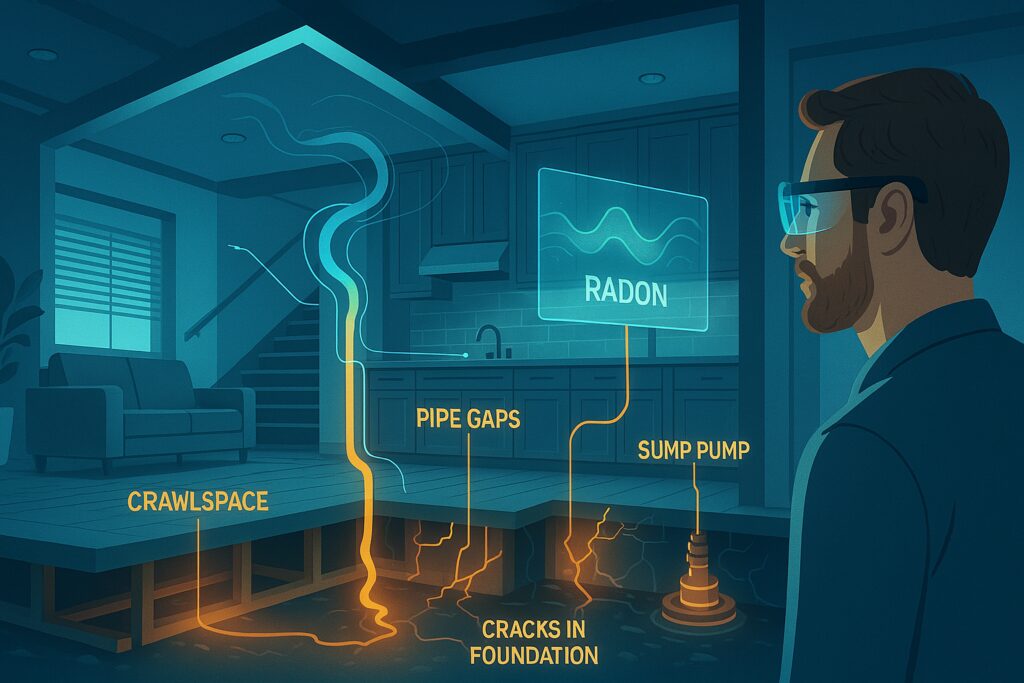
Radon is a naturally occurring radioactive gas that forms when uranium in soil and rock breaks down. It seeps upward through the ground and enters buildings through gaps in foundations, crawl space openings, and any point where the structure contacts the soil. Once inside, it accumulates. It produces no odor, no color, and no taste. You cannot detect it without a test, and exposure causes no immediate symptoms. Yet radon is the second leading cause of lung cancer in the United States.
Understanding what radon is, where it comes from, and how it behaves inside homes is the first step to making an informed decision about testing.
How Radon Forms
The process that creates radon starts with uranium, a trace element found throughout the Earth’s crust. Uranium decays over millions of years, eventually producing radium, which then decays further into radon gas. This happens continuously in the soil beneath virtually every building in the country. The gas migrates upward through soil particles and, when it reaches a structure, looks for any available opening to move into the indoor air.
Common entry points include:
- Cracks in concrete slabs and foundation walls
- Gaps around plumbing and utility penetrations
- Sump pit openings
- Crawl space soil-to-air interfaces
- Construction joints between foundation components
Once inside, radon accumulates in the lowest levels of the home — basements, crawl spaces, and ground-floor rooms — because those spaces are closest to the entry points and typically have less air exchange with the outdoors. Without active ventilation or a mitigation system, concentrations build over time.
The Health Risk from Radon
The Environmental Protection Agency estimates that radon causes approximately 21,000 lung cancer deaths each year in the United States, making it the second leading cause of lung cancer after smoking and the leading cause among non-smokers. When radon gas is inhaled, its radioactive decay products attach to lung tissue and emit alpha radiation that can damage cellular DNA over time. The resulting lung cancer typically develops 15 to 25 years after the period of significant exposure — long after the exposure itself has been forgotten.
The Centers for Disease Control and Prevention similarly identifies radon as a significant public health concern. Both the EPA and CDC note that the risk is substantially reducible: detecting elevated radon and installing a mitigation system can reduce indoor concentrations by 80% to 99%.
Radon Measurement and the EPA Action Level
Radon is measured in picocuries per liter of air (pCi/L). Outdoor air averages approximately 0.4 pCi/L. The EPA action level for indoor radon is 4.0 pCi/L — the threshold at which the EPA recommends taking steps to reduce indoor concentration. The EPA also recommends considering action at levels between 2.0 and 4.0 pCi/L for people who plan to remain in the home long term.
At 4.0 pCi/L, the EPA estimates that approximately 7 out of every 1,000 non-smokers will develop lung cancer from lifetime radon exposure. At 8.0 pCi/L, that number roughly doubles. At 20 pCi/L, it climbs to 36 out of 1,000. These are not worst-case projections — they are the EPA’s own risk estimates derived from epidemiological research.
Radon in Augusta and the CSRA
Radon levels in the CSRA, which spans Augusta, Richmond County, Columbia County, and the South Carolina communities of Aiken County and beyond, are not uniform. Local soil composition, foundation type, and construction methods all influence how much radon a specific home generates and accumulates. The EPA’s radon zone map places most of the Augusta area in Zone 2 (moderate predicted average), but zone maps are county-level averages. Individual homes in any zone can test well above or below those averages.
A neighbor’s low result does not predict your own. Two homes on the same street with the same foundation type can have meaningfully different radon levels. The only way to know the radon concentration in your specific home is to test it.
How Radon Testing Works
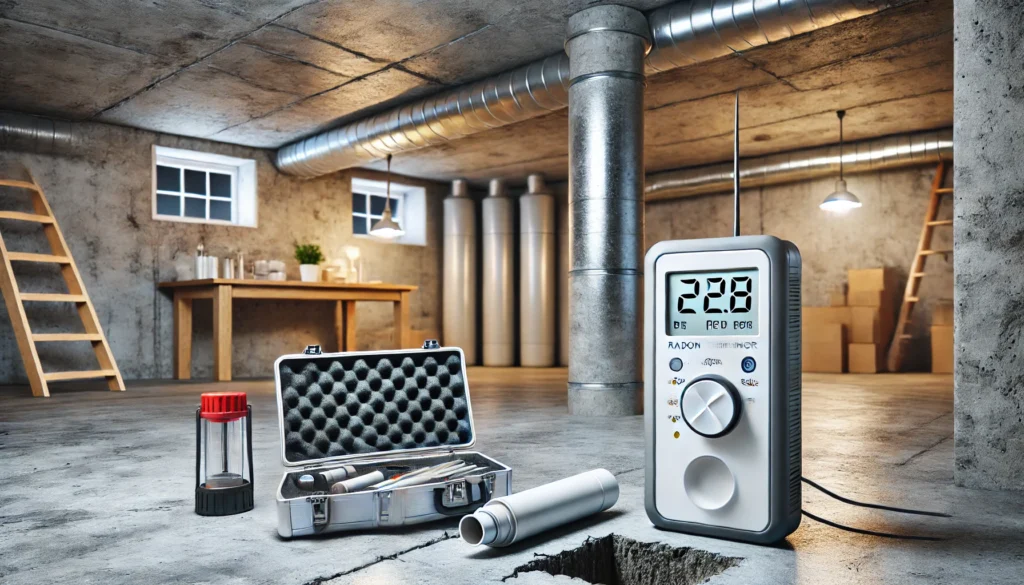
Radon testing is non-invasive and straightforward. A professional test places a calibrated monitor in the lowest livable level of your home, with windows and exterior doors kept closed for at least 12 hours before the test begins and throughout the test period. The device records radon levels during the test and calculates an average concentration.
Short-term tests run for 48 hours to several days and are commonly used for real estate transactions and initial screening. Long-term tests run for 90 days or more and produce a more accurate picture of your home’s annual average exposure by smoothing out seasonal and weather-related variation.
If your result is at or above 4.0 pCi/L, the next step is to contact a certified radon mitigation contractor. The standard mitigation approach for most homes is sub-slab depressurization: a pipe and fan system that draws radon from beneath the foundation and vents it above the roofline before it can enter the home. EnviroPro 360 handles the testing and interpretation. Mitigation is performed by separate certified contractors, and EnviroPro 360 can conduct the post-mitigation retest to confirm the system is working.
Schedule Radon Testing in Augusta or the CSRA
EnviroPro 360 provides professional radon testing for homeowners in Augusta, Evans, Martinez, Grovetown, North Augusta, Aiken, and throughout the CSRA. Testing follows EPA measurement protocols, and results are explained in plain language so you understand exactly what the number means and what steps are appropriate.
Contact EnviroPro 360 to schedule a radon test for your home.