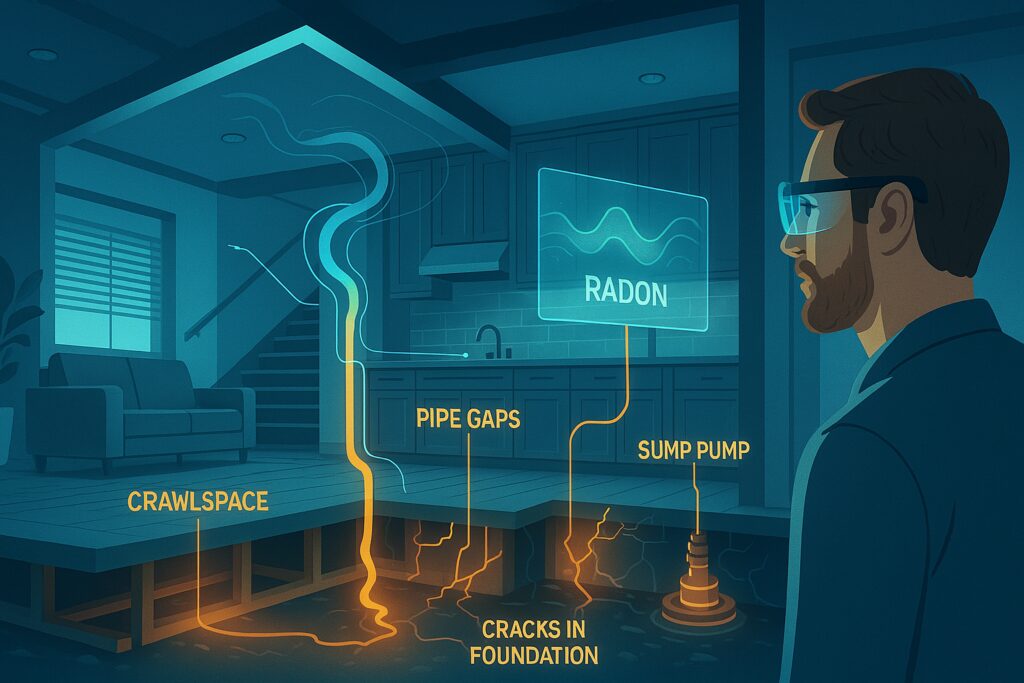
You can’t see, smell or taste radon. Your air purifier can’t catch it. Your smoke alarm won’t sound. Yet it can build up inside a normal house in Augusta, Evans or Aiken. Nothing about the home will look wrong.
This guide explains what radon is and what causes radon in homes. It covers how common it is and why it matters for your health. It also explains how radon testing works in the CSRA, and what to do with your result.
What is radon?
Radon is a radioactive gas. It forms naturally in soil and rock. It starts with uranium, a metal found in small amounts almost everywhere in the ground. Over a very long time, uranium breaks down into radium. Radium then breaks down into radon gas.
This happens under nearly every building in the country. That includes homes across Georgia and South Carolina. Outdoors, radon spreads out in the open air and stays low. Indoors, it can get trapped and build up.
Radon doesn’t stick to surfaces or react with other things. It just moves with the air in the soil. When that soil air reaches a building, the radon goes wherever the air goes.
What causes radon in homes?
Radon gets into a house from the ground below it. The house itself doesn’t make radon. The soil under it does. A home just gives the gas a closed space to collect in.
Several things affect how much radon ends up inside:
- The soil and rock under your lot
- Your foundation type: slab, crawl space or basement
- How many cracks and openings the foundation has
- How tightly the house is sealed
- How the heating and cooling system moves air
That’s why two homes on the same street can test very differently. A neighbor’s result does not tell you yours.
How does radon get into your house?
Radon moves up through the soil and in through any opening to the ground. Common entry points include:
- Cracks in concrete slabs and foundation walls
- Gaps around pipes, wires and drains
- Sump pit openings
- Open soil in a crawl space
- Joints where the slab meets the walls
A house also pulls air from the soil. Warm air rises and leaks out near the top of the house. That pulls replacement air in at the bottom, and some of it comes from the soil. This is called the stack effect. It is strongest in winter, when the heat is on.
Radon is usually highest in the lowest rooms. Basements, crawl spaces and ground-floor rooms sit closest to the soil. They also tend to get less fresh air. Radon can still reach upper floors through air flow and ductwork.
For more detail, see how radon enters your home unnoticed.
How common is radon in homes?
It’s more common than most people think. The EPA estimates that nearly 1 in 15 U.S. homes has radon at or above its action level.
Radon is measured in pCi/L (picocuries per liter). This unit tells you how much radioactivity is in a liter of air. According to the EPA, outdoor air averages about 0.4 pCi/L. The average home is about 1.3 pCi/L.
So how often is indoor radon a problem? You can’t tell from the street, the age of the house or a map. Some homes test near outdoor levels. Others test many times above the action level. The only way to know is to test.
Why radon matters for your health
The EPA says radon is the second leading cause of lung cancer in the U.S. It is the leading cause among people who have never smoked. The EPA estimates radon causes about 21,000 lung cancer deaths each year.
Here’s how the harm happens. Radon breaks down into tiny radioactive particles. When you breathe them in, they can stick to the lining of your lungs. They give off radiation that can damage lung cells over time.
Radon does not cause symptoms while you breathe it. There’s no cough, headache or burning feeling. The EPA notes that lung cancer usually shows up years after the exposure. That delay is why radon is easy to ignore. Read more in radon poisoning symptoms: what to watch for.
The CDC points out the good news. The risk drops when you test and fix high levels.
Can an air purifier or filter remove radon?
No. Air purifiers, HEPA filters and dehumidifiers are built for dust, pollen and mold spores. Radon is a gas, not a particulate. It passes right through those filters. Cleaning, new air filters and good housekeeping don’t change your radon level.
Is radon related to mold?
Not directly. Mold is a fungus that grows where there is moisture. Radon is a gas that comes from the soil. They need different tests.
They do share some of the same places, though. Damp crawl spaces and basements are common spots for both. If you have a musty crawl space, it makes sense to think about both. A mold inspection won’t tell you anything about radon, and a radon test won’t find mold.
The EPA action level and what your number means
The EPA action level is 4.0 pCi/L. At or above that level, the EPA says to fix your home. The EPA also says to think about fixing it between 2.0 and 4.0 pCi/L. No level of radon is completely safe.
Here’s what the EPA estimates at 4.0 pCi/L over a lifetime. About 7 in 1,000 people who never smoked could get lung cancer. For smokers, it’s about 62 in 1,000. Smoking and radon together raise the risk a lot.
What does a radon test result like 2.8 pCi/L mean?
A result of 2.8 pCi/L is below the action level. It’s also above the national indoor average. The EPA says to consider fixing levels in this range. A good next step is a long-term test. It shows your average over many months. See what the EPA action level means for your home for more.
Here is a simple guide to results:
- Below 2.0 pCi/L: Low. Test again every two years and after big changes to the house.
- 2.0 to 3.9 pCi/L: Consider fixing it. A long-term test helps you decide.
- 4.0 pCi/L or higher: Confirm with a second test. Then talk to a certified radon mitigation contractor.
Radon in Augusta and the CSRA
The CSRA covers Augusta, Richmond County and Columbia County in Georgia. It also covers Aiken County in South Carolina, including North Augusta and Aiken. Radon levels here are not the same from home to home.
The EPA map of radon zones ranks counties by predicted average levels. It’s a broad planning tool. The EPA says not to use it to decide whether a single home needs a test. Homes in every zone can test high.
Local housing adds to the picture. Many homes here sit on crawl spaces. Older homes often have more cracks and gaps in the foundation. Slab homes aren’t safe by default, either. Any pipe opening or settling crack can let radon in.
How radon testing works
Radon testing is simple and doesn’t damage anything. A tester places a calibrated monitor in the lowest lived-in level of your home. Calibrated means the device was checked against a known radon level, so it reads correctly.
The test needs closed-house conditions. Closed-house conditions mean windows and outside doors stay shut, except for normal coming and going. This starts at least 12 hours before the test and lasts the whole time. Open windows let outdoor air in and make the reading look too low.
There are two main types of tests:
- Short-term tests run from 2 to 90 days. They are used for home sales and first checks.
- Long-term tests run more than 90 days. They show your year-round average more closely.
EnviroPro 360’s radon testers are NRPP certified. NRPP is the National Radon Proficiency Program, which certifies radon professionals. We follow ANSI testing standards. ANSI (American National Standards Institute) standards set out how a radon test must be set up, run and checked. Our tests run at least 48 hours. Most results are ready 24 to 48 hours after the test ends.
What about radon mitigation in Augusta and Evans?
Radon mitigation means lowering the radon level in a building. The most common method is sub-slab depressurization. A pipe and a fan pull radon from under the house and vent it outside, above the roof. The CDC notes that mitigation can lower radon levels a great deal.
EnviroPro 360 does not install radon mitigation systems. We only test. That means we have nothing to sell you based on your result. If your level is high, a certified mitigation contractor installs the system. After it’s running, we can do the post-mitigation test. That test shows whether the system brought your level down. To learn what’s involved, see radon mitigation systems: how they work and what they cost.
Your next steps
- If your home has never been tested, schedule a radon test. Test again every two years and after big changes.
- Keep closed-house conditions for 12 hours before and during the test.
- If your result is 2.0 pCi/L or higher, plan a follow-up test before you decide on mitigation.
EnviroPro 360 provides radon testing for homes and businesses in Augusta, Aiken, Columbia and nearby towns, including Evans, Martinez, Grovetown and North Augusta. If you have questions about radon in your home or want to talk through your situation, the EnviroPro 360 team is happy to help. Reach out any time.