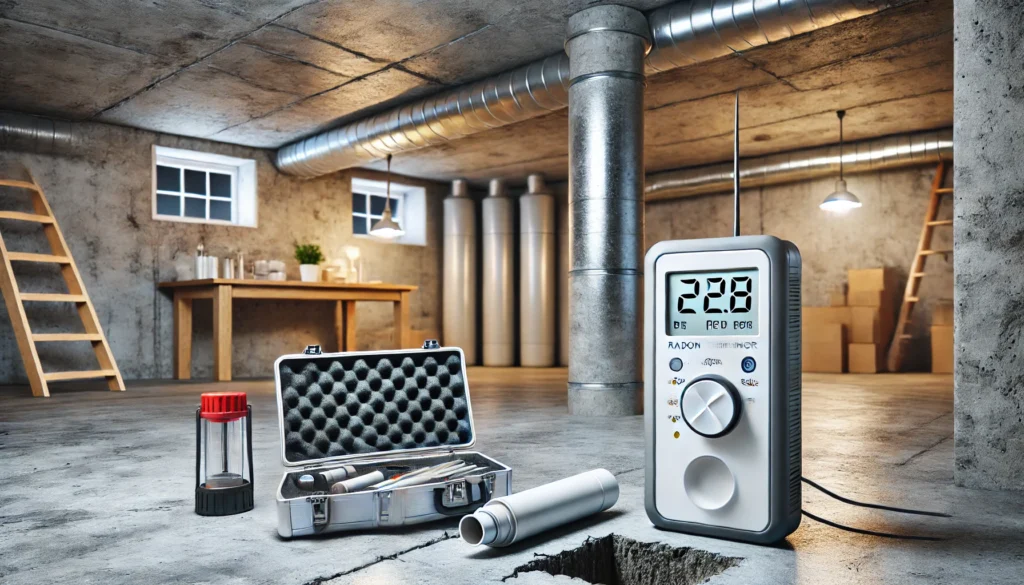
January is National Radon Action Month, a nationwide effort led by the EPA to raise awareness about radon and encourage testing during the period when indoor concentrations are typically highest. For schools and childcare facilities in Georgia and South Carolina, winter is the most informative time to test, and this post covers why that matters, what standards apply, and how facility managers can act on results.
Why Schools and Childcare Facilities Have Elevated Exposure Risk
Children spend a substantial portion of their day in school buildings. Young children in full-day childcare programs may be in the same building for eight or more hours daily. According to the EPA, radon is the second leading cause of lung cancer in the United States after smoking, and there is no known safe level of exposure. For children, whose cells divide more rapidly than adults, long-term exposure during formative years warrants the same concern as adult workplace exposure.
Schools and childcare centers also present structural characteristics that increase radon risk. Many buildings are older construction with settled foundations, cracked slabs, and aging utility penetrations. Ground-level classrooms, science labs in basement spaces, and gymnasia with below-grade utility areas are common in CSRA school buildings constructed before the 1990s. The EPA has estimated that nearly one in five schools nationally has at least one room with short-term radon levels above the 4.0 pCi/L action threshold.
Why Winter Testing Matters
Radon concentrations in buildings are highest during cold months. Windows and exterior doors remain closed, reducing air exchange. The stack effect draws more soil gas through foundation pathways as warm indoor air rises and creates negative pressure in lower levels. Heating systems run continuously, increasing the pressure differential between indoor and outdoor air.
Testing during winter provides results that reflect peak-year radon conditions. A test conducted in May or June, when windows are open and ventilation is higher, may produce a reading that underrepresents what children are exposed to from October through March. The CDC recommends testing under closed-building conditions precisely because those conditions are more representative of long-term occupancy patterns in most of the United States.
The Standards That Apply to Schools
For schools and large non-residential buildings, the recognized testing standard is ANSI/AARST MA-MFLB-2023, which covers multifamily, school, large commercial, and mixed-use buildings. This standard specifies where to place test devices, how long to run them, and how to document and report results.
Key requirements for facility managers include:
- Testing ground-contact rooms and all regularly occupied spaces at the lowest occupied level
- Maintaining closed-building conditions for the duration of short-term tests to reflect worst-case concentrations
- Retesting after significant renovations, HVAC modifications, or changes to the building envelope that could affect radon entry pathways
- Retesting rooms that previously tested below 4.0 pCi/L on a regular schedule to confirm conditions remain safe
The EPA’s Managing Radon in Schools guidance, available at epa.gov, provides a practical framework for planning a school radon program, interpreting results, and communicating findings to boards and parents.
State Resources in Georgia and South Carolina
Georgia’s Department of Public Health recognizes the EPA’s 4.0 pCi/L action level and provides radon education resources. Several Georgia libraries participate in an Electronic Radon Monitor Loan Program through UGA Extension and the Georgia Public Library Service, which can be useful for staff testing at home during National Radon Action Month.
South Carolina’s radon program, now administered through the Department of Environmental Services, offers free short-term radon test kits to South Carolina homeowners while supplies last. Facility managers in both states can contact state radon programs for guidance on school-specific testing requirements and available resources.
What to Do With Results
Results below 4.0 pCi/L should be documented and scheduled for periodic re-testing under the MA-MFLB standard. Results at or above 4.0 pCi/L require mitigation planning. A qualified mitigation contractor can design a solution, typically sub-slab depressurization or targeted ventilation adjustment, that addresses elevated rooms without disrupting the school year. Post-mitigation testing confirms performance before rooms are returned to normal use.
Transparent communication with parents and staff builds confidence. Sharing test results by room, explaining the action level in plain terms, and describing next steps for any elevated areas demonstrates that administration is taking indoor air quality seriously.
Professional Testing for Schools and Childcare Centers
Professional radon measurement ensures correct device placement under MA-MFLB standards, produces chain-of-custody documentation suitable for boards and regulators, and provides defensible results if mitigation is later required. DIY test kits are appropriate for homeowners but are not the standard for institutional settings where results may need to withstand administrative or regulatory scrutiny.
EnviroPro 360 provides certified radon testing for schools, childcare centers, and commercial facilities throughout Augusta, Evans, Martinez, Grovetown, North Augusta, Aiken, and surrounding communities in Georgia and South Carolina. If your facility has not tested this year, winter is the right time to act. Contact us to schedule school or childcare radon testing and get clear, standards-based results you can act on.