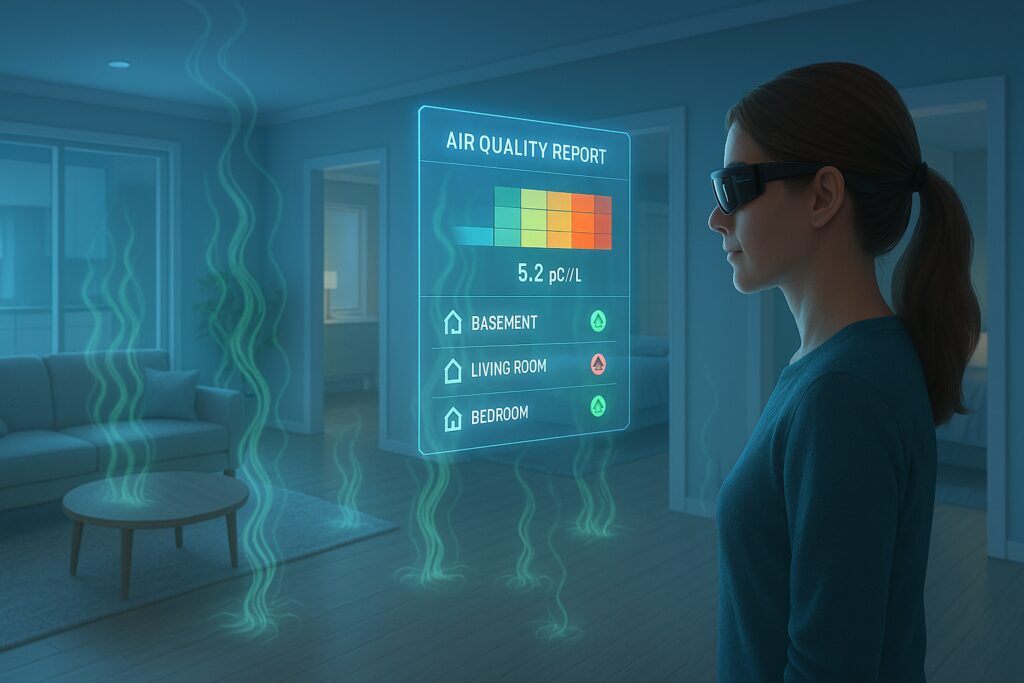
Most homeowners take indoor air quality seriously. They replace HVAC filters on schedule, run air purifiers in bedrooms, and keep surfaces clean. Those habits address dust, allergens, and airborne particles. They do not address radon. Radon is invisible, odorless, and undetectable by any air purifier, filter, or cleaning routine. The only way to know whether it is present in your home is to test for it.
What Radon Is and How It Enters Your Home
Radon is a naturally occurring radioactive gas produced by the decay of uranium in soil and rock. It forms below ground and seeps upward through cracks, gaps, and penetrations in a building’s foundation. Common entry points include:
- Cracks in poured concrete foundations and block walls
- Gaps around service pipe penetrations
- Sump pit openings
- Crawl space soil-to-air interfaces
- Construction joints between slabs and walls
Once inside, radon accumulates. The lowest levels of a home typically see the highest concentrations because radon is heavier than most air components and because the lowest level is closest to the soil entry points. Basements, crawl spaces, and ground-floor living areas tend to have the highest concentrations, though radon can diffuse to upper floors as well.
Radon has no interaction with the contaminants that indoor air quality products are designed to address. It passes through HEPA filters without being captured. It is not removed by activated carbon air purifiers or dehumidifiers. It is a gas-phase radioactive element, and its behavior in indoor air is entirely different from dust, mold spores, or volatile organic compounds.
The Health Risk and Why It Is Underestimated
The Environmental Protection Agency identifies radon as the second leading cause of lung cancer in the United States. Approximately 21,000 Americans die from radon-related lung cancer each year. The EPA recommends that homeowners take action when radon levels reach or exceed 4.0 pCi/L (picocuries per liter), though it notes that no level of radon exposure is risk-free.
The Centers for Disease Control and Prevention notes that the risk of lung cancer from radon can be reduced by testing and taking appropriate action when levels are elevated. The critical point both agencies emphasize is that radon exposure does not produce immediate symptoms. There is no coughing, no burning sensation, no warning of any kind during active exposure. The harm develops silently over years of cumulative inhalation, and by the time symptoms appear, the damage has typically been accumulating for a decade or more.
This delayed feedback loop is why radon is consistently underestimated as a household hazard. A problem that produces no immediate discomfort is easy to deprioritize. But the absence of symptoms during exposure does not reduce the statistical risk — it simply ensures that the risk goes unaddressed until the consequences are already in progress.
Radon Risk in Augusta and the CSRA
Radon risk in Georgia and South Carolina is not uniform. Local geology, soil composition, and foundation type all influence how much radon enters a given home. In the CSRA, which includes Augusta, Evans, Martinez, Grovetown, North Augusta, and Aiken, radon levels vary neighborhood to neighborhood and home to home. A neighbor’s low result does not predict your own. Two homes on the same street with identical floor plans can have meaningfully different radon levels depending on how each foundation interacts with the soil beneath it.
The only way to know your home’s radon level is to test it. There is no map, no zip code lookup, and no observable indicator that tells you whether radon is present at actionable concentrations in your specific home.
What Testing Involves and What Happens Next
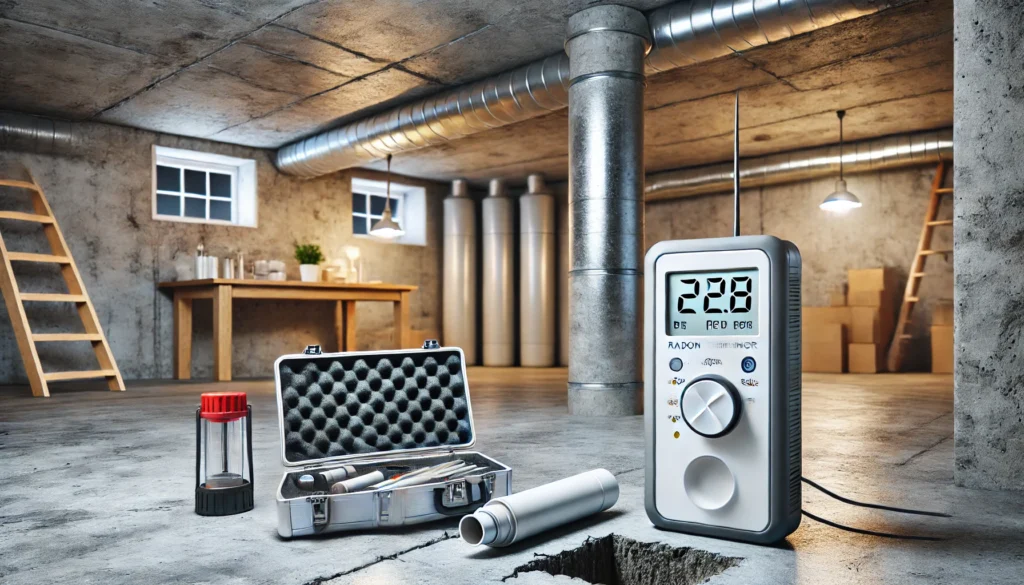
A professional radon test places a calibrated monitor in the lowest livable level of your home for a set period — typically 48 hours minimum for a short-term test. During that time, closed-building conditions are maintained to ensure the result reflects actual indoor concentration rather than temporarily diluted air. After the test, you receive a result in pCi/L along with a clear explanation of what that number means.
If your level is below 2.0 pCi/L, no immediate action is needed, though periodic retesting is recommended as conditions can change over time. If it falls between 2.0 and 4.0 pCi/L, the EPA recommends a follow-up long-term test to establish an annual average. If it is at or above 4.0 pCi/L, the EPA recommends consulting with a certified radon mitigation contractor about installing a radon reduction system.
EnviroPro 360 handles the testing and interpretation. If the result indicates that mitigation is appropriate, you would then work with a certified mitigation contractor to install the system. After installation, EnviroPro 360 can perform the post-mitigation retest to confirm the system has reduced your radon level to an acceptable range.
Schedule a Radon Test for Your Augusta-Area Home
Maintaining a healthy home means addressing threats that standard household routines cannot reach. Radon is one of them. Contact EnviroPro 360 to schedule professional radon testing in Augusta, Evans, Martinez, Grovetown, North Augusta, Aiken, or elsewhere in the CSRA.