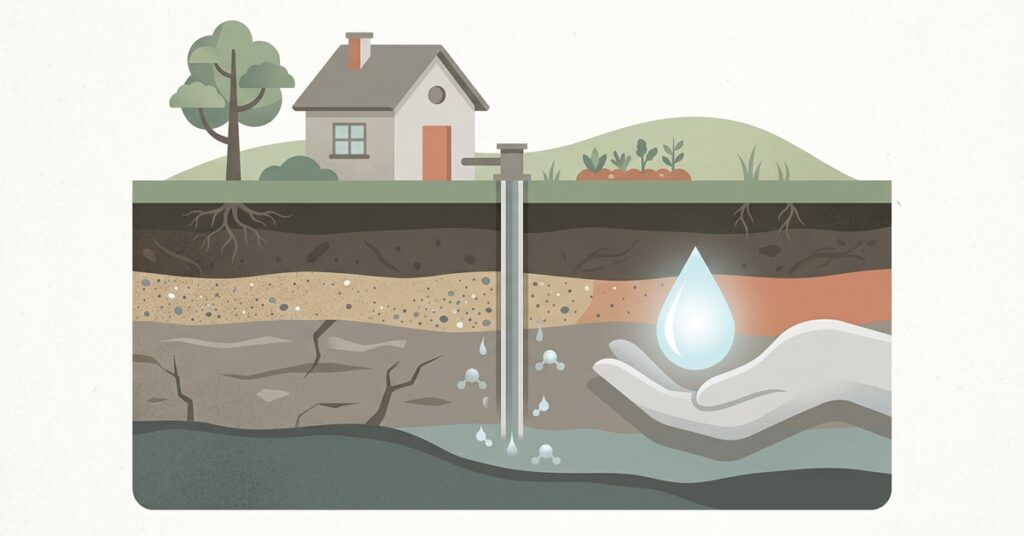
A homeowner outside Aiken had her well tested for the standard panel: total coliform, E. coli, nitrates, pH, and a metals screen. Everything came back within safe ranges, and she felt confident about her water. What that panel didn’t include, and what most standard well water tests don’t include, was radon. A separate test, prompted only because a radon mitigation contractor asked about her water source during an unrelated air test, found radon in her well water at a level the EPA considers actionable.
Radon in water is a real and separate exposure path from the airborne radon most people are familiar with, and it’s easy to miss because it isn’t part of routine well water screening.
Two Different Radon Problems
Airborne radon, the kind most CSRA homeowners test for, comes from uranium decay in soil and rock beneath a home’s foundation and enters through cracks, gaps, and porous concrete. Waterborne radon is a related but distinct issue: groundwater moving through the same uranium-bearing rock and soil absorbs dissolved radon gas, which then enters your home through the water supply itself.
This matters specifically for private wells. Municipal water systems draw from surface water sources or large aquifers and typically aerate or treat water in ways that reduce radon before it reaches your tap. Private wells draw directly from groundwater with no treatment step in between, which means whatever radon is dissolved in that water arrives at your faucet, shower, and washing machine unchanged.
How Radon Gets From Water Into Your Air
Radon dissolved in water doesn’t stay dissolved once that water is agitated or heated. According to the EPA, showering, running a dishwasher, doing laundry, and even running a faucet releases dissolved radon into the air, where it can then be inhaled. A long hot shower is actually one of the more efficient ways to transfer waterborne radon into indoor air.
This creates a compounding problem in homes that already have elevated airborne radon from soil gas: the water supply becomes an additional, ongoing source feeding into the same indoor air that a soil-gas mitigation system was designed to address. A home could have an active sub-slab depressurization system working exactly as intended and still show elevated indoor radon if the well water is also contributing.
There’s also a direct ingestion risk. The EPA’s risk assessments note that swallowing water with high radon content carries some stomach cancer risk, though the inhalation pathway from water-to-air transfer is considered the more significant health concern for most households.
Why Standard Well Testing Skips This
Most well water testing packages, including the ones recommended for annual homeowner testing, focus on bacteria, nitrates, pH, hardness, and common heavy metals because those are the contaminants most likely to cause immediate, detectable health effects or aesthetic problems (taste, odor, staining). Radon in water produces none of those signals. It’s undetectable without a specific test, and it doesn’t get flagged by the lab unless the test explicitly screens for it.
This is the same pattern that makes airborne radon dangerous: no smell, no taste, no visible sign, and no reason to suspect it unless you specifically test for it.
Who Should Check for This
Waterborne radon is most relevant if:
- You have a private well, since municipal water systems are far less likely to carry significant dissolved radon to the tap.
- Your home is in an area with known elevated soil radon, since the same uranium-bearing geology that produces airborne radon often produces waterborne radon in the same region.
- You’ve tested for airborne radon and gotten an elevated result, particularly if a mitigation system hasn’t fully resolved the reading, since water may be a contributing source worth ruling out.
- You use well water for showering and daily household activities, rather than only for irrigation or outdoor use, since the exposure pathway depends on how the water is actually used indoors.
What Testing and Treatment Look Like
Testing for radon in water requires a specific water sample collected and handled differently from a standard bacteria or chemical sample, since radon gas can escape from an improperly collected sample before it reaches the lab. Results are reported in picocuries per liter (pCi/L) of water, and the EPA has proposed guidance levels, though no federal enforceable standard currently exists specifically for radon in private well water the way one exists for airborne radon.
If elevated levels are found, treatment options include aeration systems that strip dissolved radon from water before it enters household plumbing, and granular activated carbon filtration, which is more commonly used for lower-level contamination.
What to Do
-
If you have a private well, ask specifically for a radon-in-water test. It’s not part of most standard panels and needs to be requested and collected separately.
-
If you’ve had an airborne radon mitigation system installed and still see elevated readings, consider water as a contributing source. This is an underdiagnosed reason mitigation systems appear to underperform.
-
Treat water and air radon as related but separate problems requiring separate tests and, potentially, separate solutions.
If you’re on a private well and want to know whether radon in your water is adding to your indoor air levels, EnviroPro 360 can test for it. Reach out here and we’ll help you sort out water from air.