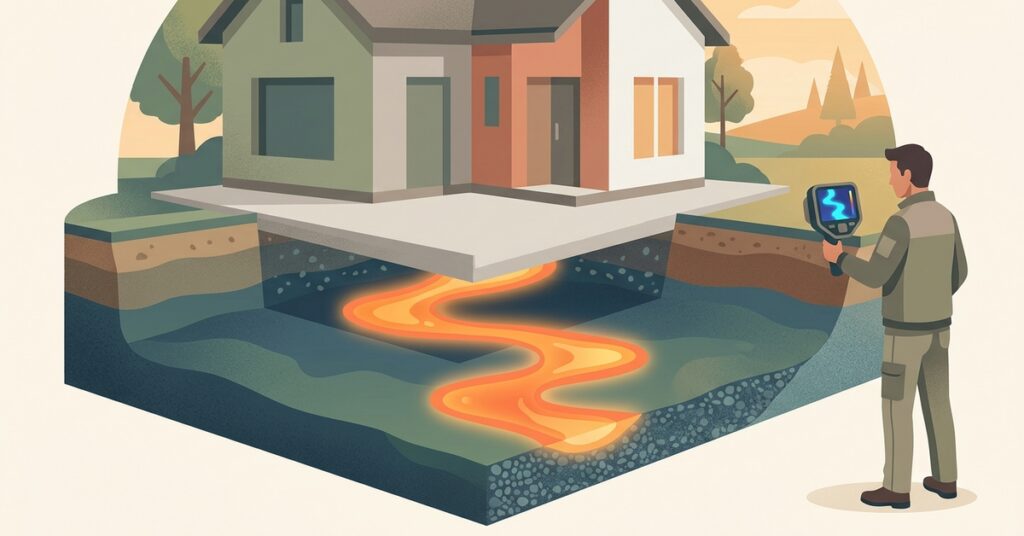
A homeowner in Martinez noticed her water bill had nearly doubled over two months with no obvious change in usage. There was no wet spot on the lawn, no soggy patch near the foundation, no water stain on a ceiling. The leak was in a pressurized supply line running under the slab, and by the time it became visible (a slight dampness at a baseboard, months after the bill first spiked) it had been running continuously for the better part of a season.
Pressurized pipe leaks behave differently than the drips and slow seeps that thermal imaging and moisture meters are built to find. Finding them earlier usually requires a different tool: listening for the leak itself, rather than looking for what it leaves behind.
Why Pressurized Leaks Are a Different Problem
Most water damage detection methods work by finding evidence of moisture after it has already spread into a material: elevated moisture content in drywall or subfloor, or a temperature anomaly caused by evaporative cooling where water has saturated a surface. Those methods are effective once moisture has moved into something you can scan.
A leak in a pressurized supply line, particularly one running under a slab or inside a wall cavity before it reaches an open space, doesn’t always produce that kind of visible or scannable evidence early on. Water under pressure can travel along the path of least resistance, sometimes for a considerable distance, before it surfaces somewhere unrelated to the actual leak location. By the time a wet spot appears, the leak may have been active for weeks or months, and the visible damage may be several feet from the actual failure point.
How Acoustic Detection Works
Water escaping a pressurized pipe under pressure creates a distinct sound, a hiss or turbulence, as it forces its way through the failure point. That sound travels along the pipe and through surrounding material, including concrete and soil, in a way that specialized listening equipment can detect and localize.
A typical acoustic leak detection process involves:
- Ground microphones or listening rods placed at accessible points along the suspected pipe route, used to identify where the leak sound is loudest, which correlates with proximity to the actual leak.
- Correlator equipment in more advanced setups, which uses two sensors placed at known points along a pipe and calculates the leak’s location based on the time difference between when the leak sound reaches each sensor.
- Ambient noise filtering, since acoustic detection has to distinguish leak sound from traffic, HVAC equipment, plumbing fixture use, and other background noise, which is part of why this work requires trained interpretation rather than just placing a microphone and reading a number.
This method doesn’t require exposing the pipe, cutting into a slab, or waiting for damage to become visible elsewhere. It locates the leak by sound while the pipe is still buried or concealed.
Where This Method Applies Best
Slab leaks. Pressurized water lines running under a home’s foundation slab are a common source of exactly this kind of hidden, long-running leak, and acoustic detection is often the most practical way to pinpoint the location without breaking up large sections of concrete to search for it.
Irrigation and outdoor supply lines. Underground irrigation systems and the supply lines feeding them can develop leaks that show up only as unexplained water bill increases or a patch of unusually green grass, with no other visible sign.
Commercial and multi-unit buildings. Pressurized supply lines running through walls, chases, or below-grade areas in larger buildings can leak for extended periods before affecting a specific unit or tenant space, and acoustic methods can help narrow down the source without disruptive exploratory demolition across multiple areas.
Situations where thermal imaging and moisture meters come back inconclusive. Sometimes a homeowner already suspects a leak, water bills are up, but scanning accessible surfaces hasn’t found clear moisture evidence yet. This often means the leak hasn’t migrated to a scannable surface, which is exactly the scenario acoustic detection is suited for.
Why Catching It Early Matters
A pressurized leak running continuously wastes water and money the entire time it goes undetected, but the larger cost is usually the damage that accumulates while it’s hidden: soil erosion under a slab, saturated fill material, mold growth in areas the leak has reached, and structural effects if the leak continues long enough to affect foundation support. Locating the leak early, before it produces visible damage, generally means a smaller, less invasive repair.
What to Do
-
If your water bill has increased without a clear explanation, don’t wait for visible water damage to investigate. That gap between the bill increase and visible signs is exactly when a hidden pressurized leak is most likely to be running.
-
Ask specifically whether acoustic detection is part of a leak assessment, particularly if a visual or thermal scan hasn’t found anything conclusive but a leak is still suspected based on water usage.
-
Combine methods when needed. Acoustic detection locates the leak; moisture assessment and thermal imaging can then confirm the extent of any resulting damage once the source is identified.
If your water bill is climbing and you can’t find a visible cause, EnviroPro 360 can help locate a hidden pressurized leak before it causes more damage. Reach out here and we’ll walk you through what detection would involve for your situation.