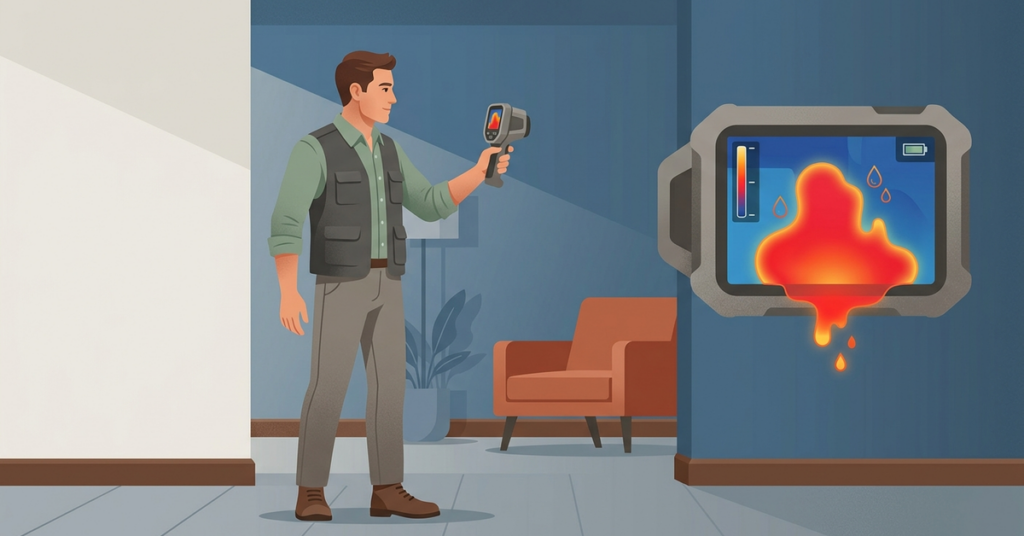
Here’s an example scenario: a homeowner in Martinez noticed her water bill had crept up significantly over a span of three months. She had not changed her habits, had no visible leaks anywhere in the house, and her utility company could not find anything unusual at the meter. After calling two plumbers who suggested “maybe the toilet flapper,” she finally had a leak detection specialist come out with thermal imaging and acoustic equipment.
The finding was a slab leak on the hot water supply line running from her garage water heater to her kitchen sink. Water had been flowing for months into the sand layer beneath her concrete slab, then migrating outward through the soil under her foundation. Her first-floor laminate floor had begun to cup slightly, which she had blamed on humidity. The subfloor beneath it was saturated. When the repair was finally completed, the total cost, including the leak detection, plumbing repair, flooring replacement, and drying of the affected area, ran over $14,000.
Slab leaks are the water damage problem homeowners rarely think about until they have one. In Georgia, where slab-on-grade construction is common and expansive clay soils respond sharply to moisture changes, a slab leak caught early can be a minor plumbing repair. A slab leak caught late can be a foundation issue.
What a Slab Leak Is and Why They Happen
A slab leak is any leak in the water supply or drain lines running inside or under the concrete slab that forms your home’s foundation. In typical slab-on-grade construction, copper or PEX supply lines and PVC or cast iron drain lines are installed before the concrete is poured, running through a bed of sand or gravel between the compacted subgrade and the underside of the slab.
Three main factors cause slab leaks over time:
Copper Pinhole Leaks
Copper supply lines, especially those installed between the 1960s and the late 1990s, are prone to pinhole corrosion in Georgia’s water conditions. The process involves small electrochemical reactions between the copper and the water or surrounding soil. Over decades, a pinhole develops and gradually enlarges, leaking slowly at first and more aggressively as the hole grows.
Hot water lines fail more often than cold water lines because elevated temperature accelerates the corrosion chemistry. This is why slab leaks frequently turn out to be on the hot side.
Physical Stress
Shifts in the soil, even small ones, can put stress on rigid pipe runs under a slab. Expansive clay in the CSRA expands when wet and contracts when dry, creating cycles of movement that metal and PVC pipes tolerate only up to a point. Connection points (elbows, tees, transitions) are the most common failure locations because they concentrate stress.
Original Installation Defects
Lines that were kinked, dented, or improperly supported during original construction can develop leaks many years later as the weak point slowly gives way. Poorly soldered joints, under-torqued fittings, and damaged insulation around hot water lines all contribute to slow failures.
Early Warning Signs You Can Check Yourself
Most slab leaks announce themselves through subtle signs long before they become obvious. Catching them in this window is the difference between a plumbing repair and a foundation repair.
Unexplained High Water Bills
This is usually the earliest sign. A leak running at one gallon per hour (barely noticeable) wastes about 720 gallons per month, which for most municipal water customers in the CSRA adds $7 to $15 to the monthly bill. At one gallon per minute (a serious active leak), you are looking at over 40,000 gallons per month and bill increases of hundreds of dollars.
The Meter Test
Turn off every water-using fixture and appliance in the house. If you have a water meter with a leak indicator (usually a small triangular or gear-shaped dial on the face of the meter), watch it for five minutes. Any movement indicates water is flowing somewhere. If the fixture shut-off is confirmed and the meter still moves, you have a leak between the meter and the nearest closed valve.
Warm Spots on the Floor
Hot water slab leaks can heat the concrete floor above the leak. Walk your floor barefoot and pay attention to localized warm areas, especially in spots where you would not expect warmth. A persistent warm patch of tile or concrete is a strong indicator of a hot water slab leak directly below.
The Sound of Running Water When Nothing Is On
If you stand in a quiet house and hear a faint running water sound with no fixtures in use, that sound is real. Slab leaks in pressurized lines produce a continuous low-volume hiss that is sometimes audible in walls or through the floor, particularly in rooms directly above the leak location.
Flooring Damage
Cupping laminate, lifting tile, discolored carpet, or a soft spot in hardwood flooring with no explanation can all signal moisture wicking up through the slab. In Georgia’s humid climate, minor floor cupping is sometimes blamed on humidity alone, but persistent cupping concentrated in one area is more often a moisture source below.
Foundation-Related Symptoms
In more advanced cases, a slab leak can affect the soil under your foundation to the point that you see structural symptoms: doors that suddenly stick, new cracks in drywall near door frames, small cracks in exterior brick or mortar, or uneven floors. These are signals that the issue has progressed far beyond a plumbing problem.
How Professional Leak Detection Actually Works
Finding a slab leak requires specialized equipment because the source is inaccessible without cutting into the concrete. Reputable leak detection specialists use a combination of methods to narrow down the location before any destructive investigation.
Thermal Imaging
Infrared cameras detect the temperature differences created by hot water leaks. The camera reveals hot water plumes radiating through the concrete, even when no surface evidence is visible. Thermal imaging is most effective for hot water supply leaks and is limited for cold water leaks or drain leaks (unless those leaks are saturating the slab enough to create evaporative cooling patterns).
Acoustic Listening
Ground microphones and electronic listening devices amplify the sound of water escaping under pressure. An experienced technician can walk the floor of a house and narrow a leak to within a small area by listening for the characteristic hiss of pressurized water escaping through a pinhole. Acoustic detection works on both hot and cold supply leaks.
Pressure Testing
Isolating sections of the plumbing and pressurizing them individually can identify which run of pipe contains the leak, which significantly reduces the area that needs to be investigated visually or acoustically.
Tracer Gas
Introducing a non-toxic tracer gas (typically hydrogen and nitrogen) into the pressurized line and then detecting where it escapes through the slab is a useful technique for very small leaks or for locating the exact escape point after other methods have narrowed the area.
Moisture Mapping
Moisture meters and hygrometers can document where water has migrated through the slab and subfloor, which helps identify the area most likely to be directly above the source.
Combining these methods typically allows a specialist to pinpoint a slab leak within a few inches of its actual location, so that the repair only requires breaking a small section of concrete rather than opening the floor across a wide area.
Repair Options After the Leak Is Found
Once the leak is located, several repair paths are possible depending on the home, the pipe, and the number of past leaks.
- Spot repair: Break the slab, expose the leaking section, repair or replace the failed pipe, and patch the slab. This is the least expensive option when a single leak has been found and other lines are in good condition.
- Reroute: Abandon the leaking line under the slab and run a replacement line through the attic or through walls to restore service without repeated concrete cutting. Often the right choice if multiple hot water leaks have occurred, because the pattern suggests more leaks are coming.
- Whole-house repipe: Replace all the under-slab lines with new runs through the attic or walls. Appropriate when the slab piping is known to be at end of life, such as older copper systems with multiple documented pinhole leaks.
The Mold Connection Most People Miss
Even after a slab leak is repaired, the moisture that migrated through the subfloor, up into wall bases, and into flooring materials can continue to feed mold growth for weeks. The EPA’s guidance on flood and leak cleanup applies equally to slab leak situations: any porous materials that were wet longer than 48 hours should be assumed to be growing mold, and drying alone does not necessarily solve the problem.
Post-repair documentation through moisture mapping and, where appropriate, mold testing provides evidence for insurance claims and ensures that the repair does not become a mold remediation project six months later. The CDC’s guidance on dealing with mold after water damage emphasizes the importance of full drying and verification, not just removal of standing water.
Your Next Steps
- If your water bill has jumped for no obvious reason, do the meter test tonight. Five minutes of watching the leak indicator can tell you whether you have a leak at all before you spend money on anything else.
- If you suspect a slab leak and the meter test confirms water is moving, call a plumber or leak detection specialist rather than start cutting concrete yourself. The cost of detection is far less than the cost of repairing an unnecessary wall opening.
- If you are buying a home with a slab foundation, ask the seller whether any slab leaks have ever been repaired, and if so how many. Repeated slab leaks often predict future ones, which changes what you should offer on the home.
- After any slab leak repair, request moisture documentation of the surrounding area. Mold that develops in the six months after a repair is usually excluded from homeowner policies but would have been included if caught during the original water event.
If you suspect a slab leak in your CSRA home or you want a professional moisture assessment after a plumbing issue, the EnviroPro 360 team can help you find the source and document the aftermath. Reach out any time.