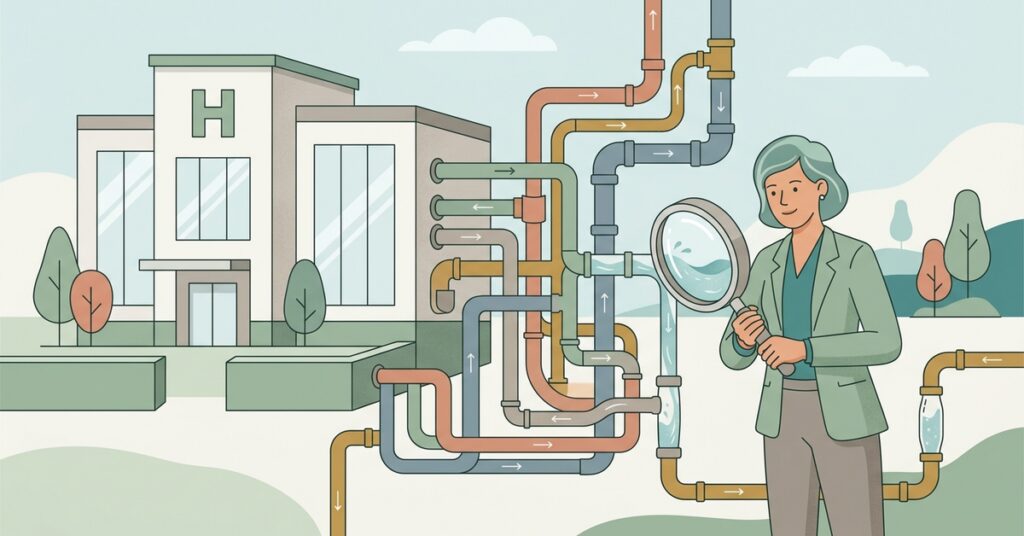
Legionella gets significant attention in healthcare settings, and for good reason. Hospitals and nursing homes concentrate immunocompromised patients in buildings with complex water systems and face specific regulatory requirements that force attention to water safety. But healthcare facilities account for a fraction of Legionella outbreaks. Residential buildings, hotels, and multi-tenant commercial properties are responsible for a substantial share of cases, and the regulatory and management frameworks for those settings are often less developed.
If you manage apartment buildings, condominiums, or other multi-unit residential properties in the Augusta area, your water system can support Legionella growth. Here is what you need to know.
How Legionella Gets Into a Building’s Water System
Legionella pneumophila (the bacterium that causes Legionnaires’ disease) is naturally present in freshwater environments at low concentrations. Municipal water treatment reduces but does not eliminate Legionella. When that water enters a building’s plumbing system, what happens next depends on the conditions it encounters.
Legionella thrives in warm water. The bacterium multiplies most rapidly between 77 and 113 degrees Fahrenheit, with optimal growth around 95 to 100 degrees. Hot water heaters set below 140 degrees Fahrenheit allow water to sit in the tank or distribution system at temperatures in the growth zone. Pipes that lose heat as they travel through exterior walls, uninsulated chase spaces, or long runs from the mechanical room reach similar conditions.
Biofilm is the other key factor. Biofilm is a layer of organic material and bacteria that adheres to pipe walls, tank surfaces, and plumbing fixtures. The CDC describes biofilm as a habitat and food source for Legionella that also protects the bacteria from disinfectants in the water. Once biofilm is established in a section of plumbing, it is difficult to eliminate without targeted treatment.
Specific Risks in Multi-Tenant Residential Buildings
Multi-unit residential buildings create conditions that are structurally more complex than single-family homes, and in some ways more favorable to Legionella amplification.
Centralized hot water systems. Large apartment buildings typically use centralized water heaters or boilers with recirculating hot water loops to maintain temperature throughout the building. If any section of the loop loses heat, or if any dead-end branch is added during a renovation without a recirculation return, that section can drop into the growth zone and harbor Legionella without the rest of the system being affected.
High turnover of units and fixtures. Units that have been vacant for extended periods have water sitting stagnant in branch pipes. Fixtures that are infrequently used, secondary bathrooms, laundry hookups, ice makers, and outdoor hose bibs all accumulate stagnant water that supports Legionella growth. When the unit is reoccupied and the faucets or showers are first run, that stagnant water flushes through and aerosolizes.
Aging plumbing. Many apartment buildings in the Augusta area were constructed in the 1960s and 1970s. The original plumbing in these buildings may include galvanized steel pipes, which corrode over time and shed corrosion products that support biofilm growth. Older pipe configurations may also include dead-end runs and low-flow sections that do not appear on any current drawing.
Cooling towers. Some multi-unit buildings use cooling towers as part of central HVAC systems. Cooling towers recirculate water through a heat exchange process that produces aerosols. If Legionella is present in the tower water, those aerosols can be inhaled by anyone in the vicinity. Cooling towers have been the source of some of the largest Legionella outbreaks on record.
Shared amenity spaces. Buildings with fitness centers, hot tubs, pools, or shared laundry facilities have additional water features that require separate attention in any water safety program.
Who Is at Risk Among Your Residents
Not everyone exposed to Legionella-contaminated water becomes sick. The most at-risk groups are adults over 50, people who smoke or have a history of smoking, people with chronic lung disease or reduced immune function, and people receiving cancer treatment or taking immunosuppressive medications.
In a diverse apartment building, you cannot know which residents fall into these categories. And since Legionella outbreaks in residential buildings often involve multiple cases before the source is identified, a single at-risk resident who becomes ill from your building’s water system represents both a human tragedy and a significant liability event.
The CDC’s Morbidity and Mortality Weekly Reports regularly include descriptions of Legionella cluster investigations in residential and commercial buildings. A recurring theme in these reports is that the building’s water system had not been assessed for Legionella risk and no water management plan was in place before the outbreak occurred.
What ASHRAE 188 Recommends for Non-Healthcare Buildings
ASHRAE 188, the primary guidance document for Legionella water management in buildings, is a consensus standard from the American Society of Heating, Refrigerating and Air-Conditioning Engineers. While ASHRAE 188 is required for healthcare facilities under Centers for Medicare and Medicaid Services (CMS) regulations, it is voluntary for most other building types.
However, ASHRAE 188 represents best practice, and courts and regulators increasingly look to it as the standard of care in Legionella-related litigation. A property manager who can document that their building followed an ASHRAE 188-compliant water management plan is in a fundamentally different legal position than one who cannot.
The core elements of an ASHRAE 188 water management plan include:
- A building water system schematic showing all components where Legionella could grow
- A risk assessment for each component
- Defined control measures for each risk (temperature management, disinfection, flushing protocols)
- Monitoring parameters and frequencies
- Documented corrective actions when parameters fall outside limits
- An annual review and update of the plan
Practical Steps for Property Managers
You do not need to become a Legionella expert to manage this risk appropriately. You do need to make sure someone with expertise has assessed your building and that a functioning water management plan is in place.
Confirm your hot water temperature. Water in storage tanks and at the heater outlet should reach 140 degrees Fahrenheit. Water delivered at fixtures used by residents can be tempered down to 120 degrees to prevent scalding, but the storage and distribution temperature upstream of the mixing valve should be maintained at 140 degrees. Measure and document this.
Flush vacant units before reoccupancy. Establish a written protocol for flushing all fixtures in units that have been vacant for more than a week before a new tenant occupies them. This means running all faucets, the shower, and any other water outlets until the water runs at the temperature of the main distribution line. Document that this was done.
Address cooling towers. If your building has a cooling tower, it requires a separate water treatment and testing program. Quarterly Legionella testing of cooling tower water is the baseline expectation in most guidance documents. This is not optional.
Survey for dead-end runs and infrequently used fixtures. Walk the building and note any fixtures, branch pipes, or water features that are not in regular use. These need to be on a flushing schedule.
Commission a water management plan. If your building does not have a formal Legionella water management plan, commission one. For multi-unit residential buildings in Augusta, particularly those with centralized hot water systems and residents over 50, this is an appropriate risk management step.
If you manage multi-unit residential or commercial property in the CSRA and want to talk through where your building’s water system stands from a Legionella risk perspective, the EnviroPro 360 team is ready to help. Reach out any time.