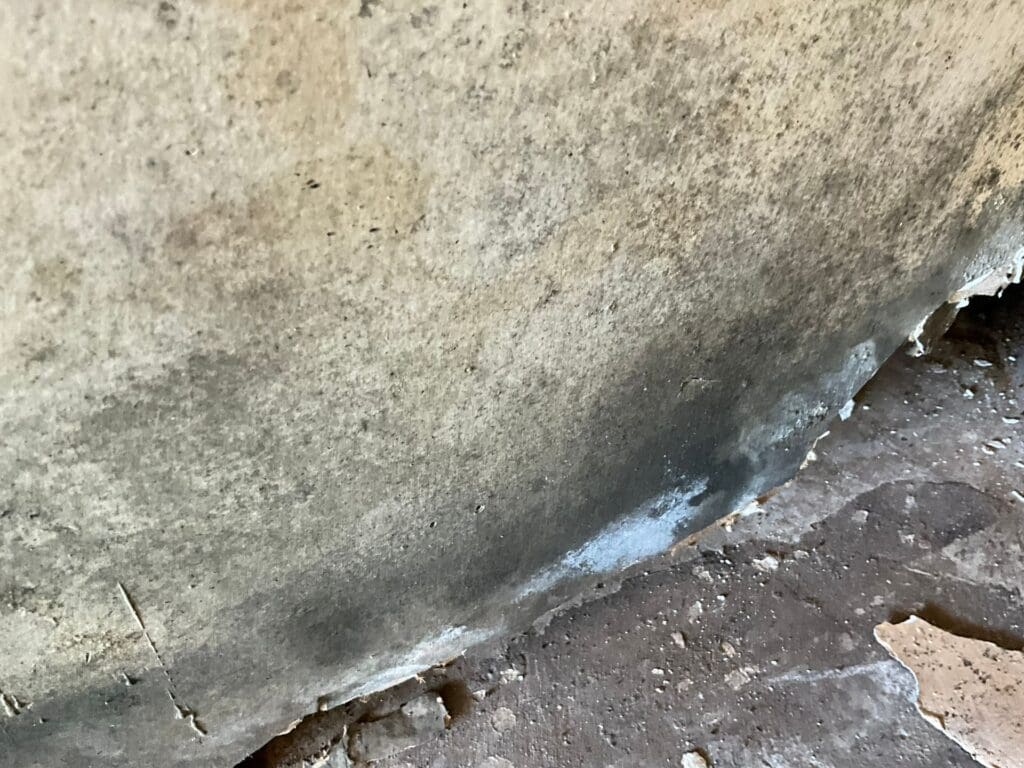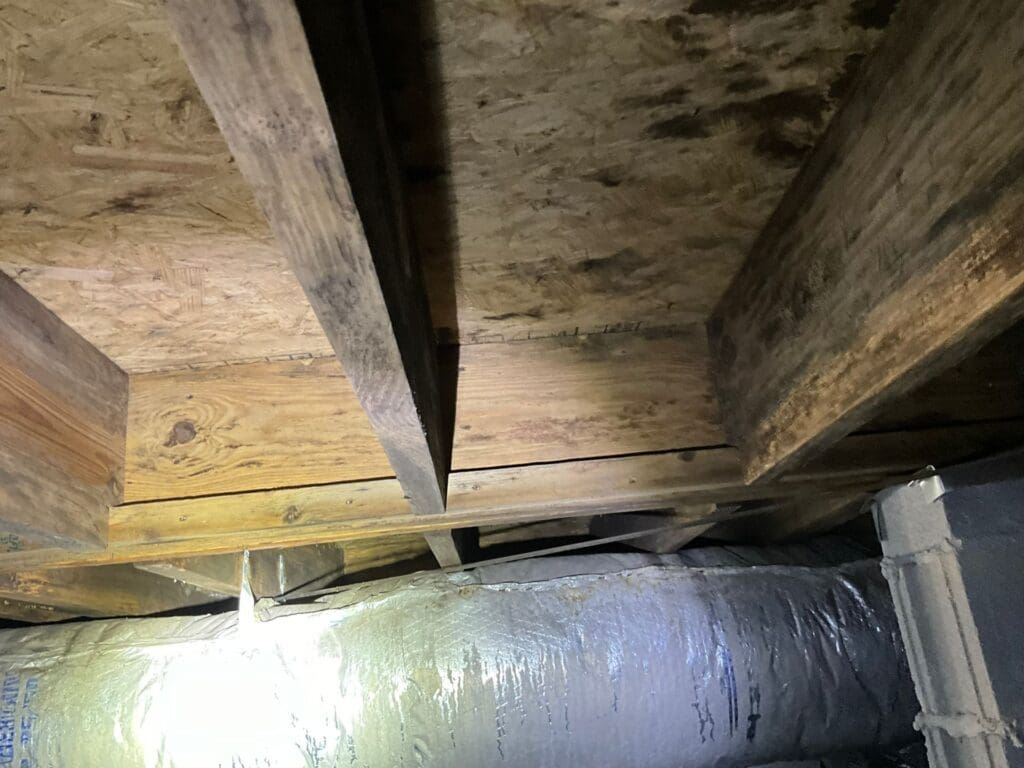
Here’s an example scenario: a family in Grovetown noticed a persistent musty odor in their master bedroom. Everything looked fine. No staining on the walls, no visible growth, no obvious water damage. The homeowner had opened windows, run dehumidifiers, replaced HVAC filters, and bought an air purifier. The smell persisted.
A moisture investigation revealed elevated moisture readings in a 4-foot section of exterior wall below a window. Infrared imaging showed a cold spot consistent with a water pathway. When the wall was opened, the inspector found a mold colony covering the back side of the drywall, the insulation, and the framing behind the window. A failed window flashing had been letting rainwater into the wall cavity for at least two years. Nothing on the finished side of the wall had ever betrayed the problem.
This is common in Georgia homes, especially in humid conditions and where moisture can enter a wall from small defects in siding, flashing, windows, or roof intersections. The most important signs of hidden mold are not visible mold. They are the environmental and physical clues that mold is growing somewhere you cannot see it.
Why Hidden Mold Is So Common
Walls, ceilings, floors, and other cavities in a home are biological landscapes in their own right. They have organic materials (paper-faced drywall, wood framing, cellulose insulation, adhesives), variable moisture levels, and limited air circulation. When moisture enters a cavity and does not dry out promptly, mold growth on the back of drywall or on framing can develop over weeks or months without any visible change on the finished side of the wall.
The EPA’s guidance on hidden mold specifically identifies wall cavities, above ceiling tiles, behind wallpaper, under carpet and padding, and inside HVAC systems as the most common locations for hidden growth. In each case, the growth surface is separated from the occupant by a layer of drywall, tile, flooring, or ductwork.
Georgia’s humidity compounds the problem. Indoor relative humidity during summer months in the CSRA often runs 55 to 70% even with air conditioning, and cooler surfaces within wall cavities (where sheathing or framing touches uninsulated exterior surfaces) can reach the dew point more easily. Condensation inside walls is common and goes undetected without testing.
The Seven Warning Signs Worth Investigating
When these signs appear and persist, hidden mold is a plausible explanation, especially if no visible source is found.
1. A Persistent Musty Odor With No Visible Source
The smell of mold is produced by microbial volatile organic compounds (MVOCs), chemical byproducts of fungal growth. MVOCs move through wall cavities and out into living spaces more easily than mold spores do. A space can smell obviously moldy even when air sampling shows normal spore counts, because the spores are contained inside the cavity while the MVOCs leak out.
If you can smell mold in a room, you have mold somewhere, even if you cannot see it. The smell is the sign. The location of the growth is what investigation is for.
2. Symptoms That Track With Specific Rooms
If a family member has respiratory symptoms, headaches, or fatigue that get worse in a specific room or area of the home and improve when they leave, the room is telling you something. Mold exposure symptoms typically correlate with time spent in the exposed environment. When symptoms are persistent and tied to location, a thorough investigation of that space, including moisture readings and cavity inspection, is warranted.
The CDC’s information on mold notes that people with mold sensitivities, asthma, or weakened immune systems can react to lower concentrations than a healthy adult would notice, which sometimes means one person in the home has clear symptoms while others do not.
3. Discoloration That Keeps Coming Back After Cleaning
Staining on walls, ceilings, or flooring that reappears after you clean it is often surface growth being fed by a moisture source behind the finished material. The visible staining is the leaf. The growth you do not see is the root system.
Ceiling discoloration around fixtures or pipes that you clean and paint over, only to see it reappear within months, is a classic sign of hidden moisture with hidden growth.
4. Persistent Higher Humidity in One Area
Most homes have relatively even indoor humidity. If one room consistently reads significantly higher humidity than surrounding spaces (often the bathroom, kitchen, or a basement room, but sometimes a bedroom against an exterior wall), there may be a moisture source in that room’s walls, floors, or ceiling.
A basic indoor hygrometer costs $15 and can tell you a lot. Move it from room to room and let it stabilize in each location for 30 minutes. A room that runs 10 to 15 percentage points higher than the rest of the house is worth investigating further.
5. Buckled, Peeling, or Cracking Paint or Wallpaper
Paint or wallpaper that develops bubbles, lifts at edges, or cracks in patterns can indicate that moisture is moving from inside the wall outward. This happens when the wall cavity carries more vapor than can pass through the finished surface.
On exterior walls, this symptom often shows up near the bottom of the wall or near windows, where water enters and pools.
6. Warped or Buckled Flooring
Hardwood, laminate, or engineered flooring that cups, crowns, or separates at joints is reacting to moisture from below or beside it. A single board warping is usually a spill. A pattern of warping across a significant area, with no identifiable event, often points to a moisture source in the subfloor or the adjacent wall base.
7. Respiratory Symptoms That Started After a Specific Event
Mold problems frequently start with a moisture event: a plumbing leak, a roof leak, an HVAC condensate overflow, an ice maker failure, a washing machine hose burst. If symptoms began in the weeks after such an event and persist, even if the visible damage was cleaned up, the possibility of hidden growth in places the cleanup did not reach is significant.
The EPA’s mold cleanup guide is explicit: water damage that is not fully dried within 48 hours is likely to result in mold growth, and the growth may not be visible from occupied spaces.
What an Investigation Looks Like
When the signs above point to the likelihood of hidden mold, a proper mold testing investigation goes beyond a visual inspection. A typical hidden-mold investigation includes:
- Detailed visual inspection of all accessible surfaces including inside cabinets, behind furniture, in closets, and at wall-floor transitions
- Moisture meter readings at systematic intervals across suspect walls, floors, and ceilings, with comparison to unaffected areas as control
- Infrared thermal imaging to identify cold spots that suggest moisture pathways or cavity condensation
- Humidity and temperature logging over at least 24 to 48 hours to identify patterns
- Air sampling in the affected areas and in controlled unaffected locations, with results compared to outdoor baseline
- Cavity inspection through carefully placed access holes in locations identified by the non-destructive tools above
The last step is often where the actual finding happens. Non-destructive methods narrow the probability; a small inspection opening confirms what is actually inside the wall.
The Mistake to Avoid
The most common mistake homeowners make is painting, sealing, or covering over a suspect area. An encapsulating primer marketed as “mold-resistant” applied over a wall that has mold growing on the other side does nothing to stop the growth. It just delays discovery and allows the colony to continue expanding. By the time the problem forces its way through the paint again, the cavity damage is worse.
Encapsulation has a place in mold remediation, but only after the moisture source has been fixed, the affected materials have been removed, and the cavity has been dried. It is not a substitute for investigation.
Your Next Steps
- Walk through your home this week and note any persistent musty odors, suspect staining, or areas that feel consistently more humid than the rest of the house. Write them down.
- If someone in your household has symptoms tied to a specific room, take that pattern seriously. Move the person out of the room temporarily if possible and note whether symptoms improve, which confirms the connection.
- If you have had a water event in the past 12 months, review whether the cleanup included actual drying and verification, or just removal of the visible water. A visible cleanup is often not sufficient.
- If signs point to hidden mold, have a professional investigation before you start cutting walls yourself. The combination of thermal imaging, moisture mapping, and air sampling usually finds the problem with far less destruction than DIY exploration.
If you suspect hidden mold in your CSRA home and want a thorough investigation rather than a surface-level inspection, the EnviroPro 360 team is happy to help. Reach out any time.