Here’s an example scenario: a homeowner in Martinez notices a faint musty smell in the master bathroom. The walls look fine. The ceiling looks fine. No visible water anywhere. She assumes it’s just the humidity and runs the exhaust fan more often. Six months later, a contractor opens the wall during a planned renovation and finds black mold covering the back side of the drywall, rotted wall studs, and saturated insulation. The source: a slow drip from a supply line connection behind the shower valve that had been leaking for over a year.
The repair cost $14,000. The leak detection that would have caught this problem six months earlier would have cost a few hundred dollars.
Why Hidden Leaks Are So Destructive
Water follows gravity and capillary action, traveling along pipes, framing, and building materials in directions you wouldn’t predict. A leak at one location can cause damage feet or even rooms away from the source. And because the water is hidden inside wall cavities, under flooring, or above ceilings, it creates the perfect environment for secondary damage before anyone sees a single drop.
Mold growth. The EPA states that mold can begin growing on wet materials within 24 to 48 hours. A hidden leak that persists for weeks or months creates extensive mold colonies inside wall cavities, under flooring, and in insulation. By the time mold becomes visible on room surfaces, the growth behind those surfaces is typically far more advanced.
Structural damage. Wood framing that stays wet rots. Subfloor sheathing weakens. Drywall loses structural integrity. Steel fasteners corrode. In Georgia’s humid climate, moisture trapped inside building cavities doesn’t dry easily because the ambient humidity outside is often as high as the moisture level inside the wall.
Insulation failure. Fiberglass insulation that absorbs water loses its insulating value and becomes a reservoir that keeps surrounding materials wet indefinitely. It won’t dry on its own in an enclosed cavity.
Pest attraction. Termites, carpenter ants, and other wood-destroying organisms are attracted to moisture-damaged wood. A hidden leak can create the conditions that bring these pests into your home.
How Professional Moisture Assessment Works
Professional leak detection and moisture assessment uses specialized instruments that see what your eyes can’t. Two technologies do the heavy lifting.
Thermal Imaging (Infrared Cameras)
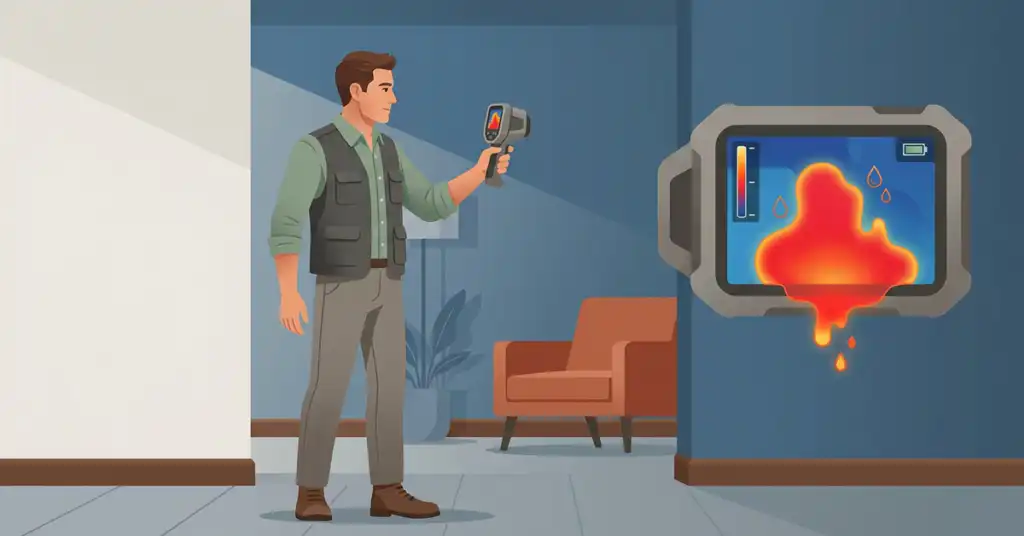
An infrared camera detects temperature differences across surfaces. Water evaporating from a wet area cools the surface slightly, creating a temperature differential that the camera renders as a distinct pattern on screen. A dry wall appears as a uniform temperature field. A wall with moisture behind it shows a cooler zone with a characteristic pattern that experienced technicians recognize immediately.
Thermal imaging is non-invasive. Nobody drills holes or opens walls. The camera scans wall, ceiling, and floor surfaces from the room side and identifies moisture patterns that are completely invisible to the naked eye. It can also detect heat loss from HVAC duct leaks, missing insulation, and air infiltration.
Thermal imaging is particularly effective for:
– Locating water intrusion behind finished walls and ceilings
– Tracing the path of water from the entry point to where it pools
– Identifying wet areas under flooring without removing floor coverings
– Detecting HVAC condensation or duct leaks in concealed spaces
Moisture Meters
Moisture meters provide quantitative data. Two types are commonly used:
Pin-type meters insert two small pins into the material and measure electrical resistance between them. Wet materials conduct electricity more readily, producing higher readings. Pin meters give precise readings at specific points and can measure moisture at different depths by driving the pins deeper.
Pinless (capacitance) meters use an electromagnetic field to detect moisture without penetrating the surface. They scan larger areas quickly and are useful for mapping the extent of moisture across a wall or floor without damaging finishes.
A professional assessment typically uses both technologies together: thermal imaging identifies the suspect areas, and moisture meters confirm and quantify the moisture levels at specific points.
When You Need a Moisture Assessment
Musty odors without a visible source. If you smell mold or mildew but can’t see any water damage or growth, there’s likely hidden moisture feeding hidden mold.
Stains that appear and disappear. A water stain on a ceiling or wall that shows up after rain and fades during dry weather indicates intermittent water intrusion. The area behind that stain is likely cycling between wet and partially dry, which is ideal for mold growth.
After any water event. If your home experienced flooding, a burst pipe, an appliance leak, or a roof leak, professional moisture mapping confirms that all affected materials have dried completely. “It looks dry” is not the same as “it is dry.” Materials inside wall cavities can retain moisture for weeks after surfaces appear dry.
Unexplained increases in water bills. A supply line leak inside a wall or under a slab can waste thousands of gallons before it creates visible damage.
Before buying a home. Adding moisture assessment to your pre-purchase inspection can identify hidden water damage that a standard visual inspection would miss. This is especially relevant for homes with crawl spaces, older plumbing, or any history of water issues.
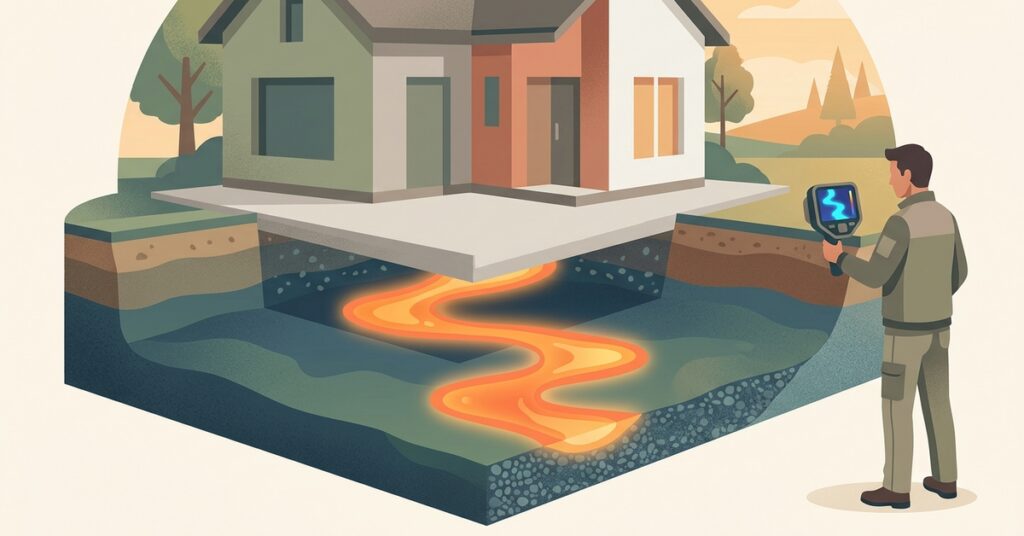
Crawl space concerns. In the Augusta area, crawl spaces are vulnerable to moisture intrusion from Georgia’s red clay soil, high water tables, and humid air. Thermal imaging and moisture meters can assess the condition of floor joists, subfloor sheathing, and insulation from within the crawl space.
The Cost Comparison
The math on hidden leaks is straightforward. A professional moisture assessment for a residential property typically costs $200 to $500 depending on the size of the area being evaluated.
Compare that to the cost of the damage hidden moisture causes when left undetected:
- Mold remediation in a wall cavity: $1,500 to $5,000+
- Structural framing repair: $2,000 to $10,000+
- Complete bathroom gut-and-rebuild due to long-term hidden leak: $10,000 to $25,000+
- Insurance complications if damage was “gradual” rather than “sudden” (many policies exclude gradual water damage)
Early detection doesn’t just save money on repairs. It preserves the structural integrity of your home and prevents the health effects associated with long-term mold exposure.
What You Can Do
-
Pay attention to subtle signs. Musty smells, unexplained humidity in specific rooms, warped baseboards, soft spots in flooring, and paint that bubbles or peels in isolated areas can all indicate hidden moisture. Don’t dismiss them.
-
Check your crawl space. If your home has a crawl space, inspect it at least twice a year for standing water, condensation on surfaces, visible mold on floor joists, and the condition of any vapor barrier. If you’re uncomfortable doing this yourself, a professional assessment covers it.
-
Act fast after any water event. If a pipe bursts, an appliance leaks, or water enters your home from any source, don’t assume that drying the visible water solved the problem. Professional moisture mapping confirms what’s happening inside the walls and under the floors.
If you suspect hidden moisture in your home or want a professional assessment, the EnviroPro 360 team has the equipment and experience to find it. Reach out here and we’ll help you catch the problem before it gets expensive.