Here’s an example scenario: during a routine CMS survey at a long-term care facility in Georgia, a surveyor asks to see the water management program. The administrator produces a binder assembled two years ago by a consultant. The surveyor opens it, finds the most recent water temperature log is from eleven months ago, sees no Legionella test results on file, and notes that the person listed as the water management team lead left the facility eight months ago. The survey results in a deficiency citation.
Having a water management program is not the same as implementing one. Since 2017, the Centers for Medicare & Medicaid Services (CMS) has required healthcare facilities to maintain active, functioning water management programs that reduce the risk of Legionella and other waterborne pathogens. The standard they reference is ASHRAE 188.
What ASHRAE 188 Is
ASHRAE Standard 188, “Legionellosis: Risk Management for Building Water Systems,” was published by the American Society of Heating, Refrigerating and Air-Conditioning Engineers. It provides a risk management framework for preventing Legionnaires’ disease, a severe form of pneumonia caused by inhaling aerosolized water contaminated with Legionella bacteria.
The standard applies to any building that meets certain risk criteria, but it’s healthcare facilities that face the most direct regulatory enforcement through CMS.
The CDC developed a companion toolkit that translates ASHRAE 188’s framework into a practical, step-by-step guide. Together, these two documents form the foundation that CMS expects healthcare facilities to follow.
The CMS Requirement
CMS Survey & Certification memo S&C 17-30, issued in June 2017, established that healthcare facilities must develop and adhere to policies that reduce the risk of Legionella disease. This memo applies to hospitals, long-term care facilities, and other facilities certified to participate in Medicare or Medicaid.
CMS does not mandate ASHRAE 188 by name. It requires facilities to have a water management program that follows “industry standards,” and ASHRAE 188 combined with the CDC toolkit is what surveyors use as the benchmark. If a surveyor asks whether your program follows ASHRAE 188 and you say no, you need a very good explanation of what alternative standard you’re following.
Non-compliance findings during CMS surveys can result in:
– Deficiency citations on your survey report
– Requirements for corrective action plans with defined timelines
– Conditions of immediate jeopardy if patient harm is involved or imminent
– Civil monetary penalties
– In extreme cases, termination of the Medicare provider agreement
The Seven Elements of ASHRAE 188 Compliance
1. Establish a Water Management Program Team
The standard requires a multidisciplinary team with defined roles and authority. At minimum, this includes someone from facilities/maintenance, someone from infection prevention, and someone from administration with authority to allocate resources.
In practice, the team also benefits from including environmental services, risk management, and any consultants providing water treatment or testing services. The team must have a designated leader.
CMS survey tip: Surveyors will ask to see a list of team members with their roles, and they’ll verify that the team is meeting regularly by reviewing meeting minutes.
2. Describe the Building Water Systems
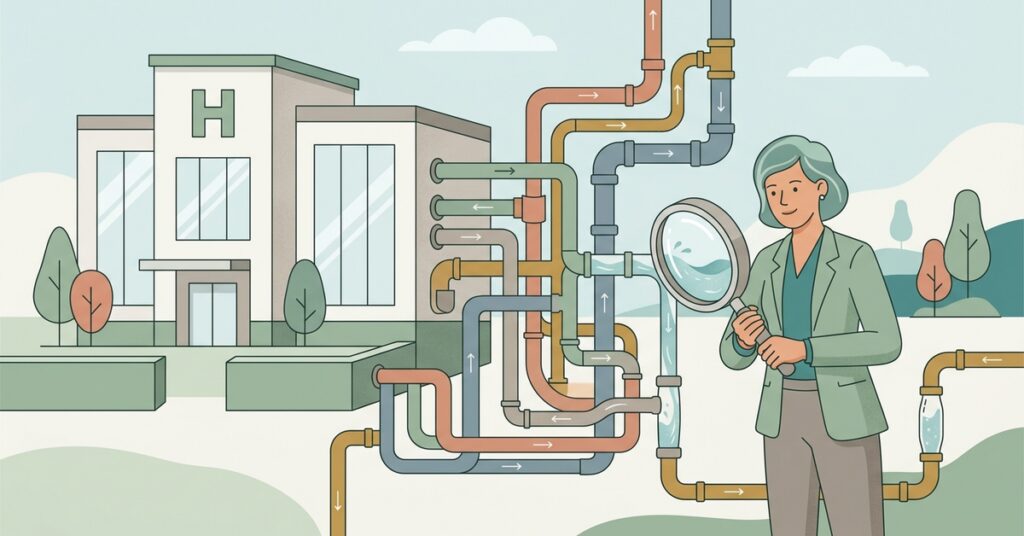
Create a written description and flow diagram of your facility’s water systems. This includes the water supply source, water heaters and storage tanks, the distribution system (risers, branches, points of use), cooling towers, decorative fountains, hydrotherapy pools, ice machines, and any other equipment that uses building water.
Identify dead legs (sections of pipe serving decommissioned rooms or equipment), low-flow or no-flow areas, and any point where water temperature may fall into the Legionella growth range of 77°F to 113°F (25°C to 45°C).
CMS survey tip: A surveyor may walk the facility and ask whether specific water features (a decorative fountain in the lobby, ice machines on patient floors) are included in your system description. If they’re not, that’s a gap.
3. Identify Where Legionella Could Grow and Spread
Using the system description, identify specific points where conditions favor Legionella amplification (growth) and points where contaminated water could be aerosolized and inhaled. Amplification points include areas of warm water stagnation, biofilm accumulation, and inadequate disinfectant residual. Dissemination points include showers, faucets, cooling tower drift, and any device that generates water aerosols.
4. Determine Control Measures for Each Hazard
For each identified hazard, define specific control measures. Common examples:
- Hot water temperature: Maintain storage above 140°F (60°C) and circulation return above 124°F (51°C). Monitor point-of-use temperatures to confirm delivery above 122°F (50°C) while managing scald risk.
- Cold water temperature: Maintain below 68°F (20°C). Warm cold water pipes near heat sources are a growth risk.
- Stagnation management: Flush low-use outlets (unoccupied patient rooms, infrequently used sinks) on a defined schedule.
- Disinfectant residual: Monitor and maintain adequate disinfectant levels throughout the distribution system.
- Cooling tower treatment: Maintain biocide program and water chemistry within specified parameters.
5. Monitor Control Measures
Define monitoring frequency, methods, and acceptable ranges for each control measure. Temperature monitoring is the most common, using calibrated thermometers at representative points. Disinfectant residual monitoring, cooling tower chemistry logs, and flushing logs all fall under this element.
CMS survey tip: Surveyors look at monitoring records. Gaps in records suggest gaps in implementation. Consistent, current records demonstrate active management.
6. Establish Corrective Actions
Define what happens when monitoring reveals a problem. If a hot water temperature reading at a point of use comes back at 105°F instead of the target 122°F, what’s the response? Who is notified, what’s the timeline for investigation, and what actions are taken?
Corrective actions must also address what happens when environmental Legionella testing returns positive results, and what happens if a healthcare-associated Legionnaires’ disease case is identified.
7. Verify the Program is Working
Verification goes beyond routine monitoring. It includes periodic review of the entire program, trending of monitoring data, and environmental testing for Legionella. The CDC toolkit recommends environmental cultures as part of program verification, particularly during the initial implementation phase and periodically thereafter.
Legionella cultures from water samples and biofilm swabs, reported in colony-forming units per liter (CFU/L), provide direct evidence of whether your control measures are keeping Legionella below acceptable levels.
What to Do
-
Audit your current program against these seven elements. If any element is missing or only exists on paper without supporting documentation, that’s the gap to close first.
-
Verify your team is active. Meeting regularly, reviewing monitoring data, and responding to deviations. A team that existed when the program was written but hasn’t met in six months is a survey finding waiting to happen.
-
Include environmental testing. Temperature monitoring alone doesn’t confirm the absence of Legionella. Periodic water sampling and lab analysis provides direct evidence that your control measures are effective.
If your facility needs Legionella testing, help developing a water management program, or a review of your existing program, the EnviroPro 360 team works with healthcare facilities throughout the CSRA. Get in touch and we’ll help you get your program where it needs to be.