Most asbestos exposure in commercial buildings doesn’t happen during formal demolition projects. It happens during routine maintenance — a plumber cutting into insulated pipe, an HVAC technician repositioning ductwork, a contractor removing a ceiling tile. The asbestos was already there, often in plain sight, and no one thought to question it.
If you manage or own a commercial building constructed before 1980, understanding what asbestos-containing insulation looks like — and what condition it’s in — is the starting point for managing the risk.
Why Insulation Is the Priority Concern
Asbestos was used across many building material types, but insulation deserves particular attention for two reasons. First, it was used extensively — in mechanical rooms, pipe systems, ceilings, and attic spaces across virtually every commercial building type of that era. Second, it deteriorates. Unlike floor tile, which tends to stay intact unless physically disturbed, insulation can degrade with age, moisture, and vibration, releasing fibers even without active renovation work.
According to OSHA’s construction standard (29 CFR 1926.1101), pre-1981 thermal system insulation must be treated as presumed asbestos-containing material unless testing has confirmed otherwise — meaning the regulatory obligation to manage it carefully applies regardless of whether you’ve had a formal survey.
What the Different Types Look Like
Pipe and Boiler Insulation
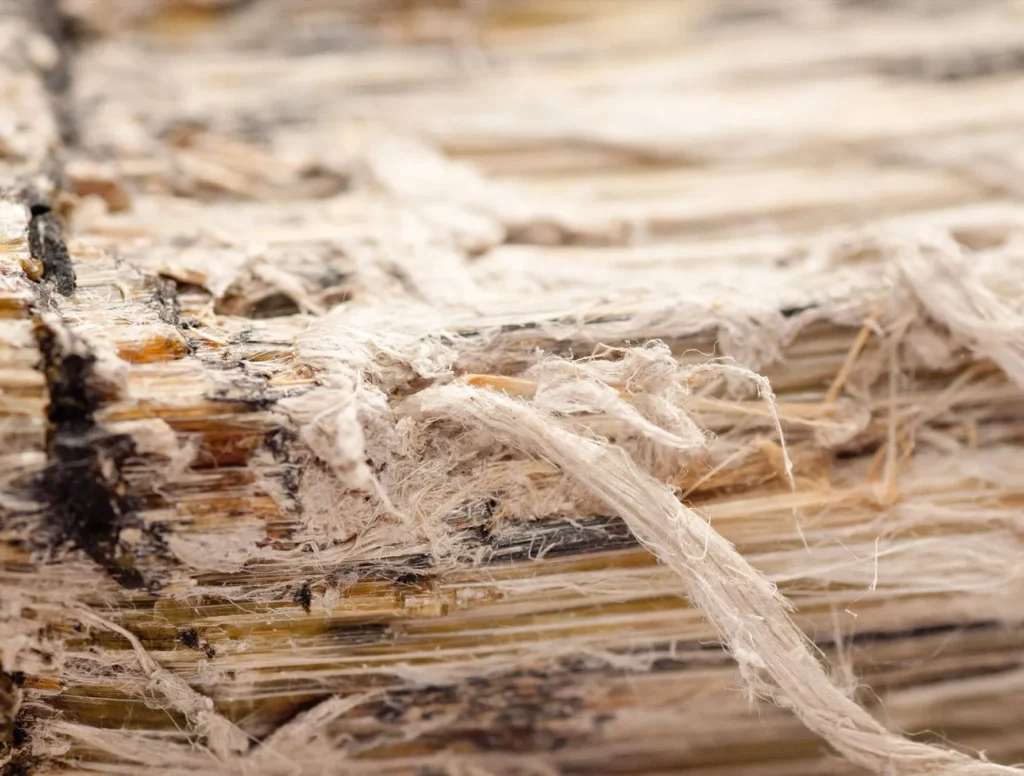
The most common source of asbestos-related exposure in older commercial buildings. Asbestos pipe insulation typically appears as:
- White or gray corrugated wrap around steam and hot water lines, often with a deteriorating cloth or canvas outer layer
- Preformed half-cylinder sections secured with metal bands — chalky, light gray, and crumbly when degraded
- Hand-applied paste (“mud”) around elbows, valves, and fittings — often flaking or crumbling at irregular joints
Deterioration signs to watch for: crumbling at fittings, loose or missing bands, water staining, cloth covering that has worn through. Any of these indicate elevated risk of fiber release during nearby work. Full detail on asbestos pipe insulation in commercial buildings.
Sprayed-On Ceiling Insulation and Fireproofing
Found in warehouses, schools, and commercial buildings where spray-applied fireproofing was applied to structural steel or concrete decking. It typically appears as a rough, gray or off-white textured coating — similar to thick, uneven plaster. When intact, it’s cohesive. When deteriorating, it becomes friable — easily crumbled by hand pressure — and may flake or dust onto surfaces below.
A drop ceiling installed beneath original spray-applied insulation is a common scenario in older office buildings. The material above is undisturbed and often forgotten until the ceiling grid is removed for renovation or maintenance work.
Loose-Fill Attic Insulation
Recognizable by small, accordion-shaped granules in gray-brown or gold tones, typically poured between attic floor joists. If your building has an accessible attic from this era, this material should be treated as potentially contaminated until tested. Disturbing it without precautions — even walking through the attic — can release fibers. Full detail on vermiculite loose-fill insulation.
Ceiling Tiles and Lay-In Panels
Older lay-in ceiling tiles common in 1960s and 1970s office buildings often contained asbestos binders. They typically look like standard 2×2 or 2×4 ceiling tiles — off-white with a textured or perforated surface. Tiles in good condition with no visible damage or water staining are generally low risk in place. Broken, crumbling, or water-damaged tiles are higher risk and warrant assessment before any work in the area.
Floor Tile and Mastic
9-inch vinyl floor tiles and the black adhesive mastic beneath them are a very common ACM in commercial buildings of this era. The tile itself may be intact and manageable. The mastic beneath often remains even when new flooring has been installed on top of the original tiles. Any renovation involving floor removal should include testing for both tile and mastic before work begins.
Low Risk vs. When to Act
Asbestos-containing materials in good condition — intact, undisturbed, not in a location where they’ll be contacted during routine work — can generally be managed in place under an operations and maintenance (O&M) plan rather than removed immediately.
The risk profile changes when:
- Material is friable — crumbles when handled or shows surface dusting
- Routine maintenance will bring workers into contact with the material
- Renovation or demolition is planned that will disturb the material
- Water damage has affected the material
- The material is in a high-traffic area where physical contact is likely
Any of these conditions warrants a professional assessment before work proceeds — not after.
Georgia and South Carolina Requirements
Both states require a pre-renovation asbestos survey before demolition or renovation work in commercial buildings. In Georgia, this is enforced by the EPD under EPA’s Asbestos NESHAP with 10 business days advance notification required. In South Carolina, SC DHEC enforces similar requirements under Regulation 61-86.1. Full pre-renovation checklist for Georgia and South Carolina property managers.
Getting a Building Assessment
If you manage a pre-1980 commercial building in Georgia or South Carolina and haven’t had a formal asbestos survey, the practical first step is an inspection by a state-licensed asbestos inspector. The inspector will identify suspect materials, collect bulk samples, and deliver a written report showing what’s present, where it is, what condition it’s in, and what needs to happen before renovation or maintenance work begins.
EnviroPro 360 provides asbestos surveys and testing for commercial properties across the CSRA. If you have questions about what a building assessment involves or want to schedule an inspection, reach out any time.