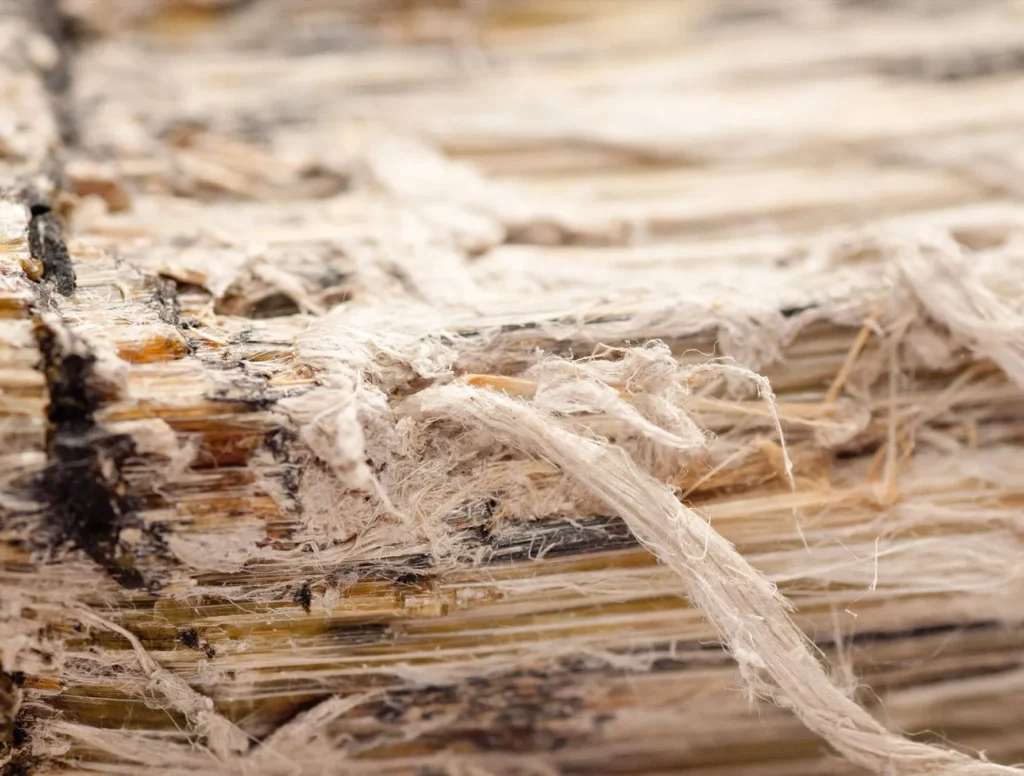
A facilities manager at an Augusta-area office building recently discovered white, flaking insulation on a hot water pipe that needed repair. He halted work before the plumber started cutting and had the material tested. Results confirmed chrysotile asbestos, the most common asbestos fiber type. Had that plumber cut into the line without precautions, he would have released fibers throughout the mechanical room and into the return air for the entire building.
That scenario plays out regularly in older commercial buildings across Georgia and South Carolina. Pipe insulation is one of the most common remaining sources of asbestos in the commercial building stock, and it is frequently encountered during routine maintenance work that no one initially intended as an asbestos disturbance.
Why asbestos was used in pipe insulation
Between the 1920s and the late 1970s, asbestos-containing insulation became the standard material for steam and hot water piping systems in commercial buildings. It offered properties that alternatives at the time could not match: fire resistance, moisture protection, durability, easy moldability around fittings and elbows, and low cost.
EPA regulations from the late 1970s restricted new applications, but existing installations in buildings were not required to be removed. Any commercial building constructed before 1981 likely still contains original asbestos pipe insulation unless it has been specifically surveyed and abated. Under OSHA 29 CFR 1926.1101, contractors are required to treat pre-1981 pipe insulation and related materials as presumed asbestos-containing material (PACM) unless testing has demonstrated otherwise, meaning the presumption of asbestos applies regardless of whether the building owner has conducted a survey.
Recognizing asbestos pipe insulation: four common forms
Corrugated or air-cell insulation
The most visually distinctive form: a white, accordion-style ridged wrap around the pipe, often covered with deteriorated cloth or canvas. It looks similar to flattened cardboard wrapped around a pipe. This material is frequently found on steam and high-temperature hot water lines in boiler rooms and mechanical spaces. When the cloth covering deteriorates, the underlying corrugated material is exposed and can release fibers with handling.
Preformed block or sectional insulation
Molded half-cylinder sections secured with metal bands or wire, designed to fit standard pipe diameters. This material typically appears chalky, crumbly, and light gray or white. It is commonly found on larger-diameter pipes in mechanical rooms and utility corridors. Sections that are no longer banded tightly or that show surface crumbling are higher-risk than intact, well-secured sections.
Elbow and fitting insulation (mudded fittings)
Pipe elbows, valves, and fittings were typically insulated with a hand-applied asbestos-cement paste, commonly called “mud,” wrapped with cloth. These mudded fittings are especially fiber-rich relative to straight-run insulation and are often in poor condition, as the irregular geometry makes them harder to maintain intact. They are a priority testing target in any pre-1981 mechanical system.
Paper or felt wrap
Thinner fiber-paper or felt wrapping was used on cold water and chilled water lines. It appears as rough, brownish paper wrap, often crumbling or peeling at joints. While less fiber-rich than high-temperature pipe insulation, it is easily overlooked and disturbed during routine work on cold water lines.
Where to look in commercial buildings
Asbestos pipe insulation is not confined to mechanical rooms. In older commercial buildings it is found throughout the building envelope:
- Mechanical and boiler rooms: The highest concentration: main supply and return lines, boiler connections, and pump piping
- Above drop ceilings: Branch lines running to terminal units, fan coil units, and radiators throughout office and corridor spaces, often entirely out of sight until ceiling work begins
- Kitchens and cafeterias: Hot water supply lines and steam lines serving food service equipment
- Behind access panels: Bathroom chases, janitor closets, and mechanical chase walls often conceal insulated piping
- Basements, parking levels, and utility tunnels: Main distribution lines running horizontally between mechanical rooms and building zones
- Pipe penetrations through floors and walls: Where pipes pass through fire-rated assemblies, insulation is frequently present and often disturbed during renovation
How exposure happens during routine maintenance
The most common asbestos exposure events in commercial buildings do not occur during formal demolition projects. They occur during everyday maintenance work where no one anticipated encountering asbestos:
- A plumber cutting or grinding a pipe runs through insulated sections
- An HVAC technician repositioning ductwork bumps into insulated steam lines above the ceiling
- An electrician drilling through a wall penetrates an insulated pipe chase
- A general contractor removing a drop ceiling grid dislodges deteriorated pipe insulation above
- A roofer working on penetrations disturbs insulated lines at the roof deck level
- A maintenance worker taping or patching deteriorating insulation without protective equipment
Each of these scenarios can release fibers into occupied or adjacent spaces. Asbestos fibers remain airborne for hours after disturbance before settling, meaning a brief disturbance in a mechanical room can affect air quality in areas served by the same air handling system.
OSHA work classifications for pipe insulation disturbance
OSHA 29 CFR 1926.1101 classifies asbestos-related construction work into four categories, each with different worker protection and containment requirements. Pipe insulation work typically falls into the higher-risk classes:
- Class I: Removal of thermal system insulation (TSI), including pipe and boiler insulation, and surfacing ACM. This is the highest-risk classification. It requires regulated areas, full containment or glove-bag methods, supplied-air respirators or full-face respirators with P100 filters, decontamination units, and a competent person on-site at all times.
- Class II: Removal of other ACM including floor tile, roofing, and siding. Less stringent than Class I but still requires regulated areas, PPE, and a competent person.
- Class III: Repair and maintenance operations where ACM may be disturbed incidentally. Requires training, PPE, and air monitoring.
- Class IV: Cleanup and custodial work in areas where ACM has been disturbed. Requires HEPA vacuums, PPE, and training.
Contractors who disturb pipe insulation without understanding these classifications, and without the training, equipment, and competent person OSHA requires, are in violation of federal worker protection law, regardless of whether they knew the material contained asbestos at the time.
Regulatory obligations for building owners
Owning a pre-1981 commercial building comes with specific regulatory obligations under both OSHA and EPA NESHAP:
- Contractor notification: Building owners must inform contractors bidding on or performing work about the presence or presumed presence of asbestos-containing and presumed asbestos-containing materials before work begins. This obligation exists even without a completed survey. The OSHA PACM presumption applies to all pre-1981 thermal system insulation.
- Labeling: Known or presumed ACM in mechanical rooms and above accessible ceilings should be labeled to notify workers before they encounter it.
- Access controls: Untrained workers must not be permitted to disturb PACM. This applies to general maintenance staff as well as outside contractors.
- Operations and maintenance plan: Buildings with confirmed or presumed in-place asbestos should have a written O&M plan (described below).
- EPA NESHAP notification: Any renovation or demolition that will disturb more than the threshold quantities of regulated asbestos-containing material requires advance notification to Georgia EPD or South Carolina DHEC, at least 10 business days before work begins.
What an operations and maintenance plan covers
An operations and maintenance (O&M) plan is a written program for managing in-place asbestos-containing materials that will not be immediately abated. It is prepared by or in consultation with a licensed asbestos professional and kept on file at the facility. A complete O&M plan includes:
- An inventory of all known and presumed ACM locations, material types, and current condition ratings
- Procedures for periodic surveillance, typically quarterly visual inspections of all accessible ACM locations to document condition changes
- Work practices for maintenance activities that could disturb ACM, including required PPE, notification procedures, and contractor requirements
- Emergency response procedures if ACM is accidentally disturbed
- Training requirements for maintenance personnel who work near ACM
- Records of all O&M activities, inspections, and any work performed on or near ACM
An O&M plan is not a substitute for abatement when materials are deteriorating or when renovation will disturb them, but it is the appropriate management tool for in-place materials in good condition that are being actively monitored.
Abatement options for pipe insulation
When pipe insulation must be addressed due to deterioration, planned maintenance disturbance, or renovation requirements, two primary approaches are used:
Encapsulation: A penetrating or bridging sealant is applied to the outer surface of intact insulation to bind fibers and prevent release. This is appropriate only when the insulation is structurally sound and not crumbling. It does not remove the asbestos. It controls it in place.. Encapsulation requires ongoing monitoring and eventual re-treatment. Cost generally ranges from $3 to $7 per linear foot depending on pipe diameter, accessibility, and condition.
Removal: Full abatement by licensed contractors under Class I OSHA protocols. This involves establishing regulated areas, full containment or glove-bag removal, negative air pressure, wet methods, HEPA filtration, worker decontamination, and waste packaging and disposal under NESHAP requirements. Removal is the permanent solution and the required approach when insulation is severely deteriorated or when renovation makes encapsulation impractical. Cost typically ranges from $15 to $30 or more per linear foot for thermal system insulation, depending on diameter, fitting complexity, and site access.
For isolated repairs such as replacing a single valve or section, glove-bag removal is often the most practical method. A glove-bag is a sealed plastic bag fitted around the pipe section, allowing the technician to remove insulation inside the bag without contaminating the surrounding space. It requires Class I training and competent person oversight but avoids the time and cost of full containment for small-scope work.
Clearance testing after abatement
After pipe insulation abatement, the work area must not be re-occupied until clearance air sampling has been completed and results are within acceptable limits. Clearance sampling is conducted by a licensed air sampling professional using aggressive sampling protocols: air is agitated by fans before and during sampling to simulate worst-case conditions. Results are analyzed by an accredited laboratory using phase contrast microscopy or transmission electron microscopy.
Clearance results must be documented and retained with the project records. No other trades should re-enter a regulated area until written clearance is received. Building management systems or HVAC systems serving the abatement area should remain isolated until clearance is confirmed.
What a commercial asbestos survey costs and what it covers
A commercial asbestos survey of a pre-1981 office building or industrial facility in Georgia or South Carolina typically ranges from $800 to $3,500 depending on building size, number of systems, and accessibility of mechanical spaces. The survey produces a written report with:
- A complete inventory of sampled materials with locations and quantities
- Accredited laboratory analysis results for each bulk sample
- Condition ratings and friability classification for each identified ACM location
- Site drawings or floor plans marking ACM locations
- Recommendations for management, monitoring, or abatement based on condition
For buildings without a current survey, investing in one before scheduling any maintenance or renovation work eliminates the PACM presumption for tested materials, gives contractors accurate information before bidding, and forms the foundation for an O&M plan. It also substantially reduces the risk of an accidental disturbance event during routine work.
FAQ
Our building was built in 1978 and we’ve never had an asbestos survey. Are we required to get one?
There is no federal law requiring commercial building owners to proactively survey for asbestos, but OSHA’s PACM presumption means that all pre-1981 thermal system insulation must be treated as asbestos-containing material by contractors unless testing proves otherwise. Without a survey, you cannot tell contractors the material has been tested and cleared, and contractors must apply full Class I OSHA protocols to any pipe insulation work. A survey removes that presumption for tested materials and gives you a documented baseline.
A contractor disturbed pipe insulation in our building without knowing it was there. What should we do?
Isolate the affected area immediately and restrict access. Do not operate HVAC systems serving the area until the situation has been assessed. Contact a licensed asbestos inspector to assess the disturbance, collect air samples if warranted, and advise on cleanup. Depending on the extent, professional decontamination by a licensed abatement contractor may be required before re-occupancy. Document the incident for your records and notify your state agency if required quantities of regulated ACM were disturbed.
Can we encapsulate instead of remove all the pipe insulation in our mechanical room?
Possibly. Encapsulation is appropriate when insulation is structurally intact and not friable. Severely deteriorated, crumbling, or heavily damaged insulation typically requires removal rather than encapsulation because the material cannot hold a sealant effectively. A licensed inspector can assess each location and recommend the appropriate approach based on current condition.
We’re replacing a boiler. Does all the pipe insulation in the mechanical room need to be abated first?
Any pipe insulation that will be disturbed, cut, or removed as part of the boiler replacement must be addressed by a licensed abatement contractor before or concurrent with that work. Insulation on lines that will not be touched during the replacement does not need to be abated at that time, but it should be documented and protected during the project. Your abatement contractor and mechanical contractor need to coordinate scope and sequencing before mobilization.
How long does pipe insulation abatement take?
Timeline depends heavily on scope. A glove-bag removal on a single pipe section can be completed in a day. A full mechanical room abatement covering hundreds of linear feet may take one to three weeks including setup, removal, clearance sampling, and documentation. Factor the abatement timeline into any renovation or mechanical replacement project schedule. Abatement cannot begin until the survey is complete and, in most cases, state notification windows have passed.
Do tenants need to be notified if we’re having pipe insulation abated in a mechanical room?
Tenant notification requirements vary by state and lease terms. Georgia and South Carolina do not have a specific statute requiring commercial tenant notification for abatement work, but best practice, and the standard expected in most commercial leases, is to notify tenants of planned abatement work, the location and scope, and the clearance process before work begins. Tenants who are not notified and later learn about an abatement project may have concerns about prior exposure that proper communication would have addressed.
What qualifications should our abatement contractor have?
In Georgia, asbestos abatement contractors must be licensed by the Georgia EPD. In South Carolina, contractors must be licensed by DHEC. Require proof of current state licensure, evidence of OSHA 1926.1101 compliance program and competent person designation, and current insurance including contractor’s pollution liability. For Class I thermal system insulation work, ask specifically about their experience with pipe insulation abatement and request references from comparable commercial projects.
EnviroPro 360: Commercial asbestos surveys and pipe insulation assessments
EnviroPro 360 provides commercial asbestos surveys, bulk material testing, and operations and maintenance plan support for office buildings, industrial facilities, and commercial properties across Augusta, GA and the Central Savannah River Area. Our licensed inspectors assess pipe insulation condition, produce contractor-ready reports with locations and quantities, and coordinate with licensed abatement teams for projects that require removal.
- Commercial asbestos surveys with pipe insulation condition assessments
- Bulk sampling and accredited laboratory analysis
- Operations and maintenance plan development
- Contractor notification documentation and NESHAP support
- Post-abatement clearance air sampling coordination
- Add-on testing: mold, radon, lead paint, and Legionella
If you manage a pre-1981 commercial building in the CSRA and have upcoming maintenance or renovation work, contact EnviroPro 360 to schedule a commercial asbestos survey before work begins.