Most people know that asbestos causes serious disease. Fewer understand why — what it is about the physical and chemical properties of asbestos fibers that makes them so persistently harmful, why disease takes decades to develop, why some fiber types are considered more dangerous than others, and why there is no established safe level of exposure. Understanding the science behind the risk helps put the practical guidance around testing, abatement, and safe handling in context.
This post covers the biology and chemistry of asbestos-related disease. For information on where asbestos is found in buildings and how to identify it, see our post on identifying common asbestos sources in homes. For the full range of diseases and their symptoms, see our post on asbestos exposure symptoms.
What asbestos actually is
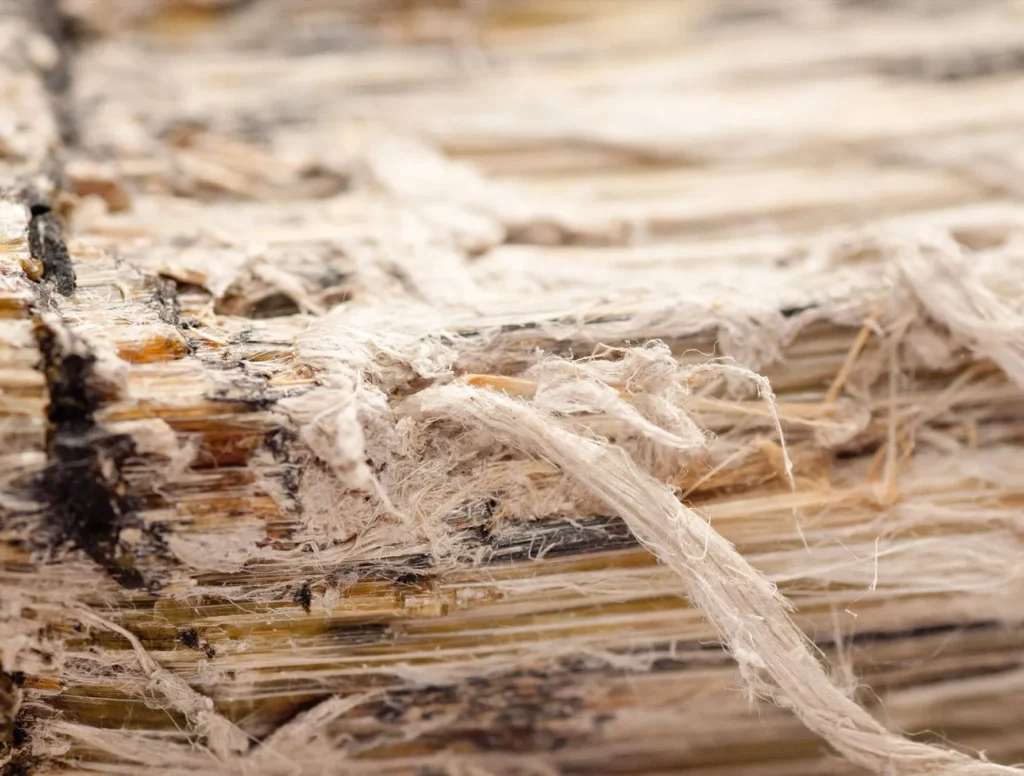
Asbestos is not a single mineral — it is a commercial name applied to six naturally occurring silicate minerals that share a fibrous crystal structure. The six regulated asbestos minerals fall into two groups:
Serpentine asbestos:
- Chrysotile (white asbestos) — the most commercially used form, accounting for approximately 95% of all asbestos ever mined. Chrysotile fibers are curly and flexible.
Amphibole asbestos:
- Amosite (brown asbestos) — widely used in insulation products
- Crocidolite (blue asbestos) — considered the most hazardous commercially used form
- Tremolite — not commercially mined but present as a contaminant in other minerals, including the vermiculite from Libby, Montana
- Actinolite — similar to tremolite, occurs as a contaminant
- Anthophyllite — least commercially significant of the amphiboles
The distinction between serpentine and amphibole fiber types is scientifically significant and continues to be debated in the toxicology literature. Amphibole fibers are needle-like, rigid, and highly durable in biological tissue. Chrysotile fibers are more flexible and are cleared from lung tissue at a faster rate — though “faster” is relative, and the medical consensus is that all six fiber types are capable of causing asbestos-related disease at sufficient exposure levels.
How fibers enter and stay in the body
When asbestos-containing materials are disturbed — cut, drilled, sanded, broken, or damaged — individual fibers are released into the air. The critical factor is fiber dimension. Fibers that are thin enough and long enough to reach the deep lung — technically, fibers with a diameter less than approximately 3 micrometers and a length greater than 5 micrometers — are the ones capable of causing disease. Shorter or thicker fibers are either filtered by the upper respiratory tract or cleared by normal mucociliary action before reaching the alveoli.
Fibers that do reach the alveoli — the small air sacs in the deep lung where gas exchange occurs — are confronted by alveolar macrophages, the immune cells whose job is to engulf and clear foreign particles. The problem with long asbestos fibers is that they are often too long for a macrophage to fully engulf. The macrophage attempts to phagocytose the fiber and fails, in a process called frustrated phagocytosis. This failed clearance attempt triggers the macrophage to release inflammatory mediators — reactive oxygen species, cytokines, and proteolytic enzymes — that damage surrounding lung tissue rather than neutralising the fiber.
This inflammatory response is not a single event. It is chronic and ongoing for as long as the fiber remains in place — which, for amphibole fibers in particular, can be for the remainder of the person’s life. Biopersistence — the tendency of a fiber to remain in tissue without being degraded — is the key property that separates asbestos fibers from other inhaled mineral particles. Many mineral fibers are cleared relatively efficiently. Amphibole asbestos fibers are not.
Why disease takes 20 to 50 years to develop
The multi-decade latency period between first asbestos exposure and the onset of disease is one of asbestos’s most important and most often misunderstood characteristics. It is not that damage begins at 20 years — it is that the cumulative damage from decades of chronic inflammation finally crosses the threshold at which clinical disease becomes detectable.
The processes involved in asbestos-related disease progression include:
- Chronic inflammation: Repeated failed phagocytosis attempts sustain a persistent inflammatory state in the lung. Chronic inflammation is a known driver of tissue damage, fibrosis, and malignant transformation across many cancer types.
- Oxidative stress: Reactive oxygen species released by frustrated macrophages and from the iron content of some asbestos fibers themselves — particularly crocidolite — damage cellular DNA and lipids in the surrounding tissue. Cumulative oxidative DNA damage that is improperly repaired is a step in the pathway toward malignancy.
- Physical DNA damage: Long asbestos fibers can interact directly with chromosomes during cell division, causing chromosomal aberrations and aneuploidy — abnormal chromosome numbers — that drive cellular dysfunction and cancer development.
- Fibrosis: In asbestosis, the sustained inflammatory response triggers progressive deposition of scar tissue (fibrosis) throughout the lung parenchyma. Fibrosis reduces lung compliance and gas exchange capacity in a process that continues independently even after asbestos exposure stops.
- Pleural changes: Fibers that migrate through the lung tissue to the pleural surface trigger similar inflammatory responses in the pleura, leading over time to pleural plaques, diffuse pleural thickening, and in some cases mesothelioma.
The latency period reflects the time required for these cumulative processes to produce tissue damage at a scale that causes symptoms or is detectable by clinical imaging. Someone with asbestosis diagnosed today may have first deposited the fibers that triggered their disease 30 or 40 years ago as a young worker.
Why no safe level of exposure has been established
For many toxic substances, a threshold dose exists below which no adverse effects are observed. The evidence for asbestos does not clearly support the existence of such a threshold. The International Agency for Research on Cancer (IARC) classifies all six asbestos fiber types as Group 1 carcinogens — established human carcinogens — based on sufficient evidence in both human epidemiological studies and animal experiments.
Several factors contribute to the difficulty of establishing a safe threshold:
- The extremely long latency period makes it difficult to conduct adequately powered studies of low-level, long-duration exposures
- Background asbestos fiber exposure exists in the general population from ambient air and from legacy building materials, creating a baseline against which low-level occupational or environmental exposures are difficult to separate
- Individual susceptibility varies — genetic factors, immune response differences, and co-exposures (particularly smoking) affect who develops disease at a given cumulative exposure level
- Different fiber types have different potencies, and real-world exposures typically involve mixtures that are difficult to characterize retrospectively
Regulatory agencies including OSHA and EPA set permissible exposure limits and ambient air standards based on risk assessment at quantifiable exposure levels, but these limits are set to reduce risk to very low levels — not to establish a threshold below which risk is zero. The occupational health community generally treats asbestos as a substance where the goal is to minimise exposure to the greatest extent practicable, not to stay below a defined safe level.
The full spectrum of asbestos-related cancers
Public awareness of asbestos-related disease focuses primarily on mesothelioma, asbestosis, and lung cancer. These are the most common and most studied outcomes, but IARC’s review of the evidence identifies a broader set of cancers with sufficient evidence to conclude asbestos causes them:
Cancers with sufficient evidence of causation by asbestos (IARC Group 1):
- Mesothelioma of the pleura, peritoneum, and pericardium
- Lung cancer
- Laryngeal cancer
- Ovarian cancer
Cancers with limited evidence (IARC considers probable or possible):
- Pharyngeal cancer
- Stomach cancer
- Colorectal cancer
The mechanism for laryngeal and upper digestive tract cancers likely involves fiber deposition in the upper airway and ingestion of fibers cleared from the respiratory tract via mucociliary action. The mechanism for ovarian cancer is less fully understood but may involve fiber migration through the peritoneal cavity.
Why smoking and asbestos exposure interact multiplicatively
The relationship between asbestos exposure and smoking is one of the most important and least understood aspects of asbestos risk. The two exposures do not simply add their risks together — they multiply them.
A non-smoker with heavy occupational asbestos exposure has approximately 5 times the lung cancer risk of a non-exposed non-smoker. A smoker without asbestos exposure has approximately 10 times the risk of a non-smoking non-exposed baseline. A smoker with heavy occupational asbestos exposure has approximately 50 to 90 times the baseline risk — far more than 5 + 10 would suggest.
The mechanism is not fully elucidated, but several factors are thought to contribute. Smoking impairs the mucociliary clearance mechanism, meaning smokers retain more inhaled fibers in the deep lung than non-smokers exposed to the same ambient concentration. Smoking also causes its own chronic inflammatory changes and oxidative DNA damage in the lung — and those processes appear to synergize with the inflammatory and DNA-damaging effects of retained asbestos fibers rather than simply adding to them.
This multiplicative relationship is the reason former asbestos workers who also smoked are at extraordinarily elevated lung cancer risk, and why smoking cessation is particularly important for people with known past asbestos exposure.
Why asbestos is still not fully banned in the United States
The United States is one of the few high-income countries that has not implemented a comprehensive asbestos ban. The reasons are partly legal and partly regulatory history.
In 1989, EPA attempted a near-comprehensive ban under the Toxic Substances Control Act (TSCA). In 1991, the Fifth Circuit Court of Appeals overturned most of that ban, finding that EPA had not adequately demonstrated that the benefits of banning each specific product use justified the costs under TSCA’s cost-benefit analysis framework. That ruling created a substantial barrier to comprehensive regulation under TSCA that persisted for decades.
In 2024, EPA finalized a rule under the reformed TSCA (amended by the Lautenberg Chemical Safety for the 21st Century Act in 2016) banning chrysotile asbestos — the only form still commercially imported and used in the US at the time, primarily in the chlor-alkali chemical manufacturing industry. That rule phases out remaining chrysotile uses over a period of years.
The legacy issue — asbestos already installed in existing buildings — is not addressed by product bans. The asbestos in buildings constructed before the 1980s will remain in place until those buildings are renovated or demolished, which is why exposure management, testing, and proper abatement procedures remain relevant for decades to come regardless of what products are sold today.
FAQ
Is chrysotile asbestos actually safer than amphibole types?
There is ongoing scientific debate. The toxicological evidence consistently shows that crocidolite and amosite (amphibole) fibers are more biopersistent and produce more potent carcinogenic effects per fiber at equivalent exposure. Some researchers and industry groups have argued that chrysotile at low exposure levels poses minimal risk. The WHO and IARC maintain that all asbestos fiber types are carcinogenic and that the evidence does not support setting a safe threshold for any of them. For practical purposes, regulatory and public health guidance treats all asbestos types as hazardous.
If asbestos is in my home but undisturbed, am I being exposed?
Minimal release of fibers from intact, well-maintained asbestos-containing materials can occur — surface abrasion, air movement, and gradual deterioration can release small numbers of fibers over time. However, the fiber concentrations from undisturbed materials in good condition are generally very low — typically close to background ambient levels. The significant exposures that drive disease risk come from disturbance: cutting, drilling, sanding, breaking, or removing asbestos-containing materials without proper controls.
Why do some people who worked with asbestos for decades not develop disease, while others develop mesothelioma after relatively brief exposure?
Individual susceptibility varies significantly. Genetic factors affecting DNA repair capacity, immune response, and inflammatory pathways all influence who develops disease at a given cumulative exposure level. Some genetic variants are associated with higher mesothelioma susceptibility — notably mutations in the BAP1 gene. The type of fiber, the concentration and duration of exposure, and co-exposures including smoking also all affect outcome. The absence of disease in some heavily exposed individuals does not indicate those exposures were safe — it reflects individual variation in susceptibility and the probabilistic nature of cancer causation.
Can asbestos fibers be detected in the body?
Yes. Asbestos fibers can be identified in lung tissue through biopsy or at autopsy using electron microscopy. Asbestos bodies — iron-protein coatings that form around fibers in lung tissue — can sometimes be seen by light microscopy in lung tissue or in sputum samples. The presence of asbestos bodies confirms prior significant exposure but is not a diagnostic criterion for any specific asbestos-related disease. Disease is diagnosed through clinical, imaging, and pathological criteria, not fiber detection alone.
Is there treatment for asbestos-related diseases?
No curative treatment exists for asbestosis or mesothelioma. Asbestosis management focuses on symptom control, supplemental oxygen when needed, and monitoring for progression and complications. Mesothelioma treatment has advanced with the development of immunotherapy combinations that have improved median survival, but the disease remains aggressive with a poor prognosis in most patients. Lung cancer associated with asbestos exposure is treated according to the same protocols as other lung cancers, and outcomes depend on stage at diagnosis — which is why surveillance and early detection matter for people with known heavy past exposure.
EnviroPro 360: Reducing asbestos exposure risk in Augusta and the CSRA
The diseases described on this page result from exposures that can often be prevented. EnviroPro 360 provides certified asbestos testing and inspection services for homeowners, contractors, and commercial property owners across Augusta, GA and the Central Savannah River Area — giving you accurate information about what materials are present in your building before any work begins.
- Residential and commercial asbestos inspections and bulk material testing
- Pre-renovation and pre-demolition surveys
- Georgia EPD and South Carolina DHEC accredited inspectors
- Air testing and post-abatement clearance sampling
- AHERA school inspections and management plan documentation
- Add-on testing: mold, radon, lead paint, and Legionella
If you are planning renovation work on an older building in the CSRA and want to know what materials are present before any disturbance occurs, contact EnviroPro 360 to schedule an inspection with a state-licensed asbestos inspector.