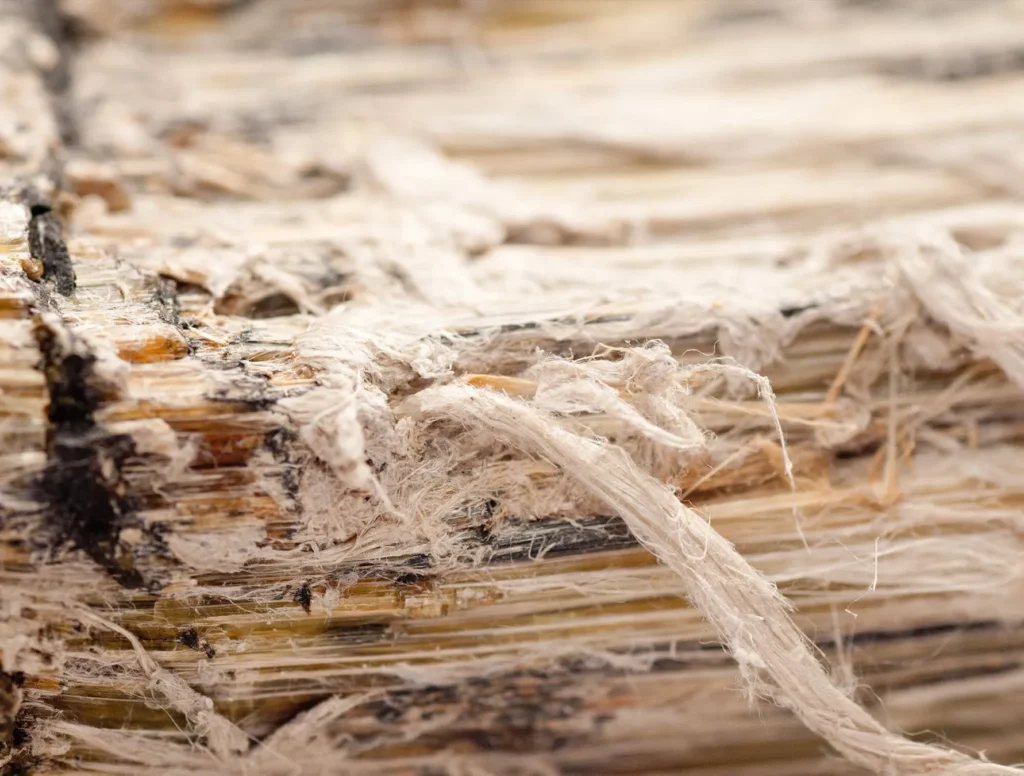
Most people think of asbestos as something in old buildings. Pipe wrap, floor tiles and popcorn ceilings come to mind. But asbestos is a natural mineral. It forms in certain kinds of rock. When that rock is crushed into gravel or dug up for fill, the asbestos comes with it.
That is how asbestos can end up on a playground, a gravel driveway, a school yard or a dirt road. This is called naturally occurring asbestos, or NOA.
This guide explains what NOA is, where it is found and how it is tested. It ends with practical advice for parents, schools and property owners.
What is naturally occurring asbestos?
Asbestos is not one mineral. It is a name for six minerals that grow in long, thin fibers.
The six regulated asbestos minerals fall into two groups.
Serpentine asbestos: chrysotile
Chrysotile is sometimes called white asbestos. Its fibers are curly and soft. It was the most widely used type in the U.S. Chrysotile forms in serpentine rock.
Amphibole asbestos
The other five are amphiboles. Their fibers are straight and needle-like. They are:
- Tremolite
- Actinolite
- Anthophyllite
- Amosite
- Crocidolite
Tremolite, actinolite and anthophyllite are the amphiboles most often found as NOA. They can occur in serpentine rock. They also show up in other rock types, such as some metamorphic rocks and in deposits of talc and vermiculite.
“Naturally occurring asbestos” simply means asbestos still in its natural setting. It is in rock or soil, not in a product. The USGS explains that NOA forms through natural geologic processes.
What is serpentine rock?
Serpentinite is a rock made mostly of serpentine minerals. It is often green, gray-green or blue-black. It can look waxy or shiny, and it sometimes feels slick. California made serpentine its state rock.
Serpentinite forms when rocks from deep in the earth react with water. These deep rocks are called ultramafic rocks. They are rich in iron and magnesium. As they change, chrysotile can grow in veins and cracks.
Not all serpentinite contains asbestos, and you can’t tell by looking. Only a lab can tell you.
How does asbestos get into gravel, fill and other materials?
Anything dug from the ground can carry asbestos if it came from the wrong rock. Here are the main paths.
Crushed stone and gravel. Quarries crush rock into gravel for roads, driveways, drainage and landscaping. If the quarry cuts through serpentinite or other asbestos-bearing rock, the gravel can contain fibers. Crushing breaks fibers loose.
Fill dirt. Soil and rock dug from one site are often hauled to another as fill. Fill from an area with NOA carries the asbestos with it.
Talc. Talc is a soft mineral mined for powders, paints and other products. Talc deposits can form near asbestos. The FDA notes that talc deposits can be contaminated with asbestos if mining sites are not carefully chosen.
Vermiculite. Vermiculite is a mineral that puffs up when heated. It was used in attic insulation and garden soil mixes. Most U.S. vermiculite came from a mine near Libby, Montana. That ore was contaminated with amphibole asbestos. The EPA has guidance on vermiculite insulation. Read our post Vermiculite Insulation: Should I Be Worried? for more.
How does NOA reach playgrounds, driveways and school yards?
Asbestos in rock is mostly harmless while it stays put. The risk starts when fibers get into the air. Fibers are released when the material is:
- Walked or run on
- Driven over, especially on dry, unpaved roads
- Raked, graded or dug
- Blown by wind or dried out in hot weather
Playgrounds and school yards are a special concern. Children play close to the ground. They kick up dust. They breathe faster than adults for their size. And a child exposed at age seven has many more years for disease to develop than an adult exposed at fifty. Asbestos diseases often take 20 to 50 years to appear.
Common playground surface materials
People often search for the best playground surface materials. Here are the common ones:
- Wood chips or engineered wood fiber
- Rubber mulch or poured rubber
- Sand
- Pea gravel
- Crushed stone or decomposed granite
Wood, rubber and washed sand rarely raise asbestos questions. Gravel and crushed stone are where NOA becomes a question. The answer depends on the source rock. Most gravel is fine. But if you don’t know where it came from, it is worth asking.
The El Dorado Hills case
The best-known NOA case in the U.S. is in El Dorado Hills, California. The town sits on rock that contains tremolite and actinolite asbestos.
In 2002, crews building a soccer field at Oak Ridge High School dug into a vein of asbestos. Parents raised concerns. The EPA tested the air while people did normal things like playing sports, biking and gardening. This is called activity-based sampling.
The Agency for Toxic Substances and Disease Registry (ATSDR) reviewed the school. ATSDR is a federal health agency. It found that past exposure of some students and staff may have been a health hazard. It said cleanup by the school district and EPA had lowered current exposure. Fixes included removing some soil, paving and adding landscaping.
The case showed that ordinary play on bare soil could stir up fibers.
Where does naturally occurring asbestos occur in the U.S.?
NOA is found in many states. The USGS mapped reported asbestos sites in the eastern U.S. The map shows a long band along the Appalachian Mountains. That band runs from Alabama and Georgia up through Virginia, Pennsylvania and into New England.
Is there naturally occurring asbestos in Georgia and South Carolina?
Yes, but mostly not near Augusta.
Georgia
Georgia has a long asbestos history. Small anthophyllite asbestos mines operated in the north Georgia mountains starting in the late 1800s. White County even has a community named Asbestos.
USGS data lists about 50 NOA locations in Georgia. Researchers have noted that most of them sit in the Blue Ridge Mountains of northeast Georgia. Rabun, White, Habersham and Towns counties hold the largest cluster.
The Piedmont has fewer known sites. The Piedmont is the rolling hill region between the mountains and the Fall Line. One studied example is Soapstone Ridge, southeast of Atlanta. There, ultramafic rock contains amphibole minerals.
South Carolina
The same USGS map shows only a handful of sites in South Carolina. They are in the Piedmont and upstate, far from the coast.
What about Augusta and the CSRA?
Augusta sits right on the Fall Line. To the south and east is the Coastal Plain. It is made of sand, clay and soft sediment. That kind of ground does not form asbestos.
North of Augusta, in counties like Columbia, Lincoln and McDuffie, the Piedmont begins. We are not aware of any mapped NOA site right around Augusta. But gravel and fill travel. A load of stone can come from a quarry hundreds of miles away.
So for most CSRA homes and schools, the bigger asbestos risk is still older building materials. We cover those in Asbestos in Your Home: Identifying Common Sources.
How are soil, rock and gravel tested for asbestos?
You can’t test for asbestos by looking. A sample has to go to an accredited lab. Here are the main methods.
PLM (polarized light microscopy)
PLM is the standard method for building materials. An analyst looks at the sample under a special microscope that uses polarized light. Each asbestos type has its own optical traits. PLM can find and name the asbestos type and estimate how much is there.
For building materials, the regulatory cutoff is 1% asbestos. Anything above 1% is called an ACM (asbestos-containing material). But 1% is a lot of asbestos in soil or gravel. Lower amounts can still release fibers when disturbed. So standard PLM may miss a soil problem.
CARB Method 435
The California Air Resources Board created Method 435 for soil, rock and aggregate. It is now the most widely used method for these materials across the U.S.
The lab first grinds the sample into a fine powder. That way, the part tested matches the whole sample. Then an analyst checks 400 points under PLM and counts how many hit asbestos. This “point count” can detect asbestos down to about 0.25%. California uses that same 0.25% level as its limit for gravel used on unpaved surfaces. See CARB’s Method 435 guidance for details.
TEM (transmission electron microscopy)
TEM uses an electron microscope. It can see fibers far too thin for PLM. It is used when PLM results are unclear or when very low levels must be ruled out. TEM is also used for air samples.
Air sampling
Testing the material tells you what is in it. Air sampling tells you what people may breathe. For NOA sites, agencies sometimes use activity-based sampling. A worker wears an air pump while raking, playing or driving on the surface. This shows real exposure during normal use.
Who should collect samples?
Samples should be collected by a trained, accredited asbestos inspector. In Georgia, asbestos programs are run by Georgia EPD. In South Carolina, inspectors are licensed through SCDES, the South Carolina Department of Environmental Services. A licensed inspector knows how to collect samples without stirring up fibers. They also keep chain-of-custody records, which track who handled each sample.
What schools need to know: AHERA
AHERA is the Asbestos Hazard Emergency Response Act. It is the federal law for asbestos in K-12 school buildings. It applies to public and nonprofit private schools. The EPA explains AHERA rules for schools.
Under AHERA, schools must:
- Have an accredited inspector check every building for ACM
- Keep a written management plan for each school
- Re-inspect every three years and check known asbestos every six months
AHERA covers school buildings. It does not directly cover playgrounds or gravel lots. But a school still has a duty to address hazards on its grounds. For more, read Is Your School’s AHERA Management Plan Up to Date?
What does PACM stand for?
PACM stands for presumed asbestos-containing material. OSHA defines PACM as thermal system insulation and surfacing material in buildings built in 1980 or earlier. Surfacing material includes sprayed-on or troweled-on coatings. These materials must be treated as asbestos unless testing proves they are not.
What can be done about NOA on a surface?
If testing finds asbestos in a playground, driveway or lot, there are three main options. These are done by licensed abatement or site contractors. EnviroPro 360 does not do this work.
Cover it. Clean gravel, soil, asphalt, concrete or rubber surfacing is placed over the material. This keeps fibers from getting into the air. It is common for paths, lots and play areas.
Keep it damp or sealed. Wetting the surface or using a sealant can hold fibers down for a time. This needs ongoing upkeep.
Remove it. The material is dug out and taken to an approved landfill. This is the most lasting fix. It also takes the most planning.
Practical advice for parents, schools and property owners
For parents
- Ask your school or daycare what the playground surface is made of.
- If it is gravel or crushed stone, ask where it came from and whether it was tested.
- Ask to see the school’s AHERA management plan. Schools must make it available.
For schools and childcare centers
- Keep records of where surface gravel and fill came from.
- Before buying new gravel, ask the supplier which quarry it comes from and what rock type it is. Ask whether it has been tested for asbestos.
- If a surface is suspect, keep children off it until it is tested. Don’t rake, sweep or grade it.
For homeowners and property owners
- Know where your driveway gravel and fill came from, especially on new builds.
- If you plan to dig, grade or landscape in an area with suspect rock, test first.
- Never sand, crush or break rock you think may contain asbestos.
Your next steps
- Find out what your playground, driveway or lot surface is made of and where it came from.
- If it is crushed stone or fill from an unknown source, keep it undisturbed until it is tested.
- Have a licensed asbestos inspector collect samples for lab analysis by PLM, CARB 435 or TEM.
EnviroPro 360 is an independent testing company. We don’t do asbestos abatement, so our results come with no sales pitch. Our inspectors are licensed in Georgia and South Carolina, and samples go to an accredited lab. Call for a quote.
EnviroPro 360 provides asbestos testing for homes, schools and businesses in Augusta, Aiken, Columbia and nearby towns. If you have questions about naturally occurring asbestos or want to talk through your situation, the EnviroPro 360 team is happy to help. Reach out any time.