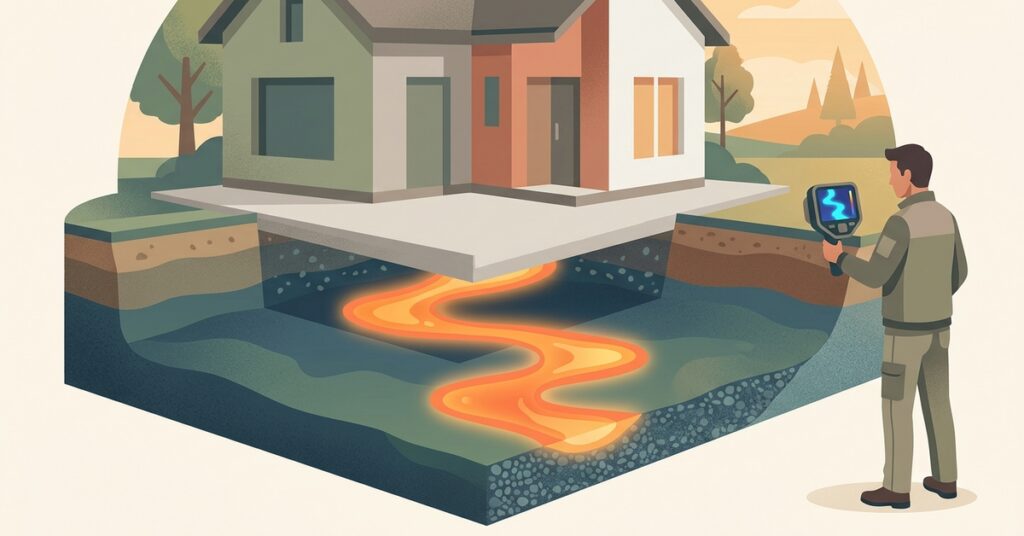
A homeowner in Evans kept catching a faint sewage smell in a hall bathroom, always strongest in the late afternoon. Her water bill had not moved. There was no wet spot on the floor, no stain on the ceiling below, and no sound of running water when the house was quiet. A plumber checked the toilet seal, replaced it, and the smell came back three weeks later. The actual problem was a hairline crack in a cast iron drain line under the slab, roughly four feet from the bathroom, and it had been leaking for years.
Drain line leaks are the quiet counterpart to the pressurized supply leaks most people picture when they hear the word “leak.” They follow different rules, they produce different evidence, and the methods that find a supply leak will often walk right past them.
Why a Drain Leak Hides Better Than a Supply Leak
Your home has two separate water systems. The supply side is pressurized, meaning water sits in those pipes under constant pressure whether you are using it or not. The drain side, formally called the DWV system (drain, waste, and vent), is not pressurized at all. It moves water by gravity, and it only carries water when a fixture is actually draining.
That single difference explains most of what makes drain leaks hard to catch.
A pressurized supply leak runs twenty four hours a day. It shows up on your bill, and that bill increase is often the first signal anyone gets. The EPA notes that household leaks waste nearly 1 trillion gallons of water annually nationwide, with the average home losing more than 9,300 gallons a year and nine percent of homes running leaks that waste 50 gallons or more per day. Those are supply-side numbers, and they are the reason a spiking water bill is such a useful diagnostic.
A drain leak produces none of that. It releases water only during the minutes a shower, sink, or toilet is draining, and that water already counted on your meter on the way in. Your bill stays flat. The leak might discharge a few gallons a day, in short bursts, into soil you cannot see.
Small and intermittent does not mean harmless. It means the damage accumulates slowly enough that nobody investigates until something structural or biological forces the issue.
What a Drain Leak Does to CSRA Soil
The Augusta area sits on red clay, and clay is the reason a modest drain leak can become a foundation conversation.
Clay soils expand when they take on water and contract when they dry out. A drain line releasing water in one localized spot creates a pocket of soil that is repeatedly wetted while the soil a few feet away goes through normal seasonal drying. That differential movement is what puts stress on a slab. Over enough seasons it can show up as hairline cracks in drywall above door frames, doors that stop latching cleanly, or a section of floor that feels slightly out of plane.
Leaks under a crawl space behave differently but are not better. Water discharging into a crawl space raises humidity in an enclosed area that already struggles with it during a Georgia summer, and the framing and subfloor above it absorb that moisture.
Wastewater also brings a contamination question that clean supply water does not. When sewage escapes containment, whether from a municipal line or a private lateral, it carries bacteria and organic material with it. The EPA’s guidance on sanitary sewer overflows covers the public-system version of this problem, and the same basic concern applies at a much smaller scale under a house.
The Signs That Actually Point to a Drain Line
Intermittent odor. Sewer gas escaping a cracked drain line or a failed vent tends to come and go rather than sitting constant, and it is often tied to when fixtures get used. A smell that shows up in the evening and fades overnight is behaving like a drain problem, not a supply problem.
A normal water bill alongside real moisture evidence. This combination is the clearest tell there is. If a moisture meter is reading elevated moisture in a baseboard or subfloor and your usage has not changed, the water is very likely coming from the drain side.
Localized settling or cracking near a wet-wall. Foundation movement concentrated near a bathroom, kitchen, or laundry area is worth treating as a plumbing question before it gets treated as a structural one.
Mold in one specific location that keeps returning after cleaning. Mold needs a moisture source, and mold that comes back in the same spot after remediation usually means the source was never found. The EPA is direct on this point in its guide to mold and moisture: controlling moisture is the only durable way to control mold.
Unusual insect or rodent activity in a crawl space. A break in a drain line creates both an access point and a water source.
How These Leaks Get Located
Camera Inspection
A small waterproof camera on a flexible push rod runs through the drain line from a cleanout, and the operator watches the interior of the pipe on a monitor. This is the most direct method available, because it shows the actual crack, offset joint, root intrusion, or collapsed section. Camera work also gives a distance reading, so the defect can be marked on the floor above before anyone cuts concrete.
Smoke Testing
A non-toxic tracer smoke gets introduced into the drain and vent system, and the technician watches for where it escapes. Smoke follows the same paths air and sewer gas do, which makes this method good at finding cracks and failed connections in the vent portion of the system that a camera has trouble reaching.
Hydrostatic Testing
The drain system gets isolated with an inflatable test plug and filled with water to a known level. If the water level drops, the system is losing water somewhere, which confirms a leak exists before anyone spends time locating it precisely. This is a pass or fail test, not a locating test, and it is most useful as a first step.
Moisture Mapping and Thermal Imaging
These methods do not find the leak. They map the damage. Once a drain leak is confirmed, moisture meters and infrared scanning define how far the water has traveled through the slab, subfloor, framing, and wall cavities, which is what determines the actual scope of repair and whether remediation is needed alongside the plumbing fix.
If You Are on a Septic System
Plenty of properties across Columbia, McDuffie, and Aiken counties run on private septic rather than municipal sewer, and that changes the picture. A failing septic tank, a cracked lateral, or a saturated drain field can produce the same odor and localized wet-soil symptoms as a broken drain line inside the house, and the two get confused regularly. The EPA’s guidance on caring for a septic system is a reasonable starting point for ruling out the obvious causes, but distinguishing a house-side drain failure from a yard-side septic failure generally takes actual testing rather than inference from symptoms.
What to Do
-
Stop using a normal water bill as evidence that you have no leak. A flat bill rules out a pressurized supply leak. It says nothing at all about the drain side, and treating it as reassurance is how these leaks run for years.
-
Treat a recurring smell or a recurring mold spot as a locating problem, not a cleaning problem. If odor or growth returns after the surface issue was addressed, the water source is still active and still needs to be found.
-
Get the moisture extent mapped, not just the pipe repaired. Fixing the crack stops the water. It does not dry out saturated framing or address growth that developed while the leak was running, and those are separate assessments.
If you are dealing with a smell you cannot place, moisture with no obvious source, or mold that keeps coming back in the same spot, the EnviroPro 360 team can help you sort out where the water is actually coming from and how far it has gone. Reach out here and we will talk through what an assessment would look like for your property.