When you start researching radon testing, two categories of test appear quickly: short-term and long-term. Both measure radon concentration in your home. Both produce results in pCi/L (picocuries per liter). The critical differences are in how long they run, what conditions they require, and how reliably their results reflect your actual long-term exposure. Choosing the right type for your situation depends on what you need the result for and how much time you have.
Short-Term Radon Tests
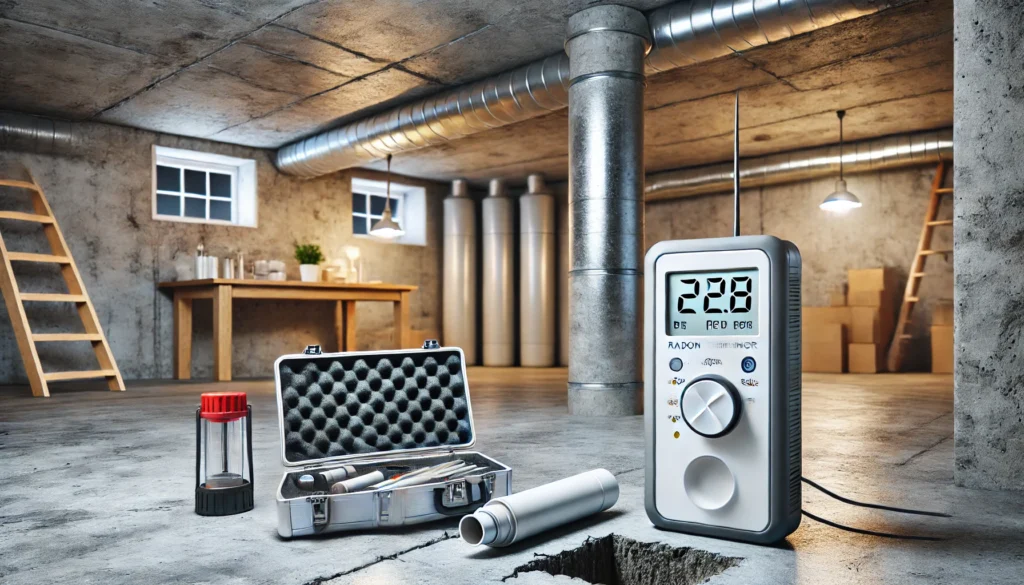
Short-term tests run for a minimum of 48 hours and typically no more than 90 days. The most common short-term devices are passive charcoal canister kits — small devices placed in the home’s lowest livable level, left for the test duration, then sealed and mailed to a lab for analysis. Professional continuous radon monitors (CRMs) are another short-term option: electronic devices that record radon levels hour by hour throughout the test period and produce a report showing the average alongside the full variation curve.
Short-term tests require closed-building conditions to produce a valid result. According to the Environmental Protection Agency, windows and exterior doors should remain closed for at least 12 hours before the test begins and throughout the entire test period, except for normal entry and exit. Any deviation from closed-building conditions — a window left open, a door propped for an extended period — can dilute indoor radon concentrations and produce a result that underestimates actual levels.
Short-term tests are best suited for:
- Real estate transactions: Home inspections have fixed timelines. A 48-to-96-hour CRM or charcoal test fits within the typical inspection contingency window and gives both buyer and seller a documented result.
- Initial screening: When you want a quick indication of whether your home likely has elevated radon before deciding whether to invest in a longer or more detailed test.
- Post-mitigation confirmation: After a mitigation system is installed, a 48-hour test confirms whether the system has reduced radon to an acceptable level.
Long-Term Radon Tests
Long-term tests run for 90 days to one year. The standard device is an alpha track detector, a small passive unit that records cumulative radon exposure over the measurement period and is then sent to a laboratory for analysis. Because long-term tests capture radon levels across multiple seasons and weather patterns, they produce a result that more accurately reflects annual average exposure than any short-term snapshot can.
Radon concentrations in a home are not static. They fluctuate with outdoor temperature, barometric pressure, soil moisture, HVAC operation, and seasonal changes in how tightly the home is sealed. A short-term test in March may yield a result noticeably different from a short-term test conducted in July in the same home, even with identical closed-building conditions. A long-term test averages across those variations, giving you data that more closely reflects what you and your family are actually breathing over the course of a full year.
The Centers for Disease Control and Prevention identifies radon as the second leading cause of lung cancer in the United States, responsible for approximately 21,000 deaths annually. Because radon risk is a function of both concentration and duration of exposure, an accurate picture of annual average concentration is the most meaningful data point for long-term health risk assessment.
Long-term tests are best suited for:
- Confirming a borderline short-term result: If your short-term test came back between 2.0 and 4.0 pCi/L, the EPA recommends a follow-up long-term test to determine whether your true annual average is above or below the action level.
- Establishing a baseline in your home: If you are testing for the first time and are not under real estate time pressure, a long-term test gives you the most complete picture of your radon environment.
- Ongoing monitoring after mitigation: Some homeowners use alpha track detectors on a two-year cycle to confirm that a mitigation system continues to perform effectively as the system ages.
Which Test Should You Use?
The straightforward decision framework:
- If you need a result within a week or two — for a real estate transaction, a quick baseline, or post-mitigation confirmation — use a short-term test conducted under strict closed-building conditions.
- If you have time and want the most accurate long-term picture of your radon environment — particularly if a short-term test came back between 2.0 and 4.0 pCi/L — use a long-term alpha track detector.
- If your short-term result was at or above 4.0 pCi/L, the EPA recommends confirming with a second short-term test rather than waiting 90 days for a long-term result. Two consecutive short-term tests provide enough data to proceed with a mitigation decision.
Professional Testing in Augusta and the CSRA
EnviroPro 360 provides professional radon testing for homeowners throughout Augusta, Evans, Martinez, Grovetown, North Augusta, Aiken, and the broader CSRA. Testing follows EPA measurement protocols and is conducted with calibrated equipment that meets professional certification standards. Results are provided with a plain-language explanation of the number and its significance.
Whether you need a short-term result for a real estate transaction or a long-term baseline for your own home, EnviroPro 360 can handle the testing and give you a result you can act on. Contact EnviroPro 360 to schedule radon testing for your Augusta-area home.