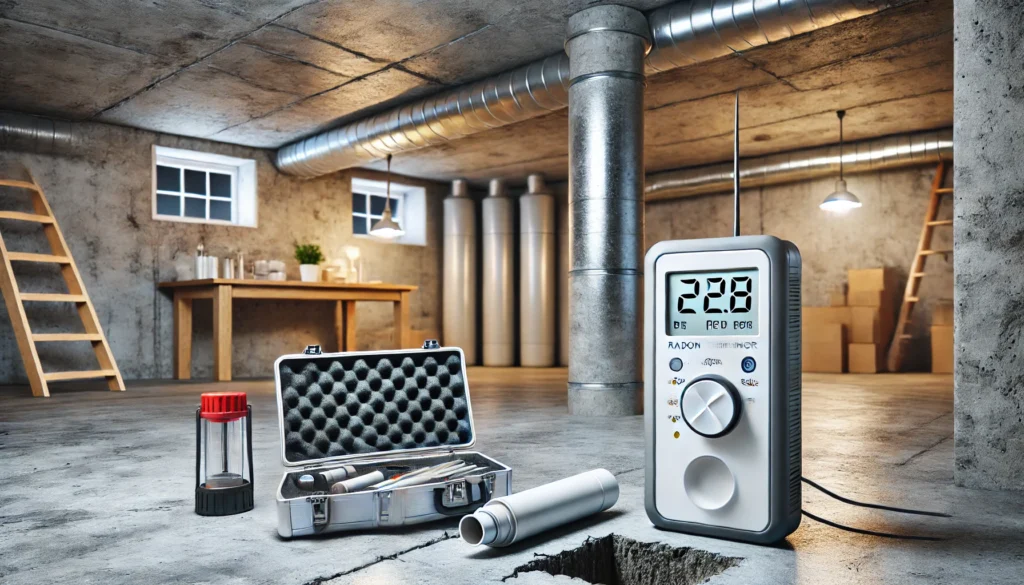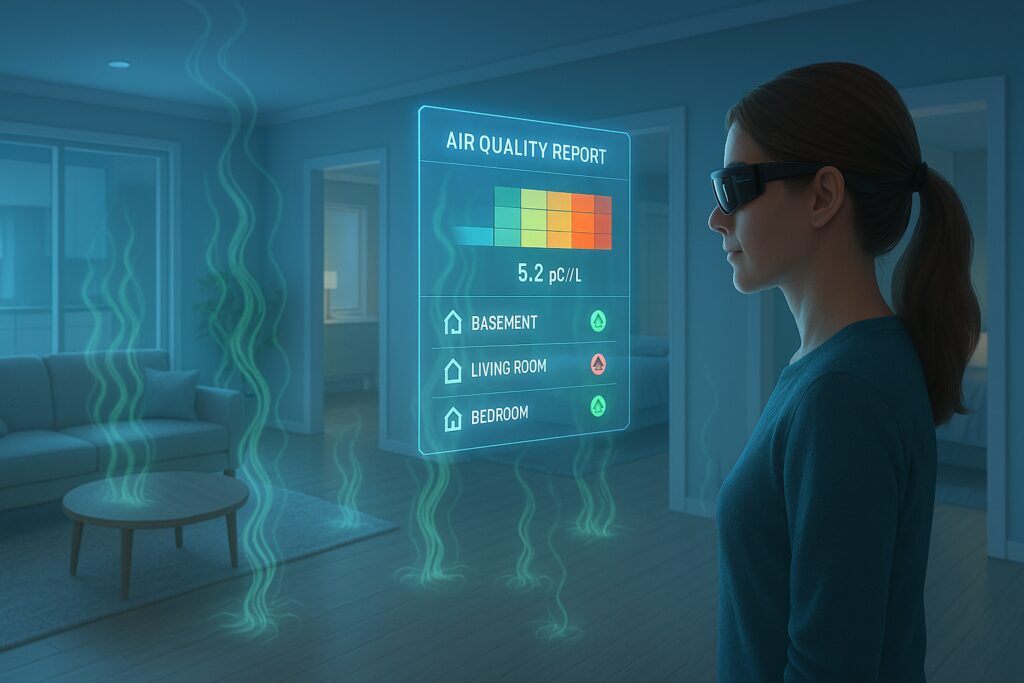
Basements are the most common finishing project in residential homes and one of the most popular living spaces for families who want extra room for a home office, a media area, or a guest suite. They are also consistently the room in the house with the highest radon concentrations. That combination — heavily used living space and highest radon risk — makes basements a top priority for radon testing.
Why Radon Concentrates in Basements
Radon forms when uranium in soil and rock decays naturally, releasing a radioactive gas that migrates upward toward the surface. When it reaches a structure, it enters through any available gap: cracks in the foundation slab, gaps around plumbing penetrations, sump pit openings, construction joints, and crawl space-to-air interfaces. All of these entry points are concentrated in and around the basement level.
Once inside, radon accumulates in the lowest areas of the home for two reasons. First, it enters at the lowest level, making the basement the first space to receive elevated concentrations. Second, the stack effect — the natural tendency of warm air to rise through a building — creates slight negative pressure in lower levels that draws radon upward from the soil more aggressively. The result is that basement air typically has the highest radon concentration in the home, often significantly higher than upper floors.
The Environmental Protection Agency identifies radon as the second leading cause of lung cancer in the United States, responsible for approximately 21,000 deaths annually. The EPA recommends taking action when indoor radon levels reach 4.0 pCi/L (picocuries per liter). In basements that are heavily used as living spaces, even moderate concentrations — those between 2.0 and 4.0 pCi/L — represent meaningful long-term exposure risk for people spending hours there each day.
How Basement Use Changes the Risk Calculation
Radon exposure risk is a function of two variables: concentration and time. A basement used exclusively for storage, with no one spending more than a few hours per month there, carries lower practical risk than the same basement used as a daily workspace or bedroom. The problem is that basements have been increasingly converted into actively occupied spaces — home offices, playrooms, fitness areas, and spare bedrooms — which dramatically increases the hours of daily exposure.
The Centers for Disease Control and Prevention notes that the risk of lung cancer from radon can be substantially reduced by testing and taking action when levels are elevated. For finished basements where family members spend significant time, testing is not optional — it is the direct response to the exposure reality of how the space is used.
Finished vs. Unfinished Basements: Does It Matter?
The finishing status of a basement does not significantly change its radon concentration. Drywall, flooring, and insulation do not meaningfully block radon entry or affect its distribution in the air. A finished basement can have the same or higher radon concentration as an unfinished one, depending on how the finishing affects air circulation.
In fact, some finished basement configurations make radon harder to address. If the basement is heavily partitioned into rooms, radon can concentrate in smaller enclosed spaces. If finishes cover floor-level cracks or seams that serve as radon entry points, it can be harder to identify and seal those entry points during mitigation planning.
Whether your basement is finished or unfinished, the radon test should be conducted in the lowest livable level of the home, following EPA closed-building protocol, with the monitor placed away from windows, exterior doors, and HVAC vents.
Radon in Augusta-Area Basements
In the Augusta and CSRA region, many older homes were built with full or partial basements, particularly in the hilly terrain of Richmond County, Columbia County, and areas like Evans and Grovetown. These homes often have foundation cracks from decades of settling and sump systems that create direct soil-to-air pathways for radon. Even homes without formal basements — those built on crawl spaces — can accumulate radon that then migrates through floor systems into ground-floor living areas.
Radon levels vary significantly from property to property, even in the same neighborhood. Testing your specific home is the only way to know your actual concentration. A neighbor’s low result does not tell you anything useful about your own basement’s radon level.
What to Do If Your Basement Tests High
If a professional radon test of your basement comes back at or above 4.0 pCi/L, the appropriate response is to consult with a certified radon mitigation contractor. The standard treatment for most basement radon problems is sub-slab depressurization: a system of piping and a continuously running fan that draws radon from beneath the foundation slab and vents it outdoors above the roofline. These systems are typically installed in a single workday and reduce radon concentrations by 80% to 99%.
After installation, a post-mitigation retest confirms the system is working correctly. EnviroPro 360 handles both the initial test and the post-mitigation retest. Mitigation installation is performed by separate certified contractors.
Test Your Basement Before Using It More
If you are planning to finish your basement, convert it to a home office, or add a bedroom, test for radon before construction begins. Once walls and flooring are in place, accessing entry points for remediation planning becomes more difficult and more expensive. A pre-finishing test costs little and takes 48 hours. It gives you the information you need to address any elevated concentration before the space is occupied full-time.
Contact EnviroPro 360 to schedule radon testing for your Augusta-area home, including basement and crawl space evaluation, and get results that reflect the air your family is actually breathing.