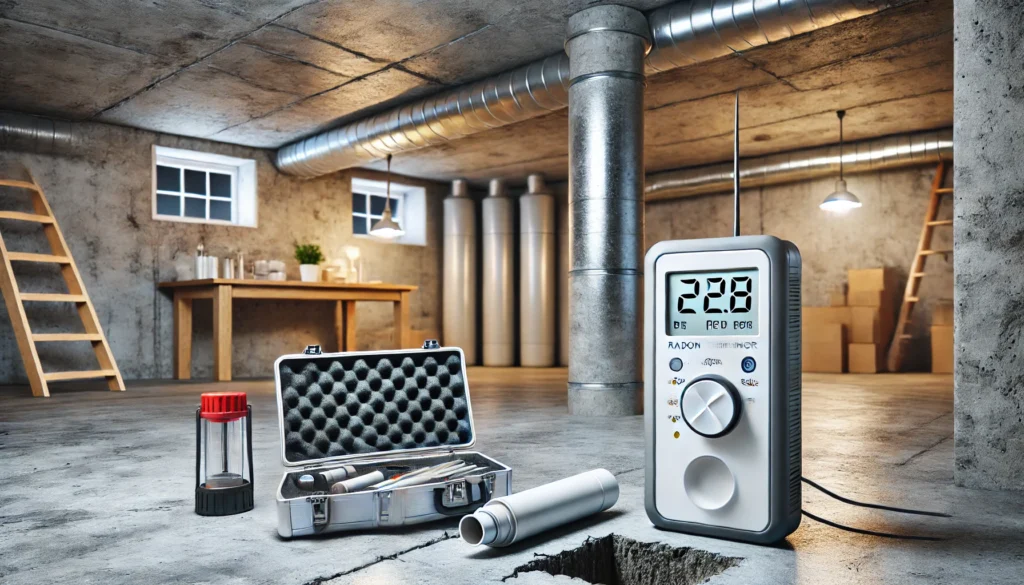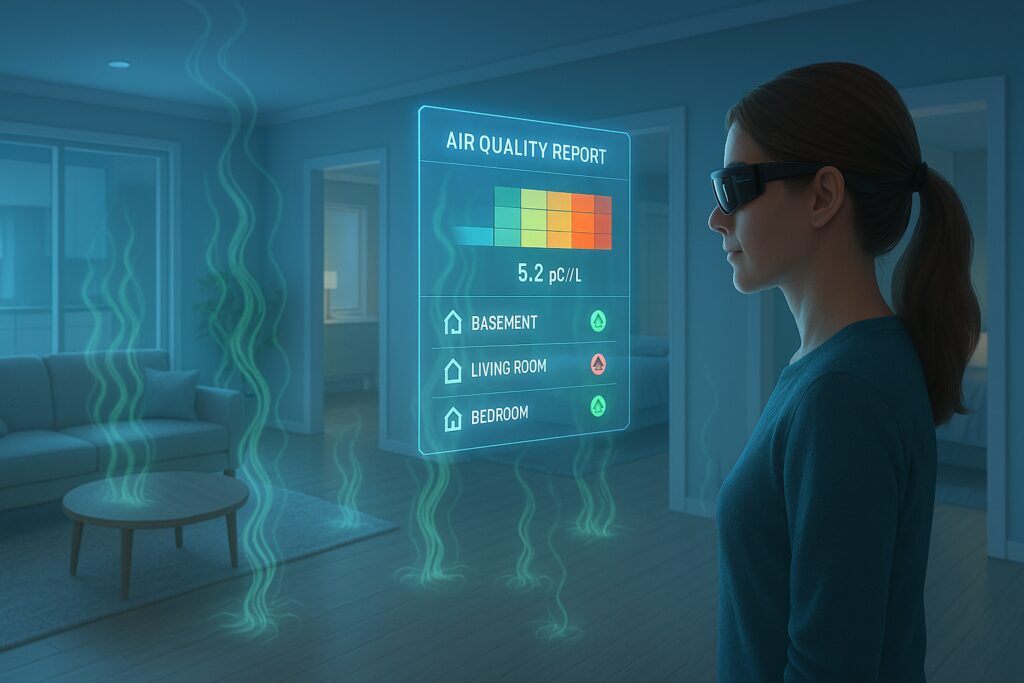
Here’s an example scenario: a family moves into a newly built home in a Columbia County subdivision. Everything is new: new HVAC, new windows, new foundation. They assume that a modern, well-built home doesn’t have radon problems. Three years later, a friend mentions radon testing. They pick up a test kit out of curiosity. The result: 5.4 pCi/L (picocuries per liter, the standard unit for measuring radon in air), well above the EPA’s action level of 4.0 pCi/L.
The home is three years old, built to current code, and has a radon problem. This surprises people, but it shouldn’t. Radon comes from the ground, not from the building. A new home built on soil that produces radon will have radon in the indoor air. The age and quality of the construction have little to do with it.
Why New Homes Are Not Immune
Radon is a naturally occurring radioactive gas produced by the decay of uranium in soil and rock. It seeps upward through the ground and enters buildings through any pathway between the soil and the interior: cracks in the foundation (even hairline cracks in new concrete), gaps around utility penetrations, sump pits, and the natural porosity of concrete itself.
Two factors determine whether a home has elevated radon: the amount of radon-producing material in the soil beneath the home, and the pathways available for the gas to enter the building. Neither factor has anything to do with when the house was built.
In fact, modern construction practices can actually make radon accumulation worse in some ways.
Tighter Building Envelopes
Modern homes are built to be energy-efficient. Better insulation, tighter window and door seals, house wrap, and reduced air infiltration all reduce energy costs. They also reduce the natural air exchange between indoor and outdoor air.
In older, draftier homes, radon that enters through the foundation dilutes somewhat as outdoor air infiltrates through gaps and cracks in the building envelope. In a tight, modern home, there’s less dilution. The radon that enters accumulates to higher concentrations because it has fewer escape routes.
The EPA acknowledges this tradeoff: energy-efficient construction is important, but it requires deliberate attention to radon management.
Foundation Design
Most new homes in the Augusta area are built on either slab-on-grade or crawl space foundations. Both are susceptible to radon entry:
Slab foundations develop micro-cracks as concrete cures and settles during the first few years. Control joints (intentional cuts in the slab designed to control where cracking occurs) create linear pathways. Penetrations for plumbing, electrical conduit, and HVAC condensate lines create point pathways. The junction between the slab edge and the foundation wall is rarely perfectly sealed.
Crawl space foundations with exposed soil provide a direct pathway for radon to enter the space beneath the home. Even crawl spaces with vapor barriers allow some radon transmission through the barrier material and at seams and edges.
What Radon-Resistant New Construction Looks Like
The EPA promotes a set of techniques called Radon-Resistant New Construction (RRNC) that can be incorporated during building for a cost of $250 to $750, a fraction of the cost of retrofitting a mitigation system after the fact.
The EPA’s RRNC technical guidance describes these features:
Gas-permeable layer. A 4-inch layer of clean gravel beneath the foundation slab allows soil gases to move freely beneath the building toward a collection point.
Plastic sheeting. Heavy polyethylene sheeting over the gravel layer and beneath the slab serves as a vapor barrier to limit radon entry through the slab.
Vent pipe. A 3 or 4-inch PVC pipe runs from the gravel layer beneath the slab up through the building and exits above the roofline. In the passive configuration, natural air convection draws some radon up and out. If testing later reveals elevated levels, a fan can be added to the pipe to convert it to an active system (identical to a standard mitigation system) at minimal additional cost.
Sealed penetrations. All openings in the foundation for plumbing, electrical, and other utilities are sealed with caulk or expanding foam to limit radon entry points.
Junction sealing. The joint between the foundation wall and the floor slab is sealed.
These features are inexpensive to include during construction and dramatically reduce the likelihood of elevated indoor radon. If passive operation isn’t sufficient, adding a fan takes an hour and costs a few hundred dollars.
Why Georgia Doesn’t Require It
Georgia’s building code does not require radon-resistant construction features in new residential buildings. Unlike some states (Illinois, for example, requires RRNC in high-radon counties), Georgia leaves the decision to builders and buyers.
Some builders in the Augusta area voluntarily incorporate RRNC features, but many don’t. Unless a buyer specifically requests and pays for radon-resistant features, they are unlikely to be included in a standard new build.
The Georgia Department of Public Health provides radon information but does not mandate testing or construction requirements.
This means the responsibility falls entirely on the homeowner. If you’re buying new construction, you need to either request RRNC features during the building process or test for radon after moving in and mitigate if needed.
What New Home Buyers Should Do
-
If you’re building, ask for RRNC features. The cost is minimal ($250-$750 added to a new construction budget) and provides permanent, passive radon reduction with an easy upgrade path to active mitigation if needed. Get the features specified in writing in your construction contract.
-
If you’ve already moved into a new home, test. Don’t assume your new home is safe from radon because it’s new. A 48-hour continuous radon monitor test gives you a definitive answer. Test the lowest livable level of the home with doors and windows closed.
-
Test before the warranty expires. Most new home warranties include structural and systems coverage for 1 to 2 years. If radon testing reveals elevated levels that could have been prevented with RRNC features, you may have recourse with the builder, but only if you test while warranty coverage is active.
According to the CDC, radon is the second leading cause of lung cancer in the United States after smoking. New construction does not change that risk. If you are buying or building in the Augusta area and want to know where you stand, the EnviroPro 360 team can test your home and advise on next steps. Get in touch and we will help you make sure your new home is safe.