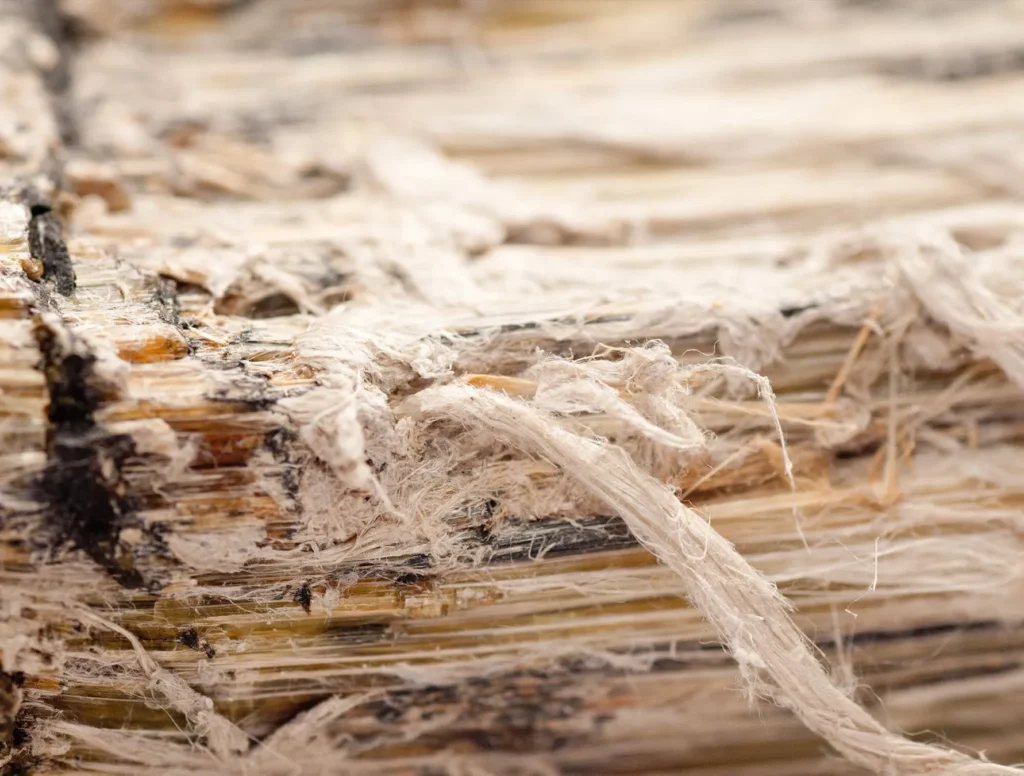
You pull up a corner of old vinyl flooring in a 1960s kitchen and find a black adhesive underneath. Or your home inspector writes “possible asbestos” next to the popcorn ceiling and moves on. Either way, the next question is the same: how do you actually find out what is in that material, and what happens after you do?
This guide walks through asbestos testing from start to finish: when it is worth doing, what a certified inspector does at your property, how the laboratory analyzes samples, how to read the report, and what your results mean for renovating, buying, selling, or renting. If you want to know where asbestos tends to hide in a house, see our guide to identifying common asbestos sources. For airborne fiber testing, see how asbestos air testing works.
When asbestos testing is worth doing
Asbestos-containing material (ACM, any material with more than 1% asbestos) that is intact and left alone poses little day-to-day risk. The danger comes when it is cut, drilled, sanded, scraped, or broken, because that releases microscopic fibers you can inhale. The EPA (Environmental Protection Agency) links long-term asbestos exposure to lung cancer, mesothelioma, and asbestosis. So the trigger for testing is usually planned disturbance, not simply the age of the house.
Test before you:
- Renovate walls, ceilings, or floors in a home built before 1980, including flooring replacement, popcorn ceiling removal, and kitchen or bathroom remodels
- Have HVAC or plumbing work done that will disturb ductwork, pipe insulation, or mechanical chases
- Add attic insulation, run cable, or install recessed lighting
- Demolish all or part of any pre-1980 structure
- Close on a pre-1980 home you plan to renovate
Consider testing even without a project if pipe insulation is crumbling, old floor tiles are cracking or lifting on their own, or a previous owner renovated without any record of testing.
Testing is usually not urgent if you have no renovation planned and the materials are intact, or the home was built after about 1990, when residential use had largely ended.
The one rule before anyone tests: do not disturb it
Do not scrape, sand, drill, cut, or pull apart anything you suspect contains asbestos before the inspector arrives. Do not sweep up debris or use a household vacuum on it. Standard vacuums blow fine particles back into the room.
If you have already disturbed a suspect material, stop work, close off the area, and keep people and pets out of it. Then have a licensed inspector assess it before you go back in. Stopping early almost always costs less than finishing the job and cleaning up a contaminated house afterward.
The three types of asbestos testing
Bulk material testing
This is the most common test. The inspector collects a small piece of a suspect material, such as floor tile, mastic (the adhesive under tile), joint compound, ceiling texture, or pipe insulation, and an accredited laboratory reports whether it contains asbestos and at what percentage. Bulk testing is what you need before renovation or demolition.
Air testing
A calibrated pump pulls air through a filter cassette, and the laboratory counts the fibers it captures. Air testing is used during abatement (professional removal) to confirm containment is working, and when a material may already have been disturbed in an occupied space.
Clearance testing
Clearance testing is air sampling done after abatement to confirm fiber levels are low enough to take down containment and reoccupy the space. On regulated projects, it should be done by someone independent of the abatement contractor.
How a professional asbestos inspection works, step by step
Step 1: The site visit
Testing starts with a walkthrough by a state-licensed inspector. Georgia inspections are governed by the Georgia EPD (Environmental Protection Division) asbestos rules. South Carolina’s asbestos program is run by the SC Department of Environmental Services (SCDES), which took over DHEC’s environmental programs in 2024, under Regulation 61-86.1. A license in one state does not cover a regulated job in the other.
The inspector reviews the building’s age and renovation history, walks every accessible area including crawl spaces, attics, and mechanical rooms, and records each suspect material with its location, quantity, and condition. That list becomes the sampling plan. Each distinct material in each distinct area is its own sample: the kitchen floor tile, the hallway floor tile, and the mastic under each are separate samples.
Step 2: Sample collection
Sampling is the step most likely to release fibers, which is why technique matters. A trained inspector will:
- Shut off HVAC serving the area so fibers are not spread through ductwork
- Wear a respirator with P100 (HEPA, high-efficiency particulate air) filters, gloves, and coveralls
- Mist the material with water so fibers fall rather than float
- Cut a coin-sized sample through the full thickness of the material, since each layer can test differently
- Seal it immediately in a labeled container and patch the sampling point
- Clean up debris with a damp wipe or HEPA vacuum
You will not be left with a large hole, and you do not need to leave the house during a standard inspection. A typical single-family home takes one to three hours on site.
Step 3: Chain of custody
Every sample travels with a chain of custody form that records who collected it, where, when, how it was stored, and everyone who handled it before the lab received it. That record is what makes results defensible for regulatory compliance, real estate transactions, and insurance or legal disputes. A gap in the chain can call results into question.
Step 4: Laboratory analysis
Samples should go to a laboratory accredited under NVLAP (the National Voluntary Laboratory Accreditation Program, run by the National Institute of Standards and Technology). The accreditation number should appear on your report.
- PLM (polarized light microscopy) is the standard method for bulk samples. It identifies asbestos by how the fibers interact with polarized light and estimates the percentage. Its practical detection limit is about 1%, so some tightly bound materials, notably certain vinyl floor tiles, can read as non-detect when asbestos is present.
- TEM (transmission electron microscopy) uses an electron beam for much higher magnification. It is used when PLM results are inconclusive and for clearance air samples in many regulated settings. It costs more and takes longer.
- PCM (phase contrast microscopy) counts all fibers in an air sample but cannot tell asbestos from fiberglass. It is used to monitor worker exposure during abatement, not to clear a space.
How to prepare for the inspector’s visit
- Clear access to crawl spaces, attic hatches, basements, and mechanical rooms.
- Gather records of past renovations, permits, or earlier asbestos testing.
- Describe your project. If you are replacing the kitchen floor and removing a wall, say so, so those exact materials are sampled.
- Be there, or have someone there, to walk through with the inspector and ask questions.
- Keep children and pets out of areas being sampled.
Reading your results
A bulk sample report lists, for each sample, the ID, the material description, the analytical method, whether asbestos was detected, the asbestos type (such as chrysotile or amosite), the estimated percentage, the other materials found, and the analyst’s name and NVLAP number.
The federal threshold is 1%. A result of 2% chrysotile means the material is regulated ACM. A result of “trace” or “<1%” means fibers were seen at a low level. It is not regulated ACM, but many professionals treat trace results cautiously, especially in crumbly (friable) materials. If a report flags a PLM result as inconclusive, ask about TEM confirmation rather than treating it as clean.
Your results will fall into one of three outcomes:
- No asbestos detected. The sampled materials are cleared for your project. Keep the report. It documents what was tested if you sell or renovate again. The clearance applies only to what was sampled.
- Asbestos found in materials you will not disturb. This is common and not automatically a problem. Leave the material alone, keep it intact, and tell any future contractor about it before they start.
- Asbestos found in materials you need to disturb. The material must be encapsulated (sealed in place) or removed by a licensed abatement contractor before your general contractor starts, followed by clearance air testing. Larger projects can require advance notification to Georgia EPD or SCDES. Your renovation still happens, with one extra step first.
Buying, selling, and renting an older home
Buying
A standard home inspection does not test for asbestos. The inspector may note a suspect material and recommend further evaluation, but will not take samples. If you are buying a pre-1980 home you plan to renovate, schedule an asbestos inspection during your due diligence period. It lets you budget for abatement up front, gives you documented findings to bring to the seller, and keeps you from discovering asbestos mid-renovation with a crew already on site.
Selling
Georgia’s Seller’s Property Disclosure Statement and South Carolina’s Residential Property Condition Disclosure Statement ask about known environmental hazards. If you know asbestos is present, that belongs in your disclosure. Testing before you list gives you an accurate, documented picture and lets you decide how to handle it on your terms instead of mid-negotiation.
Renting
Managing known asbestos in a rental is the landlord’s responsibility. As a tenant, do not disturb suspect materials, report damaged insulation or ceiling material to your landlord in writing with photos, and contact your local health department or the state environmental agency if a real hazard is not addressed.
Working with contractors
Many general contractors are not licensed for asbestos work. Under OSHA standard 1926.1101, contractors must treat pre-1981 thermal system insulation and surfacing materials as presumed asbestos unless testing shows otherwise. Before work starts in an older home, ask whether the materials being disturbed have been tested. If not, make testing a condition of starting.
Why a DIY test kit is not a substitute
- Collecting the sample is the risky part. Without wetting, proper protection, and the right depth, you risk exposure and an unreliable result.
- No chain of custody or accredited collector, so the result cannot satisfy EPA NESHAP (the federal asbestos demolition and renovation rules), OSHA, or state requirements.
- One or two samples miss things, such as the mastic under the tile you tested or the pipe wrap in the crawl space.
- A number without context. An inspector tells you what the result means for your project and what to do next.
How long it takes and what it costs
On-site time for a typical home is one to three hours. Standard laboratory turnaround for PLM bulk analysis is usually several business days after the lab receives samples, with faster rush analysis often available for an added fee. TEM takes longer.
The price of a professional inspection depends on the size of the home or building and how many suspect materials need samples. Laboratory analysis is usually included, and rush analysis adds a per-sample fee. Call us for a quote.
Frequently asked questions
How many samples will my home need?
It depends on how many distinct suspect materials are in the areas you will disturb. A 1970s house with a popcorn ceiling, vinyl floor tile, and crawl space pipe insulation commonly needs somewhere around 6 to 12 samples to cover each material and location.
If one material tests positive, does the whole house have asbestos?
No. Results apply only to the material and location sampled. Other materials are tested separately.
What is the difference between an asbestos survey and asbestos testing?
A survey is the full process: site visit, identifying materials, sampling, chain of custody, lab analysis, and a written report with recommendations. “Testing” often means just the lab analysis. When people ask whether they need asbestos testing, they usually need a survey.
I already pulled up old floor tile. What should I do?
Stop, do not sweep or vacuum the debris, keep traffic out of the area, and have a licensed inspector assess whether air testing or professional cleanup is needed before you continue.
My home was built in 1982. Do I need testing before renovating?
The risk is much lower than in pre-1980 homes, but some asbestos products stayed in use into the early 1980s. If you find materials like 9-inch by 9-inch floor tile or old pipe insulation, testing them before disturbing them is an inexpensive precaution.
Does homeowners insurance cover asbestos testing or removal?
Usually not. Most policies exclude asbestos under pollution exclusions, though removal may be covered when it results from a covered event like a fire or storm. Check your policy and plan testing into your renovation budget.
Your next steps
- List the materials your project will disturb and the year your home was built.
- Leave suspect materials alone until they are tested.
- Schedule a licensed inspection before demolition starts or before your due diligence period ends.
EnviroPro 360 provides asbestos inspections and testing for homeowners, buyers, sellers, and contractors in Augusta, Aiken, Columbia, and across the CSRA and Midlands. If you have questions about asbestos in your home or want to talk through your project, the EnviroPro 360 team is happy to help. Reach out any time.