The most expensive water damage in a home is rarely the kind you can see. A burst pipe that floods a basement is dramatic and obvious. You know it happened, you know approximately when, and you can see the scope of the damage. The more costly problems, in terms of both repair costs and long-term structural and health effects, tend to be the leaks you cannot see: the pipe fitting seeping slowly inside a wall, the shower pan leaking beneath tile, the ice maker line weeping behind a refrigerator for months before anyone notices.
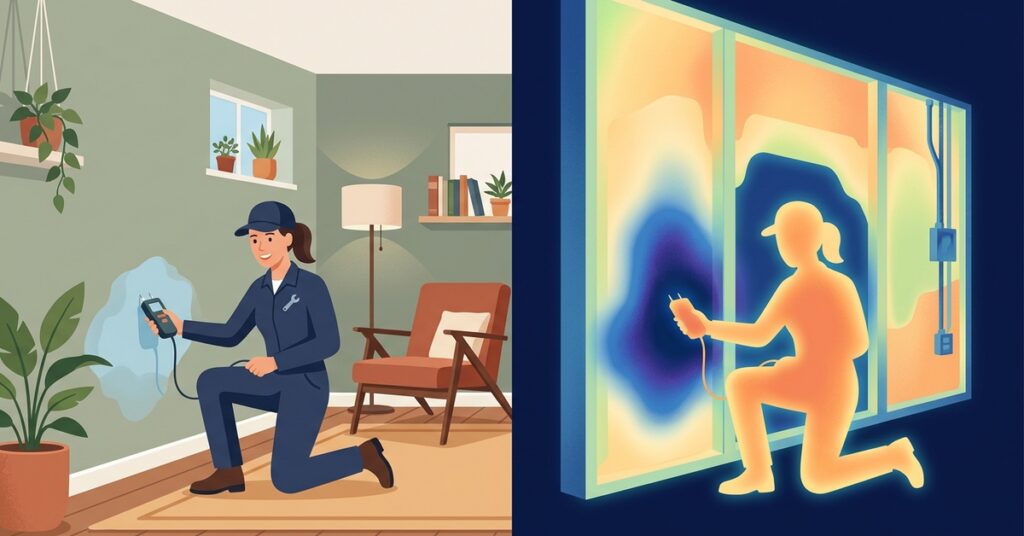
Thermal imaging is the tool that makes hidden water damage visible, not by seeing through walls, but by detecting the temperature differences that moisture creates on surfaces that are accessible to the camera.
How Infrared Thermography Works
A thermal imaging camera, also called an infrared camera or IR camera, does not produce a regular visible-light image. It detects infrared radiation emitted by surfaces and converts that data into a heat map that represents temperature distribution. Warmer areas appear in one range of colors, cooler areas in another, and the gradient between them reveals variations in surface temperature.
Water affects surface temperature in two relevant ways. First, water has a much higher thermal mass than most building materials. When a section of wall cavity is wet, that section holds heat differently than surrounding dry materials. On a warm day, a wet area behind drywall may appear cooler because evaporation is drawing energy away from the surface. On a cool morning, a wet area may retain warmth longer than surrounding dry materials. Either way, the thermal camera sees a difference.
Second, water migrates through building materials by capillary action and gravity. A slow leak that starts at a pipe fitting does not stay in one place; it spreads through insulation, drywall paper, wood framing, and concrete or masonry. As it spreads, the thermal signature spreads with it. An experienced thermographer can often read the shape of a wet zone and trace it toward its source.
The American Society for Nondestructive Testing recognizes infrared thermography as a Level I and Level II inspection method, meaning it is a trained professional discipline with defined competency standards. The quality of a thermal inspection depends substantially on the skill and experience of the inspector.
What Thermal Imaging Can Find
In residential and commercial buildings, thermal imaging is used to locate:
Plumbing leaks inside walls and ceilings. Supply line fittings that are seeping, drain connections that are not fully watertight, and corroded sections of supply pipe all produce moisture that migrates into surrounding materials and creates detectable thermal signatures.
Roof leaks and water intrusion at penetrations. Water that enters through a compromised roof membrane, a failed flashing, or a cracked skylight seal travels down the roof structure and through ceilings. Thermal imaging of the ceiling below a suspected roof penetration, particularly in the early morning when the thermal gradient is most pronounced, often reveals the path of water migration.
Shower pan and bathtub failures. Tile shower enclosures are not inherently waterproof. The waterproofing is in the pan liner or membrane beneath the tile. When that membrane fails, water penetrates through grout joints and accumulates beneath the tile and in the wall framing behind the surround. The floor-level moisture in the adjacent structure is often detectable thermally.
HVAC condensate leaks. Air handlers and evaporator coils produce condensate that is collected in drain pans and evacuated through drain lines. If the drain pan overflows or the drain line leaks at a connection, the condensate ends up in the ceiling or wall cavity below the unit. This is a particularly common source of mold in Augusta homes and one that thermal imaging reliably locates.
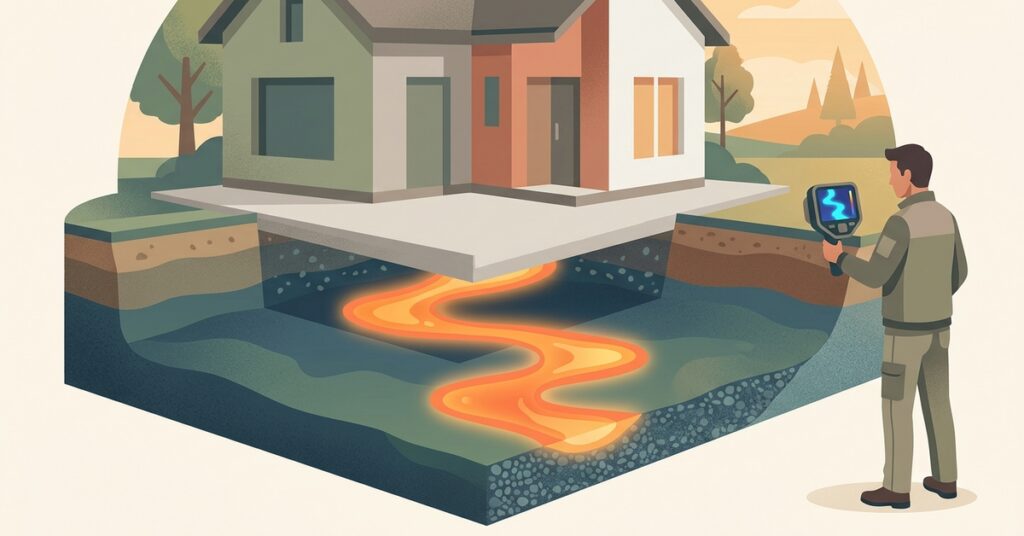
Slab leaks. When a hot water supply line beneath a concrete slab develops a pinhole or fitting failure, the hot water warms the slab above the leak location. On a finished floor, the temperature anomaly may be subtle, but a thermal camera in the hands of an experienced inspector can detect the warm zone and trace it toward the likely leak point.
Foundation and crawl space moisture intrusion. Exterior moisture that migrates through foundation walls or enters through crawl space vents can be detected thermally at the interior surface of foundation walls and on subfloor materials.
The Limitations of Thermal Imaging
Thermal imaging is a powerful diagnostic tool, but it does not see moisture directly. It sees temperature difference. This means it has limitations that are important to understand before relying on a thermal inspection.
It requires a thermal gradient. If the building’s interior and exterior temperatures are identical, thermal imaging produces limited useful information. Inspections are most effective when there is a temperature difference of at least 10 degrees Fahrenheit between inside and outside. In Augusta’s climate, early morning inspections in summer and midday inspections in winter often produce better conditions than midday summer inspections when everything is uniformly hot.
It cannot determine water volume. Thermal imaging tells you where a moisture anomaly is, not how much water is present. It is a detection and mapping tool, not a quantification tool. Follow-up with moisture meters or invasive investigation is needed to confirm and characterize the finding.
Findings require interpretation. Thermal images require a trained eye to distinguish genuine moisture anomalies from other temperature variations: cold drafts at air leaks, warm spots from HVAC ducts, or variations from different insulation densities. An inspector who is not experienced in building envelope thermography may generate false positives or miss real findings.
Thermal imaging does not replace moisture meters. A moisture meter, which measures the electrical conductivity or capacitance of materials and converts that to a moisture content reading, provides confirmation of what thermal imaging detects. The two tools are complementary. Thermal imaging maps the extent of an area to investigate; moisture meters provide quantitative confirmation.
When Thermal Imaging Is the Right Choice
Thermal imaging becomes particularly valuable in a few specific circumstances:
After any significant water intrusion. Following a plumbing failure, storm event, or appliance leak, thermal imaging documents the extent of moisture migration beyond the obviously wet area. This matters for remediation, because dry-out crews who only address visible moisture often leave wet building materials in wall cavities that become mold growth zones.
When you have symptoms but no obvious source. A persistent musty odor, visible efflorescence on a wall, or chronically elevated indoor humidity without an apparent source are all indications that water is entering somewhere you cannot see. Thermal imaging is an efficient first step in finding where.
Before purchasing an older property. A thermal inspection as part of due diligence on a property purchase can reveal moisture history and current water intrusion that a standard home inspection does not detect.
Before renovation work. Opening a wall that has hidden water damage without knowing it is wet is how renovation projects become mold remediation projects. A thermal survey before demolition avoids surprises.
If you have a suspected water intrusion, unexplained moisture symptoms, or want to document the dryness of a property before renovation or purchase in the Augusta or CSRA area, the EnviroPro 360 team can help. Reach out any time.