If your home was built before 1980, asbestos may be somewhere in it. That is not a reason to panic. Asbestos that is intact and left alone usually doesn’t release fibers at harmful levels.
The risk starts when these materials are cut, drilled, sanded, broken or removed. That often happens during repairs and remodeling. This guide covers what asbestos is and why it’s a hazard. It explains the symptoms of asbestos exposure and when they appear. It also shows where asbestos hides in older homes and buildings, and when to test.
What is asbestos?
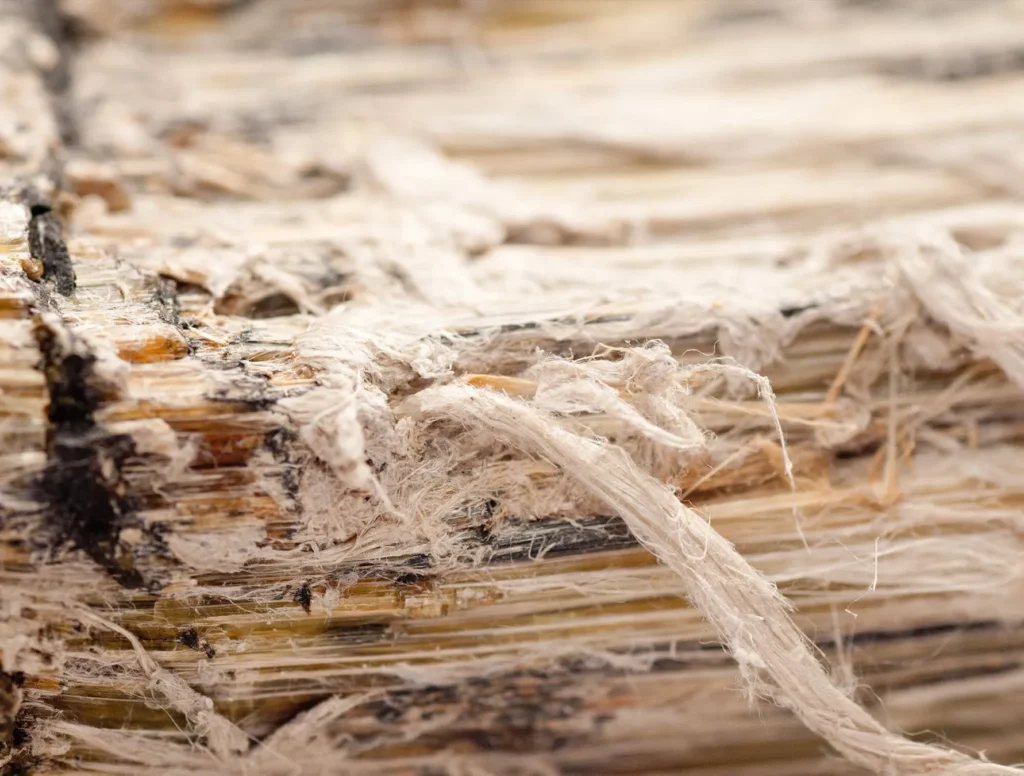
Asbestos is a group of natural minerals made of tiny fibers. It was mined and added to building products for most of the 1900s. It resists heat and fire. It’s strong, lasts a long time and was cheap.
Those traits put asbestos in hundreds of products. Builders used it from the 1930s through the 1970s. The health effects take decades to show up, so the full danger wasn’t clear for years.
A material with asbestos in it is called ACM. That stands for asbestos-containing material.
Why asbestos is dangerous
When ACM is disturbed, tiny fibers get into the air. You can’t see them. When you breathe them in, they can lodge deep in your lungs. Your body can’t get rid of them. Over many years, they can cause serious damage.
Asbestos is linked to these diseases:
- Mesothelioma. This is a rare cancer of the lining around the lungs, belly or heart. It is the cancer most closely tied to asbestos.
- Asbestosis. This is scarring of the lung tissue. It makes breathing harder over time. There is no cure.
- Lung cancer. Asbestos raises the risk of lung cancer. Smoking raises that risk even more.
- Pleural disease. The thin lining around the lungs can thicken and scar. This can limit breathing even without cancer.
The National Cancer Institute lists asbestos as a known cause of cancer in people. These diseases take decades to show up. That long delay is what makes asbestos so hard to manage. The symptoms section below covers what to watch for.
Is there a safe level of asbestos exposure?
No. OSHA (Occupational Safety and Health Administration) says there is no “safe” level of exposure to any type of asbestos fiber. Risk goes up with each exposure.
Is asbestos dangerous if undisturbed?
Usually not. ACM in good shape that no one touches gives off few or no fibers. The danger comes when it’s damaged or disturbed. Material that crumbles in your hand is called friable. Friable material is more likely to release fibers.
Asbestos exposure symptoms: what to watch for
This section is general health information, not medical advice. If you’re worried about your health, talk to your doctor.
How long after exposure do symptoms appear?
Usually many years. Asbestos you breathe in now won’t make you sick next week. Fibers that lodge in the lungs stay there. Over time they can cause swelling, scarring and, in some people, cancer.
The ATSDR says it often runs 10 to 20 years or more for asbestosis. For mesothelioma it’s usually 30 to 40 years, and sometimes longer. Lung cancer tied to asbestos often shows up 20 to 30 years later. That’s why many people are diagnosed in their 60s or 70s from work they did decades earlier.
How do you know if you’ve been exposed?
There’s no quick test that tells you. Most exposure happens without any warning sign. You may have been exposed if you:
- Worked in construction, shipyards, power plants, auto brake repair or the insulation, pipe and boiler trades before the 1980s
- Served in the military, especially the Navy
- Remodeled an older home without testing
- Lived with someone who brought work dust home on their clothes
That last one is called secondary exposure. Family members of workers have gotten sick this way.
The ATSDR says a chest X-ray is the most common test. But it mainly shows lung changes after heavy exposure. A CT scan can find smaller changes. Breathing tests show how well your lungs work. A biopsy may be needed to confirm cancer.
Signs and symptoms by condition
The CDC/ATSDR asbestos fact sheet and the National Cancer Institute describe these common signs:
- Asbestosis: shortness of breath, first with activity and later at rest. A dry cough, tiredness and chest tightness are common. A doctor may hear crackles in the lungs.
- Pleural plaques and thickening: often no symptoms at all. They usually show up on a chest scan. Wide thickening can cause shortness of breath or chest pain.
- Pleural effusion: fluid around the lungs. It can cause shortness of breath and chest pain that’s worse when you breathe in.
- Mesothelioma: chest pain, often on one side, and shortness of breath that doesn’t go away. Weight loss without trying is another sign. When it affects the belly, it can cause pain and swelling there.
- Lung cancer: a new cough or one that changes, coughing up blood, chest pain, hoarseness and weight loss.
These symptoms also come from many other, more common illnesses. Having one doesn’t mean you have an asbestos disease. It means it’s worth a visit to your doctor.
When to see a doctor
See a doctor if you have any of these symptoms and a history of possible exposure. Tell them about your work and home history. Without that detail, a doctor may not think of asbestos at first. If you had heavy exposure at work, ask whether regular checkups make sense even without symptoms.
A lung doctor is often the right specialist. So is a doctor who treats work-related illness.
I was exposed once. Should I worry?
The risk rises with how much you breathed in and for how long. A single short exposure carries far less risk than years of work around asbestos. Still, there is no known safe level. If it worries you, tell your doctor what happened.
Why asbestos was used so widely, and when it was banned
Rules came slowly. The EPA and other agencies limited asbestos one product at a time:
- 1973 to 1978: EPA banned spray-on asbestos and new asbestos pipe insulation.
- 1977: The Consumer Product Safety Commission banned asbestos in patching compounds.
- 1989: EPA tried a broad ban. A federal court overturned most of it in 1991.
- 2024: EPA banned chrysotile asbestos, the type still used in some industries.
What houses have asbestos? Assume any home built before 1980 may have ACM until it’s tested. Homes built in the 1980s may still have some. Builders kept using older stock after the rules changed. Homes built after 1990 carry much lower risk.
Where is asbestos found in homes?
These are the most common places asbestos hides in older homes.
Popcorn and textured ceilings
Spray-on textured ceilings were popular from the 1950s through the late 1980s. They look bumpy, like cottage cheese. Asbestos was added for fire resistance. Ceilings put in before 1979 are prime candidates for testing. Read more about popcorn ceilings and asbestos.
Vermiculite attic insulation
Vermiculite looks like small gray, silver or tan pebbles poured between attic joists. Most U.S. vermiculite came from a mine in Libby, Montana. That ore was mixed with asbestos. Treat it as ACM until it’s tested. Don’t disturb it. Learn more in vermiculite insulation: should I be worried?
Vinyl and asphalt floor tiles and black mastic
Floor tiles from the 1950s through the 1980s often had asbestos. The 9-inch by 9-inch size is the classic warning sign. But 12-inch tiles from that era can test positive too. The black mastic glue under the tiles often contains asbestos as well. These tiles are often hiding under newer carpet or laminate.
Pipe insulation and duct wrap
Old steam and hot water pipes were often wrapped in asbestos insulation. It may look white or gray, chalky, or like corrugated cardboard. You’ll often find it in basements, crawl spaces and utility rooms. Older HVAC ducts may have gray or white wrap too. Crumbling insulation is a higher risk than solid insulation.
Roofing, siding and exterior panels
Asbestos cement was used for roofing and siding from the 1940s through the 1970s. It’s often gray, flat or wavy, with a hard, cement-like feel. Siding made this way is sometimes called transite. It’s low risk when intact. Cutting, drilling or breaking it releases fibers.
Does Masonite contain asbestos? Masonite is a hardboard made from wood fibers and resin. It is generally not made with asbestos. But it’s easy to confuse with asbestos cement siding. If you aren’t sure which you have, test before you cut.
Drywall joint compound
The mud used to tape drywall seams often had asbestos through the mid-1970s. Sanding it makes fine dust. That makes it one of the higher-risk jobs in an older home. The compound is usually hidden under layers of paint. If you plan big drywall work, test the joint compound first.
Furnace, boiler and wood stove insulation
Older furnaces and boilers were often wrapped in asbestos boards, blankets or tape. Wood stoves used asbestos rope seals and door gaskets. Millboard is a dense, stiff panel used as a heat shield behind stoves. It often contained asbestos too. Flaking material near a heat source should be tested first.
Window glazing, caulk and wall texture
Some window putty, caulk and textured wall coatings made before the late 1970s had asbestos. They are low risk when intact. Test them before you sand, scrape or replace them.
Asbestos in buildings and the workplace
Commercial and industrial buildings built before 1981 often have asbestos too. Look for it in pipe insulation, sprayed-on fireproofing, ceiling tiles, duct insulation and transite panels. Maintenance work often disturbs these materials. That’s why workers face higher exposure than most homeowners.
OSHA’s construction standard for asbestos is 29 CFR 1926.1101. Employers must check for ACM before work that could disturb it. They must also keep worker exposure at or below 0.1 fibers per cubic centimeter over an 8-hour shift.
How do you know if a building has asbestos?
You can’t tell by looking. A material that looks safe may contain asbestos. One that looks suspect may be clean.
The only way to know is lab testing. A licensed inspector collects a bulk sample, which is a small piece of the material. An accredited lab checks it. Most labs use polarized light microscopy (PLM), which finds fibers under a special microscope. Some use transmission electron microscopy (TEM), which can see much smaller fibers.
When is asbestos testing required?
It depends on the building and the job.
- Commercial buildings and larger apartment buildings. Before renovation or demolition, the EPA’s Asbestos NESHAP requires an inspection. NESHAP is a federal air rule for asbestos. It covers apartment buildings with more than four units. See asbestos testing before renovation.
- Single-family homes built before 1985. Testing may not be legally required. But it’s strongly recommended before work on ceilings, floors or insulation.
- Damaged materials. Crumbling or water-damaged materials should be checked before people go back into the space.
What to do if you suspect asbestos
- Don’t disturb it. Don’t scrape, sand, drill, cut or try to remove it.
- Don’t sweep or vacuum debris. Regular vacuums blow fine fibers back into the air. Only HEPA vacuums should be used.
- Call a licensed asbestos inspector. In Georgia, asbestos programs are run by Georgia EPD. In South Carolina, the SCDES Asbestos Section licenses inspectors. SCDES took over these programs in July 2024. Check credentials before any sampling.
- Wait for results before you start work. Don’t take samples yourself. Breaking off a piece without the right gear can release the fibers you’re trying to avoid.
Do you always have to remove asbestos?
No. ACM in good shape that won’t be disturbed can stay in place. The EPA often prefers managing it in place. Removal done wrong creates its own exposure.
Removal is usually needed when the material is damaged or crumbling, or when planned work will disturb it.
When removal is needed, hire a licensed asbestos abatement contractor. Abatement is the controlled removal or sealing of asbestos. It uses containment, air monitoring and approved disposal. A general contractor should not do this work.
Home sales, disclosure and insurance
Sellers in Georgia and South Carolina can face liability if they hide known problems, including asbestos. A buyer’s inspector may also flag suspect materials. Testing before you list lets you deal with it on your terms.
Does home insurance cover asbestos?
Usually not. Most homeowner’s policies exclude asbestos removal as a pollution or environmental risk. Some cover it when a covered event, like a fire or storm, disturbs the asbestos. Read your policy and call your insurer before you count on coverage.
Homes in Augusta and the CSRA
Augusta and the Central Savannah River Area have many homes built from the 1940s to 1980. Growth tied to military and industry added whole neighborhoods in those years. Many of these homes likely have some ACM. That same history means many local workers spent years in the trades, plants and federal sites where asbestos was common. If that’s you, share it with your doctor.
We often find popcorn ceilings, 9×9 floor tiles with black mastic and pipe insulation in crawl spaces. If your home is from this era and hasn’t been fully remodeled, test before any big project.
How much asbestos testing costs and how long it takes
The price depends on the size of the building and how many materials need samples. Call us for a quote. Lab results often take a few business days. Your report lists the asbestos content of each material, plus the inspector’s notes on condition.
My home was built in 1985. Should I still worry? Possibly. Some products made from old stock were used into the early 1980s. Test anything you plan to disturb.
How EnviroPro 360 helps
Our licensed asbestos inspectors work in both Georgia and South Carolina. We also have a licensed abatement project designer. We offer AHERA management planning too. AHERA is the federal asbestos law for schools. Samples go to an accredited lab.
We test only. We don’t do asbestos abatement, so our results are unbiased. We can also test for mold, radon, lead paint and Legionella.
Your next steps
- Find out when your home or building was built, and note any suspect materials.
- Don’t disturb anything you think may contain asbestos.
- Before any remodel, repair or sale, schedule asbestos testing with a licensed inspector.
EnviroPro 360 provides asbestos testing for homes and businesses in Augusta, Aiken, Columbia and nearby towns. If you have questions about asbestos in your home or building or want to talk through your situation, the EnviroPro 360 team is happy to help. Reach out any time.