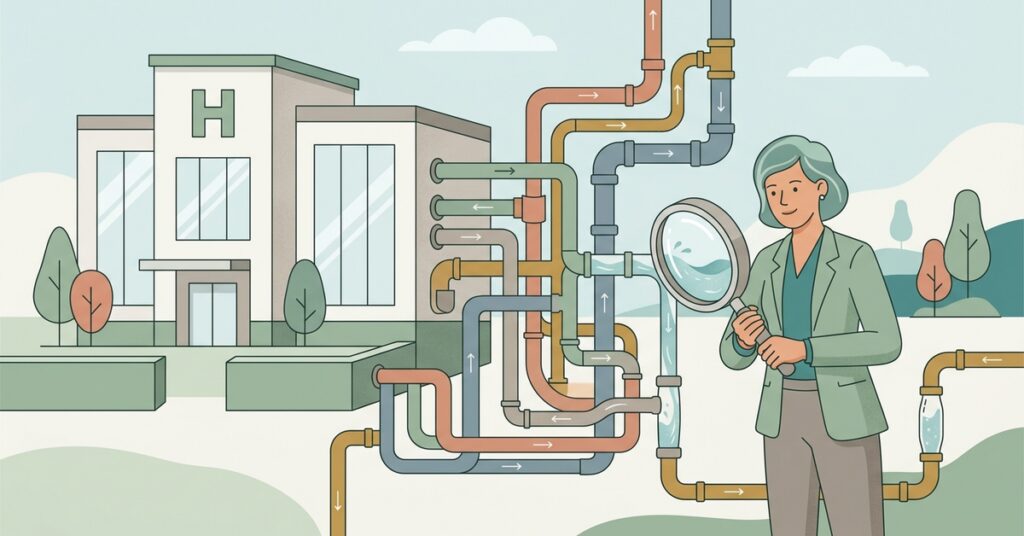
In 2017, the CDC published an investigation of a Legionnaires’ disease cluster traced to a decorative fountain in a hospital lobby. Fourteen people were sickened, including immunocompromised patients and visitors. The fountain had been part of the lobby for over a decade, was maintained by housekeeping staff according to a general cleaning protocol, and had never been tested for Legionella. Water samples from the fountain matched the clinical isolates from the cases.
The lesson from that outbreak has shaped investigation practice ever since: when a Legionnaires’ case appears in a building, investigators now routinely ask about every water feature, every hot tub, every splash pad, and every decorative water display, not just the cooling towers and hot water systems. The CDC’s own experience is that the unexpected water sources cause a meaningful share of outbreaks.
If you manage a building that has any kind of decorative water feature, hot tub, splash pad, or similar aerosol-generating water equipment, you have a water safety responsibility that often falls outside your building’s main water management plan. This is the category of water risk that is easiest to overlook and easiest to fix once you know what to do.
Why These Sources Are Legionella Factories
Several common features of decorative and recreational water equipment create ideal conditions for Legionella growth and transmission.
Warm Water Temperatures
Decorative fountains and hot tubs typically operate at temperatures in the 75 to 105 degree Fahrenheit range. This is squarely within the Legionella growth zone of 77 to 113 degrees. A hot tub kept at 104 degrees for spa comfort is essentially incubated at a temperature Legionella loves.
Stagnation Between Uses
Many decorative fountains operate intermittently. They are on during business hours, off overnight. They are sometimes drained seasonally and refilled, sometimes topped off with municipal water, sometimes shut down for weeks during renovations. Each of these patterns creates stagnant water periods when biofilm builds up on interior surfaces.
Hot tubs and spas have similar issues. Residential hot tubs are often used sporadically, left heated between uses, and cleaned less frequently than they should be. Commercial hot tubs in hotels and gyms see high use but can have high bather loads that overwhelm disinfection.
Biofilm-Friendly Surfaces
Decorative water features are typically designed for aesthetics, not for disinfection. They include rough stone, unglazed tile, porous concrete, textured copper or bronze fixtures, and natural materials that all provide ideal surfaces for biofilm to anchor. The CDC’s Legionella toolkit identifies biofilm as the key habitat for Legionella growth because biofilm protects bacteria from disinfection chemicals.
Aerosol Generation
A fountain, a splash pad, or a hot tub produces aerosols as a normal part of operation. Water droplets small enough to be inhaled deeply into the lungs are produced continuously. Anyone walking past a lobby fountain is breathing those aerosols. Anyone sitting in a hot tub is breathing them from inches away.
Specific Equipment to Watch
Decorative Fountains
Indoor lobby fountains, exterior landscape fountains, wall-mounted water walls, and any permanent decorative water feature with a recirculating pump present Legionella risk. Small features are not necessarily lower risk than large ones; they can be higher risk if maintenance is sparse.
The CDC’s guidance on decorative water features recommends specific disinfection and maintenance practices, including continuous disinfection, daily water quality monitoring, weekly cleaning of reachable surfaces, and routine Legionella testing.
Hot Tubs and Spas
Commercial and residential hot tubs alike support Legionella growth if disinfection chemistry is inadequate. The combination of warm water, high organic loading from bathers, and aerosol generation makes hot tubs one of the better-documented Legionella sources in the medical literature.
The CDC’s Model Aquatic Health Code provides detailed guidance for commercial hot tub operation, including disinfectant residual targets, turnover rates, and testing frequency.
Splash Pads and Interactive Water Features
Public splash pads that spray, mist, or pour water for children to play in are an increasingly documented Legionella source. These features generate heavy aerosols at low height, where small children breathe them directly. Cases have been traced to splash pads where recirculated water was inadequately treated.
Humidifiers in Commercial Buildings
Industrial and commercial humidification systems that use ultrasonic or evaporative methods can aerosolize Legionella if the water reservoir becomes contaminated. Some hospital HVAC systems, some manufacturing facilities, and some specialty buildings use central humidification that needs the same water safety oversight as hot water systems.
Eye Wash Stations and Emergency Showers
Safety equipment required by OSHA in laboratories and certain workplaces can harbor Legionella because the fixtures are rarely used under normal conditions. Water sits stagnant between uses. When the station is activated, it delivers aerosolized water directly at a worker’s face. Routine flushing is required but sometimes missed.
Cooling Misters and Patio Cooling Systems
Outdoor misting systems installed on restaurant patios, building entrances, and outdoor gathering areas aerosolize water directly at occupants. These systems are often installed without thought to water quality and without maintenance schedules.
Ice Machines
Ice machines do not aerosolize directly, but they can harbor Legionella in reservoirs, ice bins, and internal tubing. Contaminated ice that melts in a drink can expose consumers, particularly immunocompromised ones.
What Effective Management Looks Like
For each of these water sources, effective management follows the same general framework:
Inventory
List every water-using device or feature in the building that could aerosolize water or that sits at Legionella-favorable temperatures. This is more than just the cooling tower and hot water heater. Walk the building with fresh eyes and note every fountain, spa, eye wash, humidifier, mister, and ice machine.
Risk Assessment
Evaluate each item on the inventory for Legionella risk factors: operating temperature, stagnation potential, disinfection method, aerosolization intensity, and exposure to high-risk populations. A decorative fountain in a pediatric clinic lobby is a much higher priority than a small decorative fountain in a low-traffic administrative office.
Control Measures
Define control measures appropriate to each item. Typical controls include:
- Continuous disinfection (chlorine, bromine, copper-silver ionization, or ultraviolet treatment depending on the feature)
- Regular cleaning and descaling of accessible surfaces
- Periodic drain-and-refill cycles
- Temperature management where practical
- Routine flushing of low-use fixtures
- Water quality testing at defined frequencies
Monitoring
Measure the right parameters at the right frequency. Disinfectant residual, pH, temperature, and turbidity are common control parameters depending on the equipment. Records are maintained so that trends can be spotted before they become outbreaks.
Legionella-Specific Testing
Environmental Legionella sampling is the ultimate verification that controls are working. Frequency depends on the building type and the risk level. Healthcare facilities should test higher-risk features more often; low-risk features in lower-risk buildings may only need annual or semi-annual testing.
Response Plan
A documented procedure for what to do if Legionella is detected, if a Legionnaires’ case is reported, or if environmental conditions fall outside control limits. The plan includes communication with public health authorities, shutdown procedures for the affected feature, and remediation steps.
The Most Common Mistake
The most common mistake is treating water features as decorative objects rather than as equipment. A marble fountain in a lobby is usually on the facilities manager’s visual inventory but not on the water management inventory. A hot tub at a hotel is in the housekeeping rotation but not the water safety plan. An eye wash station is on the safety committee’s audit list but not the Legionella review.
Water features are not decorations. They are water systems. They belong in your water management plan, under someone’s documented responsibility, with a defined maintenance and testing schedule. If your current plan does not include them, adding them costs far less than responding to a case.
Your Next Steps
- Walk your building this week and list every water-using feature that aerosolizes water or that sits at 75 to 110 degrees Fahrenheit. Include decorative fountains, hot tubs, splash pads, misters, humidifiers, ice machines, and eye wash stations.
- Cross-reference the list with your water management plan. Anything on the list that is not in the plan needs to be added.
- For features that are in use now, verify they are being maintained with appropriate disinfection and that someone on staff is documenting that maintenance.
- If your building has never performed environmental Legionella testing on decorative water features, schedule a baseline round. One round of testing gives you data to work from and tells you whether your controls are actually working or whether you have a latent issue.
If you manage a building in the CSRA with decorative water features, hot tubs, or other aerosol-generating water equipment and want help integrating them into a Legionella water management plan, the EnviroPro 360 team can help. Reach out any time.