In 2017, the CDC published a study of hospital-onset Legionnaires’ disease showing that 76% of cases in acute care settings were linked to the facility’s water system. What the headline number did not capture was the population hit hardest: patients with chronic conditions that compromise immune response and lung function. Patients on dialysis rank near the top of that list.
Dialysis clinics operate in a difficult zone. They are not full hospitals, but they are also not ordinary outpatient facilities. They treat thousands of patients whose immune systems, kidney function, and often pulmonary health are already impaired. And they rely on high-volume, warm-water systems that happen to be excellent environments for Legionella growth. If you manage clinical operations or facilities at a dialysis center in the CSRA, the combination of patient vulnerability and water system biology makes Legionella one of your most important water safety risks.
Why Dialysis Patients Are Especially Vulnerable
Legionnaires’ disease is a severe form of pneumonia caused by Legionella bacteria, most commonly Legionella pneumophila. People catch it by inhaling aerosolized water droplets that contain the bacteria, whether from showers, faucets, cooling towers, decorative fountains, or any other device that produces fine mist. Healthy adults exposed to low concentrations usually do not get sick. The bacterium is opportunistic. It takes advantage of weakened defenses.
Dialysis patients present several overlapping vulnerabilities:
- Immunocompromise. End-stage renal disease and the medications often used alongside dialysis reduce the body’s ability to clear bacterial infections. Patients who are also on immunosuppressants for autoimmune conditions or post-transplant care are especially at risk.
- Comorbidities. A substantial portion of dialysis patients live with diabetes, cardiovascular disease, and chronic lung conditions like COPD. Each of these independently raises Legionnaires’ risk and reduces the body’s reserve to recover from pneumonia.
- Frequent exposure. Typical in-center hemodialysis involves three visits per week, often for multiple years. A patient visits the same water system 150 or more times per year. Repeated exposure to even a slightly contaminated system is more consequential than a single exposure.
- Age. The CDC’s surveillance data consistently shows Legionnaires’ incidence climbing sharply after age 50 and peaking in the 65+ demographic. The dialysis patient population skews heavily older.
The case fatality rate for Legionnaires’ disease in the general population is about 10%. In healthcare-associated cases, it has historically run 25% or higher. In vulnerable patient groups like dialysis patients, outcomes are worse still.
Why Dialysis Clinic Water Systems Favor Legionella
Legionella grows in water between about 77 and 113 degrees Fahrenheit, with peak growth in the 95 to 115 degree range. It thrives where water is warm, stagnant, and coated with biofilm (the slimy layer bacteria form on pipes, tanks, and fixtures). Dialysis clinics have several system features that create those conditions.
Water Treatment Loops
Dialysis requires ultra-pure water. Clinics run municipal water through a treatment train that typically includes softeners, carbon filters, reverse osmosis (RO), ultrafiltration, and a distribution loop that feeds each dialysis station. The RO and ultrafiltration stages remove most bacteria, including Legionella, from the water used to mix dialysate. But the raw water supply before treatment, and the hot water system throughout the rest of the facility, is not necessarily protected.
Patient exposure does not come from dialysate. It comes from the water patients encounter elsewhere in the clinic: handwashing sinks, restrooms, break rooms, and showers or rinse areas in some facilities. These systems operate on the conventional hot water side and follow the same Legionella rules as any other building.
Low Flow and Long Runs
Many dialysis centers operate morning-to-evening shifts and then sit idle overnight and on Sundays. Extended low-flow or stagnant periods allow water in pipes to drop out of hot recirculation, cool into the Legionella growth range, and sit long enough for biofilm to develop. The first water through a fixture Monday morning has had the longest opportunity to incubate bacteria.
Fixture-Level Complexity
Dialysis clinics have a lot of fixtures: many sinks, eye wash stations, utility sinks, ice machines, and coffee stations. Each fixture adds length, stagnation points, and potential for aerosolization. Faucet aerators and flow restrictors are classic Legionella reservoirs.
Warm Water by Design
Many states and ASHRAE guidelines recommend storing hot water at 140°F or above and circulating at 124°F or above to suppress Legionella. But patient comfort and scald risk push clinics to temper water at fixtures. If temperature control at the mixing valve fails, you can end up with long runs of water at ideal Legionella growth temperatures.
What a Water Management Plan Looks Like for Dialysis
The CMS memorandum on Legionella risk reduction (QSO-17-30-Hospital/CAH/NH) applies to certified healthcare facilities including hospitals, nursing homes, and critical access hospitals. While freestanding dialysis clinics are not all subject to that specific memorandum, the principles are directly applicable, and many health systems apply them to dialysis clinics voluntarily as a best practice. Specific ESRD (end-stage renal disease) network guidance and accreditation standards increasingly reference Legionella risk management.
An effective water management plan for a dialysis clinic typically includes:
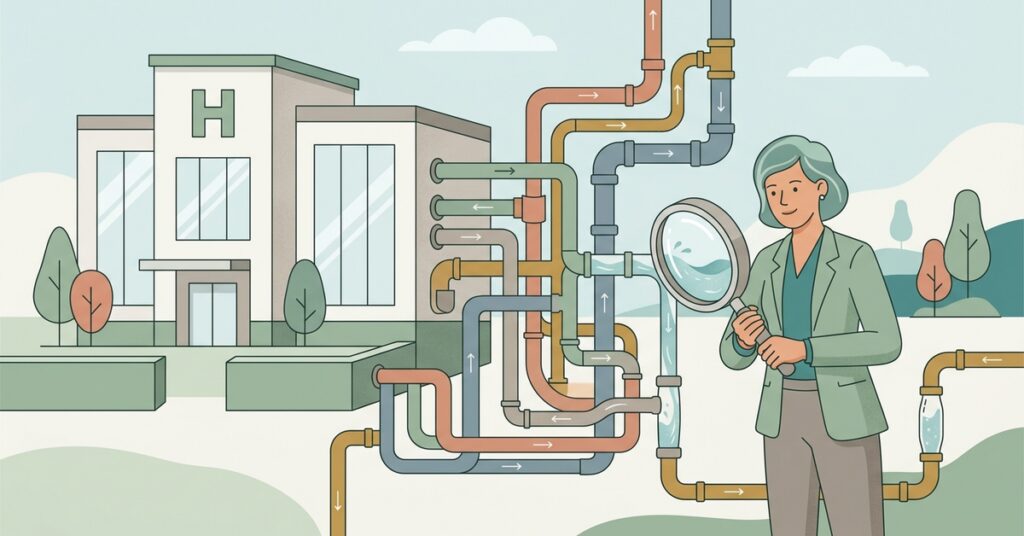
- A current water system diagram covering cold water in, hot water generation, the treatment loop for dialysis water, the hot and cold distribution to all patient-accessible fixtures, and any point-of-use devices
- Identified control points with measurable parameters (temperature, disinfectant residual, flow)
- A monitoring schedule that tracks those parameters at documented frequencies
- Defined response actions when parameters fall outside control limits
- Environmental Legionella testing on a defined schedule, typically quarterly for high-risk healthcare facilities
- Case surveillance and reporting procedures linking clinical Legionnaires’ detection back to facility water investigation
- Documentation and team ownership so the plan actually gets executed and updated
What to Watch for Between Formal Audits
Facilities and clinical managers who work in the clinic every day can catch early warning signs that a water system is drifting into risk:
- Cooling trends on hot water: if patients mention the water at a sink is “lukewarm” or if you notice fixtures running cooler than expected, the hot loop may be compromised
- Visible biofilm: slimy residue at faucet aerators, sink drains, or ice machines
- Water quality complaints: odor, discoloration, or taste changes
- Long unused fixtures: any sink or shower that sits idle for more than a week is at risk and should be flushed before use
- Recent construction or plumbing work: any disturbance of the water system can mobilize biofilm from pipe walls into patient-accessible water
The Veterans Health Administration’s Legionella directive is a useful benchmark; it requires weekly fixture flushing of low-use outlets and regular monitoring for exactly this reason.
Your Next Steps
- Confirm whether your clinic has a current, documented water management plan (WMP). If the answer is “I think so but I have not seen it recently,” that is effectively no.
- Identify the staff member accountable for the WMP day to day. The plan is only as good as the person running it.
- If environmental Legionella testing has not been performed in the last 12 months, schedule a round. Testing is how you verify your controls are working, not just that they exist on paper.
- Make sure any plumbing or renovation work in the clinic triggers a post-construction flush and testing protocol before the area returns to patient use.
If you manage a dialysis clinic or a multi-site renal care organization in the CSRA and you want help building or auditing a Legionella water management plan, the EnviroPro 360 team has the experience to support you. Reach out any time.