Radon testing can seem straightforward until you start comparing options. Short-term or long-term? Charcoal canister or continuous monitor? Professional service or hardware store kit? The choice matters because radon levels in your home fluctuate, and the method you use determines how accurately the result reflects your actual long-term exposure.
This post explains the two main categories of radon tests, what each is best suited for, what factors affect results, and how EnviroPro 360 approaches testing and interpretation for homeowners in Augusta and the CSRA.
Why Radon Testing Is the Only Way to Know Your Level
Radon is a naturally occurring radioactive gas produced when uranium decays in soil and rock. It enters homes through foundation cracks, gaps around pipes, sump pit openings, and crawl space-to-air interfaces. It is odorless, colorless, and tasteless. No home maintenance habit, cleaning practice, or air filtration system detects or removes it.
The Environmental Protection Agency recommends action when indoor radon levels reach 4.0 pCi/L (picocuries per liter) or higher. The Centers for Disease Control and Prevention identifies radon as the second leading cause of lung cancer in the United States, responsible for approximately 21,000 deaths annually. A risk that is substantially reduced when elevated levels are detected and addressed.
The only way to know whether radon is present in your home at actionable concentrations is to measure it.
Short-Term Radon Tests
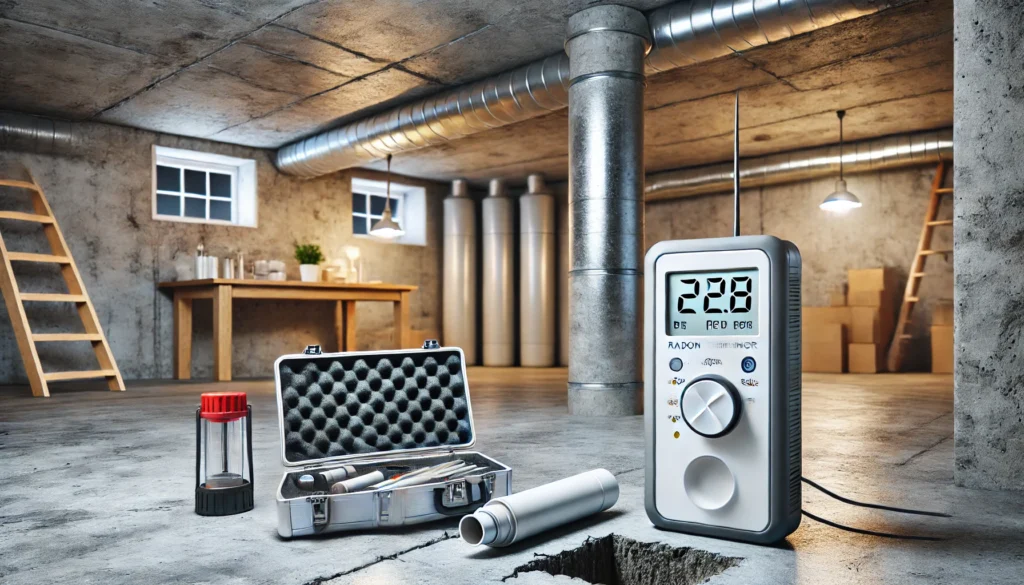
Short-term tests measure radon concentration over a period of 48 hours to 90 days. The most common short-term devices are passive charcoal canisters, which absorb radon during the test period and are then sent to a laboratory for analysis. Professional continuous radon monitors are also used for short-term measurements; they record data throughout the test and produce a report showing hour-by-hour variation alongside the average result.
Short-term tests are best suited for:
- Real estate transactions where there is a limited inspection window
- Initial screening when you want a quick snapshot before deciding whether further testing is warranted
- Post-mitigation confirmation tests, where the question is whether a newly installed system is working
Short-term test limitations are real. Radon levels vary with season, weather pressure, and HVAC operation. A 48-hour test conducted during a mild week in October may yield a result that is lower than your home’s annual average radon level. This is why the EPA recommends that short-term results below 4.0 pCi/L in homes with additional risk factors be confirmed with a follow-up long-term test before concluding the home is definitively low.
Long-Term Radon Tests
Long-term radon tests measure radon for 90 days to one year. Alpha track detectors are the most common long-term device. They are placed in the home, left undisturbed throughout the measurement period, then sent to a laboratory for analysis. The result represents radon levels integrated across multiple seasons and weather patterns, making it the most reliable indicator of actual long-term average exposure.
Long-term tests are best suited for:
- Homeowners who want a complete picture of annual average exposure rather than a seasonal snapshot
- Follow-up testing when a short-term result fell between 2.0 and 4.0 pCi/L
- Situations where there is time to gather a full-picture result before making a mitigation decision
What Can Affect Your Radon Test Result
Several variables influence the radon reading in your home, and understanding them helps you interpret results accurately.
- Season: Winter typically produces higher radon readings because homes are sealed more tightly. Summer may produce lower readings due to increased ventilation.
- HVAC operation: Heating and cooling systems affect pressure differentials inside the home, which influence radon entry rates and distribution.
- Closed-building conditions: EPA protocol requires windows and exterior doors to be kept closed for at least 12 hours before and throughout a short-term test. Failure to maintain these conditions typically produces an artificially low reading.
- Test placement: The monitor should be placed in the lowest livable level of the home, away from exterior walls, windows, doors, and HVAC vents. Placement near radon entry points or airflow sources distorts the result.
- Recent renovations or foundation changes: New cracks, added penetrations, or modifications to crawl space ventilation can change radon entry patterns, making a previous test result less relevant to current conditions.
When to Test
Testing is appropriate at these points in a home’s life:
- Before purchasing or selling a home
- After completing a basement finishing project or any work that changes the foundation
- If you have never tested and your home is older or has a crawl space or basement
- Every two years as a general maintenance measure, since conditions change over time
- After installing a mitigation system, to confirm the system has reduced levels to an acceptable range
How EnviroPro 360 Handles Radon Testing in Augusta and the CSRA
EnviroPro 360 provides professional radon testing for homeowners throughout Augusta, Evans, Martinez, Grovetown, North Augusta, Aiken, and the broader CSRA. Testing follows EPA measurement protocols, with equipment placed to reflect actual occupant exposure. After testing, results are explained in plain language so you understand what the number means relative to the EPA action level and what the appropriate next steps are for your situation.
If your radon level is elevated and a mitigation contractor installs a system, EnviroPro 360 can also perform the post-mitigation retest to confirm the system is functioning correctly. This step provides documentation for your property records and ensures you are not relying solely on the mitigation contractor’s assessment of their own work.
Contact EnviroPro 360 to schedule radon testing for your Augusta-area home and get clear results you can act on.