Maybe you found a dark patch on the bathroom ceiling. Maybe a musty smell won’t go away. Your first thought may be “black mold.”
This guide explains what black mold really is and how to identify it in your home. It covers what it looks and smells like, how testing works, and what to do next. It is written for homeowners in Augusta, Evans, Aiken, Columbia and nearby towns in Georgia and South Carolina.
What is black mold?
“Black mold” is a common name, not a science term. Most people use it to mean Stachybotrys chartarum. The CDC calls it a greenish-black mold. It grows on materials high in cellulose, such as drywall paper, wood, ceiling tiles and cardboard. It needs steady moisture from a leak, flood or condensation.
Many other molds are also dark. Some common ones are Cladosporium, Aspergillus and Alternaria. They can look almost the same as Stachybotrys.
Is all black-colored mold “black mold”?
No. Color alone can’t tell you the species. A dark stain could be Stachybotrys or one of many other molds. It could even be dirt, soot or mildew.
Color also doesn’t tell you the risk. The CDC and NIOSH say the color of mold does not show whether it is more or less dangerous. The CDC says all molds should be treated the same when it comes to health risks and removal.
Why black mold is a serious concern
Any mold growing indoors is worth taking seriously. The CDC says mold can cause:
- A stuffy nose and sneezing.
- Coughing and wheezing.
- Itchy or red eyes.
- Skin irritation.
- Asthma attacks in people with asthma.
People with allergies, asthma, lung disease or a weak immune system are at higher risk.
You may read that black mold is “toxic.” Stachybotrys can make mycotoxins. Mycotoxins are natural chemicals some molds produce. But the CDC says there is no proof that Stachybotrys causes rare problems like memory loss or bleeding in the lungs. So be careful. Don’t panic, and don’t ignore it either.
There is one more reason to care. Mold growth means you have a moisture problem. That water can also rot wood, damage drywall and draw pests.
Signs black mold might be a health risk in your home
- Symptoms are worse at home and better when you leave.
- More than one person in the home has the same symptoms.
- Symptoms get worse when the heat or air conditioning runs.
- Symptoms started after a leak or flood.
- Someone in the home has asthma or a weak immune system.
If any of these fit, talk to your doctor. Then find out what is growing and why.
How to identify black mold in your home
You can’t confirm Stachybotrys by looking at it. But you can spot signs that mold is growing. Then you can decide if you need testing.
What does black mold look like?
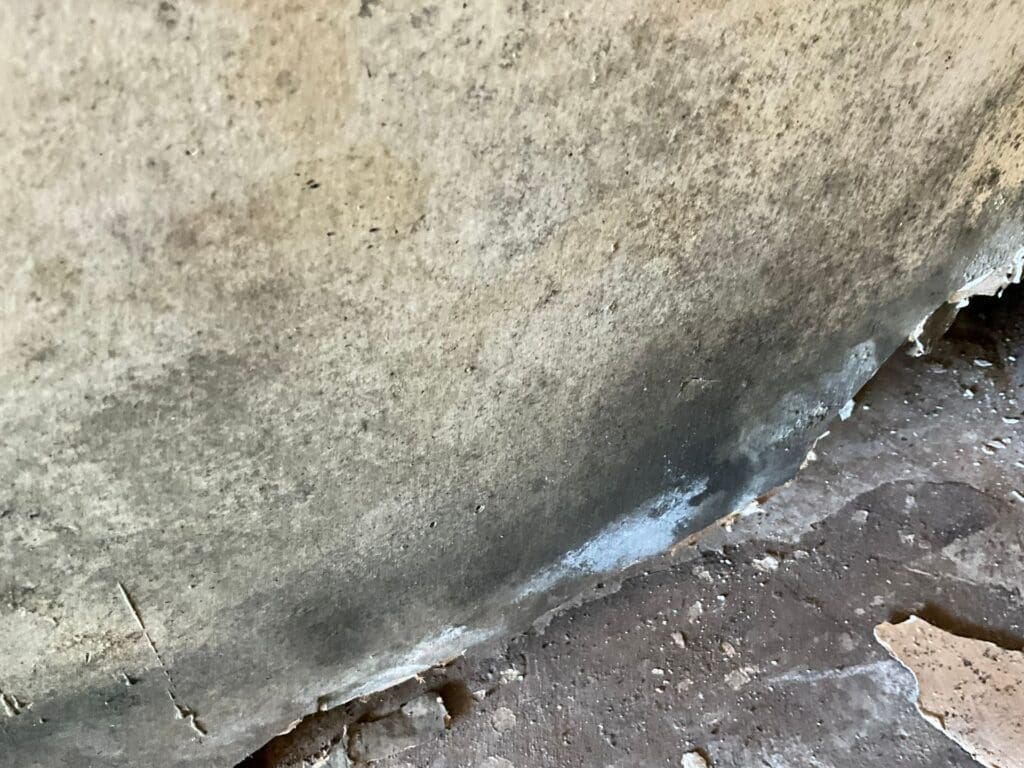
Black mold is usually dark green, gray or black. It can look slimy when wet. It can look dry and sooty, or a bit fuzzy, when it dries out. It often grows in uneven, spotty patches. Early growth may look greenish or gray, not solid black.
What does black mold smell like?
Most active mold smells musty and earthy. Some people say it smells like wet socks or rotting wood. The smell comes from gases that growing mold gives off. They are called MVOCs (microbial volatile organic compounds).
The smell is often the first sign. It may be stronger in the morning after the house was closed all night. It may also hang around after you clean and air out the room. A musty smell with no visible mold often means mold is hiding inside a wall, under the floor or in the crawl space.
How to tell if you have black mold: surface by surface
Drywall and walls
- Dark or stained patches, sometimes slimy or fuzzy.
- A musty smell that gets stronger on damp days.
- Bubbling, peeling or bulging paint. This points to water behind the wall.
Bathroom tile, grout and showers
- Black or deep green spots along grout lines and caulk.
- Stains that come back soon after cleaning.
- Mold on the shower curtain or around the tub edge.
Toilets
- Dark growth around the base of the toilet. This can mean a slow leak at the wax ring.
- Spots on the tank from sweating, also called condensation.
- Stains on the wall or floor behind the toilet.
Ceilings
- Round or spreading stains, often near air vents or under a roof leak.
- Soft or sagging drywall around the stain.
Wood and flooring
- Dark spots on floorboards, subfloor or framing, often in basements and crawl spaces.
- Warped or cupped boards and a musty smell from the floor.
Heating and cooling systems
- A musty smell when the system first turns on.
- Dark spots on vent covers, filters or the drain pan.
Black mold in the bathroom
Bathrooms are the most common place people find dark mold. Showers create steam every day. A weak exhaust fan lets that moisture sit on walls and grout. Small surface spots on tile are common. Mold that keeps coming back, or that shows up on the ceiling or behind the toilet, needs a closer look. Read how to tell if your bathroom fan is making mold worse.
Black mold on the outside of a house
Dark streaks on siding, decks or roofs are common in our humid climate. They are often mildew, algae or dirt. Outdoor growth is usually not an indoor air problem. But check where it is. Growth near a leaking gutter or a damp wall can point to water that is also getting inside.
How do you test for black mold in your house?
There are two main ways to test for black mold.
Black mold surface testing
A swab or tape-lift sample is taken from a stain. A lab looks at it under a microscope. The lab can tell you if it is Stachybotrys or another mold. This answers “what is this spot?” It doesn’t tell you what is in the air or what is hidden.
Air testing and a full mold inspection
A professional collects air samples in several rooms. They also take an outdoor control sample at the same time. The lab compares indoor spores to outdoor spores. That shows whether mold is growing inside.
Stachybotrys spores are heavy and sticky. They don’t float in the air as easily as many other spores. So a low count in the air doesn’t always rule it out. That is why a good inspection also looks for hidden moisture.
You may wonder if you even need a test. The EPA says that if you can see mold, testing usually isn’t needed to decide to clean it up. Testing helps most when the source is hidden, health concerns are present, a home is being sold, or you need proof after remediation. Remediation means removing mold and fixing the cause.
Can a DIY black mold test kit help?
Home kits can confirm that a spot is mold. But they can’t show hidden growth or whether indoor levels are high. Learn more in how to use a mold test kit.
Why professional black mold testing matters
A black mold inspection does more than name the mold. Here is what it adds:
- Correct identification. A lab names the types of mold present. That replaces guessing by color.
- Hidden areas. Inspectors check attics, crawl spaces, wall cavities and the heating and cooling system.
- Moisture readings and thermal imaging. A moisture meter shows wet materials without opening walls. A heat-sensing camera shows cool, damp spots behind surfaces.
- The moisture source. Mold comes back if the water isn’t fixed. Finding the source is the most important step.
- A written report. It helps you, your remediation company, your insurer or a buyer.
Our inspectors are Council-certified mold inspectors (CMI) and Council-certified structural mold investigators (CSMI). We are also IICRC certified. We don’t do mold remediation. So we have no reason to find more mold than is there.
What to do if you find black mold
Immediate steps
- Don’t disturb it. Scraping or dry brushing sends spores into the air.
- Keep people and pets away, especially anyone with asthma.
- Find the water. Look for leaks, condensation or a damp crawl space nearby.
- Don’t paint over it. Paint doesn’t kill the colony, and the stain comes back.
Can you clean black mold yourself?
The EPA says you can usually clean a small area yourself. Small means less than about 10 square feet. That is about a 3 foot by 3 foot patch.
For a small area on a hard surface:
- Wear gloves, goggles and an N-95 respirator.
- Fix the water problem first.
- Scrub hard surfaces with detergent and water.
- Dry the area fully within 24 to 48 hours.
- Throw away soft, soaked materials like carpet pad or ceiling tile if they stay moldy.
Never mix bleach with ammonia or other cleaners. It makes toxic fumes.
When to call a professional
- The mold covers more than about 10 square feet.
- You smell mold but can’t find it.
- The mold is in your heating and cooling system.
- The mold keeps coming back after cleaning.
- Someone in the home has health problems that seem tied to the house.
- You are buying or selling a home.
After a large cleanup, post-remediation verification is a smart step. It is a test that checks whether the work met its goal. Read why you should test for black mold after DIY cleanup.
How to keep black mold from coming back
- Control humidity. The EPA says to keep indoor humidity below 60%, and ideally between 30% and 50%. A dehumidifier helps in basements and crawl spaces.
- Run exhaust fans. Use the bathroom fan during showers and for 20 to 30 minutes after.
- Fix leaks fast. Check under sinks, behind toilets and around the water heater.
- Watch the crawl space. In Georgia and South Carolina, crawl spaces stay damp much of the year.
- Check your heating and cooling system. Keep the drain line clear and change filters on schedule.
- Use mold-resistant materials when you remodel a bathroom or basement.
For more on why our climate makes this harder, see why Georgia crawl spaces are a mold magnet.
Your next steps
- Look for the signs above, and follow your nose to any musty smell.
- Clean small spots on hard surfaces safely, and fix the moisture source.
- If the mold is large, hidden or keeps coming back, book a black mold inspection.
EnviroPro 360 provides mold inspection and black mold testing for homes and businesses in Augusta, Aiken, Columbia and nearby towns. If you have questions about black mold or want to talk through your situation, the EnviroPro 360 team is happy to help. Reach out any time.